
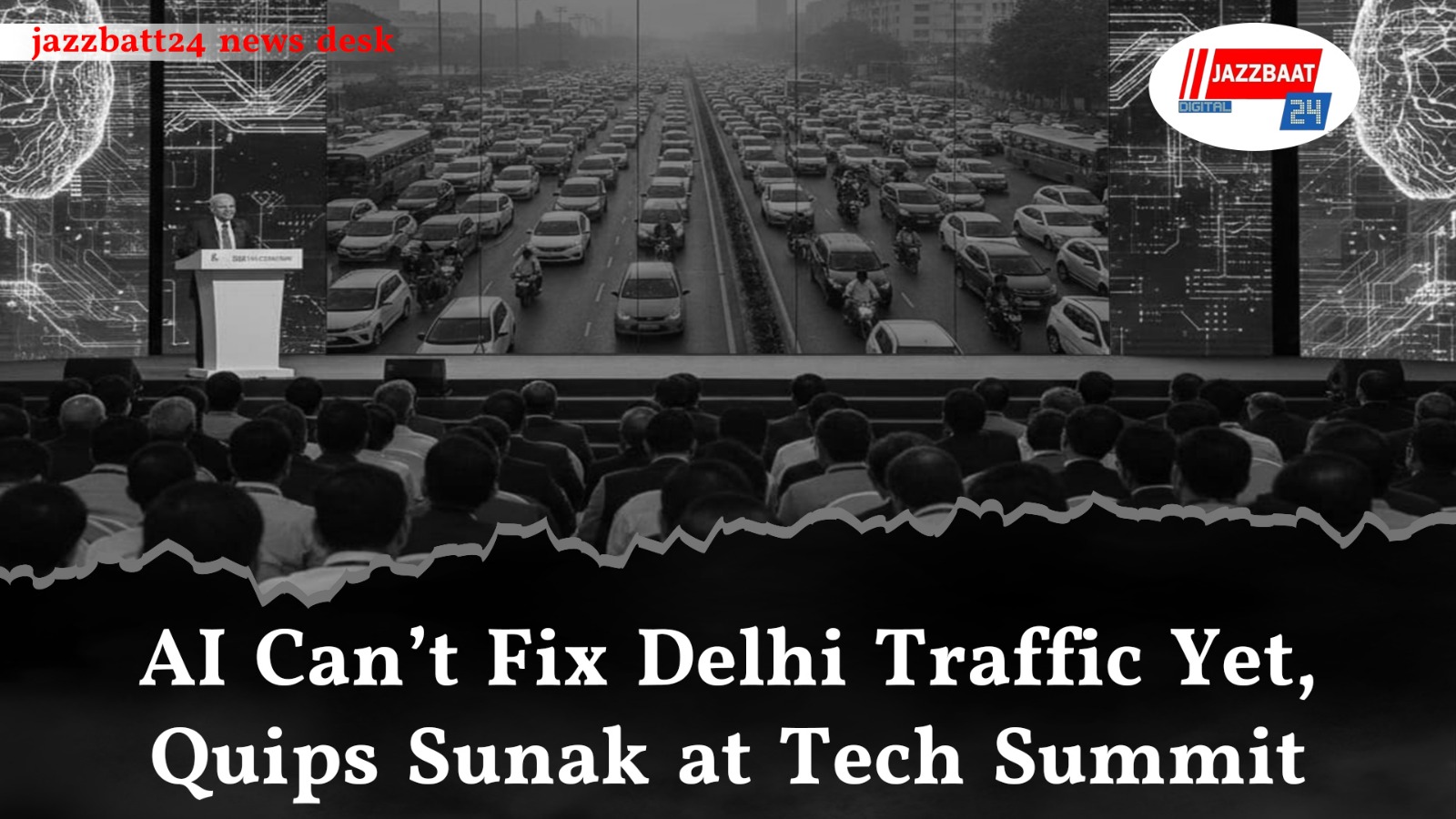
Former UK Prime Minister Rishi Sunak drew laughter at a technology gathering when he remarked that while artificial intelligence can achieve remarkable feats, it “still can’t fix Delhi’s traffic.”
Speaking during a session on emerging technologies in New Delhi, Sunak used humour to underline both the promise and the limitations of AI. He noted that AI systems today can diagnose diseases, optimise supply chains and even generate complex code, but urban challenges like chronic congestion require more than algorithms they demand coordinated policy, infrastructure upgrades and behavioural change.
Delhi’s traffic congestion has long been a point of discussion, with rising vehicle numbers, road bottlenecks and rapid urban expansion straining the city’s transport network. While AI-driven traffic management systems, smart signals and real-time navigation tools have improved efficiency in many global cities, Sunak suggested that technology alone cannot substitute for long-term urban planning.
His comment came amid broader discussions about responsible AI deployment, digital governance and the balance between innovation and public policy. Delegates at the summit emphasised that AI can assist governments in predictive modelling, smart mobility solutions and infrastructure optimisation, but its effectiveness ultimately depends on data quality, institutional capacity and political will.
Sunak’s light-hearted observation resonated with the audience, serving as a reminder that while AI is reshaping industries and economies, some real-world problems remain stubbornly complex. As cities like Delhi explore smart mobility initiatives and data-driven traffic solutions, the intersection of technology and governance will likely determine whether AI can one day ease the capital’s notorious gridlock.