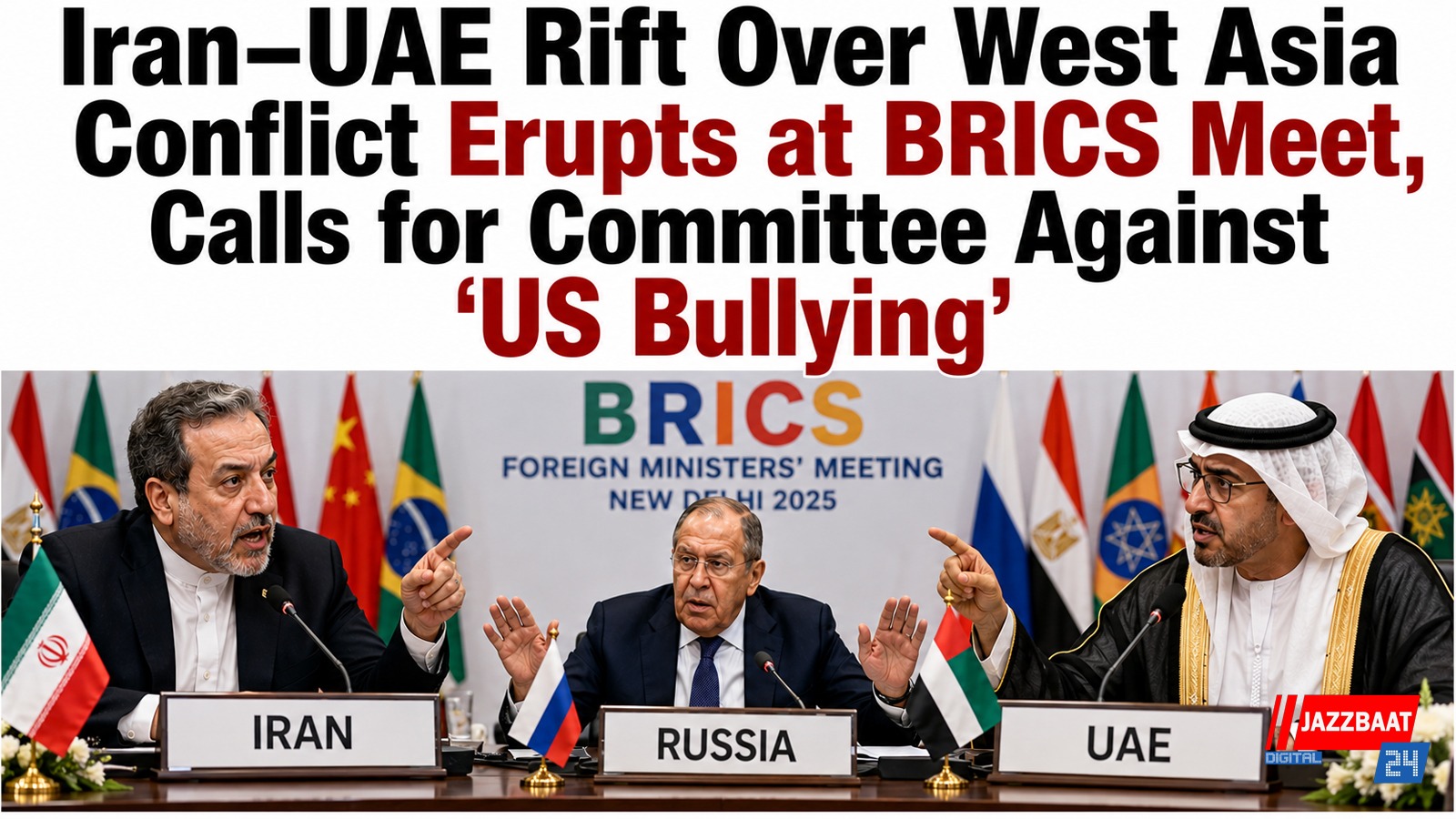
Sharp differences between Iran and the United Arab Emirates (UAE) over the ongoing West Asia conflict surfaced at the BRICS foreign ministers’ meeting in New Delhi, exposing deep divisions within the grouping on how to address the regional crisis and relations with the United States.
According to diplomatic sources and media reports, tensions flared during discussions on Thursday when Iranian Foreign Minister Abbas Araghchi and UAE Minister of State for Foreign Affairs Khalifa Shaheen Al Marar exchanged strong views over the ongoing conflict and its geopolitical consequences. The disagreements reportedly escalated to heated exchanges during closed-door sessions, requiring intervention from Russian Foreign Minister Sergey Lavrov to calm the situation.
Iran used the platform to strongly criticise the United States and its allies, with Araghchi describing Washington’s actions in the region as “bullying” and calling for BRICS nations to take a collective stand. Tehran reportedly pushed for the formation of a BRICS-level committee or coordinated mechanism to respond to what it termed “US coercive policies” and violations of international law.
The UAE, meanwhile, is understood to have taken a different position, with diplomatic sources indicating that it sought a more balanced approach and expressed concerns over Iran’s regional activities. The divergence highlighted the broader challenge facing BRICS, which now includes countries with sharply differing foreign policy alignments and regional interests.
The issue of West Asia tensions and maritime security also dominated wider discussions at the summit, with member states struggling to agree on a unified statement. Reports suggest that deep divisions—particularly between Iran and the UAE—have made it difficult for the bloc to present a common position on the conflict.
Iran, on its part, urged BRICS members to “explicitly condemn” what it called illegal military actions by the US and Israel, framing the conflict as resistance against Western dominance. Several members, however, remain cautious about adopting language that could further polarize the grouping.
The disagreements underscore the growing complexity within BRICS as it expands and brings together countries with conflicting alliances and security concerns. While discussions on economic cooperation and development continue, geopolitical tensions are increasingly testing the bloc’s ability to maintain unity on global issues.
As deliberations continue, it remains unclear whether BRICS will be able to issue a joint statement on the West Asia situation, with diplomats indicating that consensus is still uncertain.