

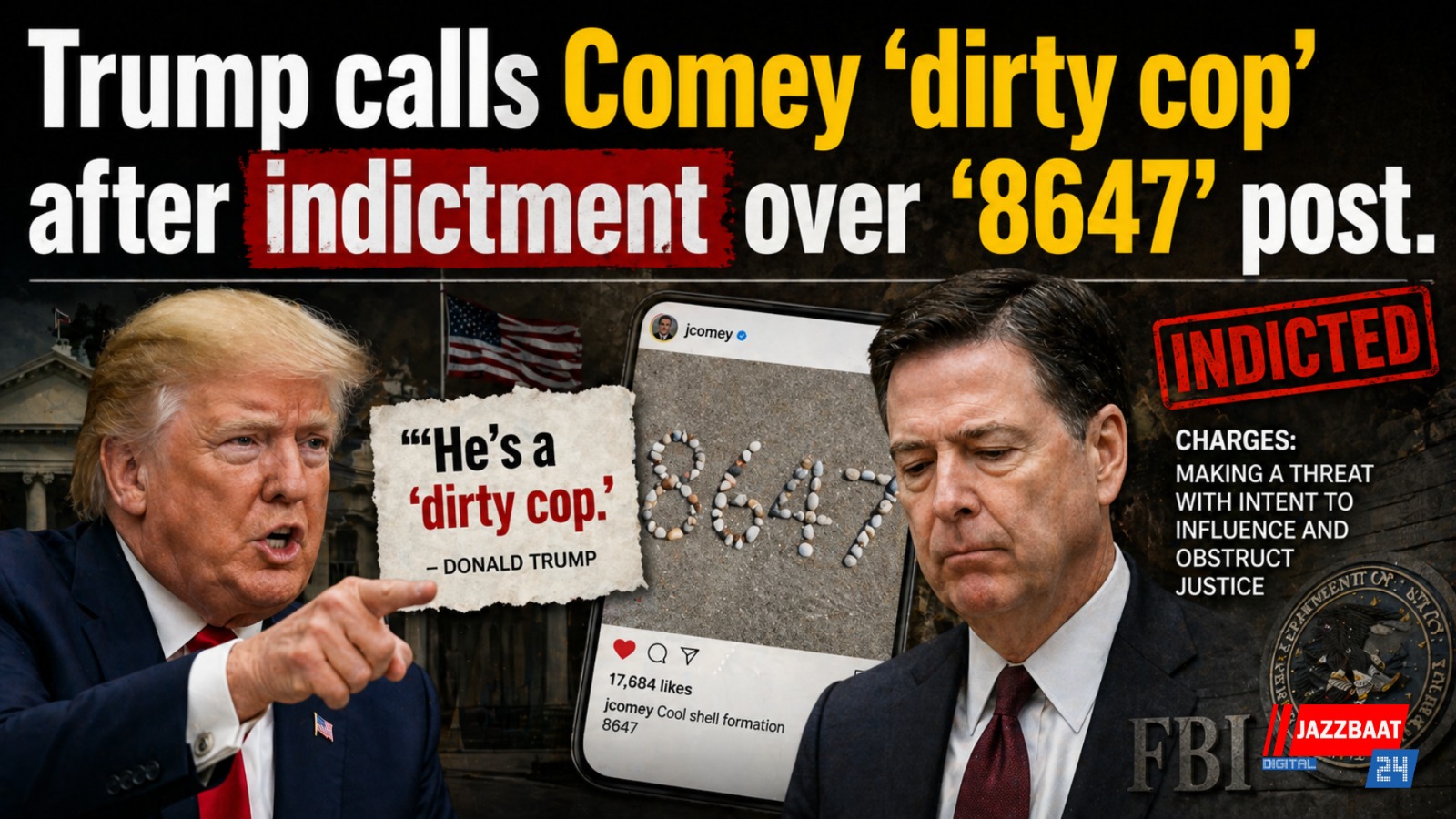
US President Donald Trump has sharply criticised former FBI Director James Comey, calling him a “dirty cop” after federal prosecutors indicted Comey over a controversial social media post that allegedly hinted at a threat against the president.
The case centres on an Instagram photo posted by Comey in May 2025, showing seashells arranged to form the numbers “8647.” Prosecutors claim the numbers carried a hidden meaning: “86” is sometimes used as slang for eliminating or getting rid of someone, while “47” is widely interpreted as a reference to Trump, the 47th President of the United States.
According to the indictment, Comey is accused of threatening the president and transmitting a threat across state lines, charges that could carry serious legal consequences if proven in court.
Reacting to the development, Trump told reporters that the term “86” has long been used in criminal slang to mean killing someone, and suggested the post could be interpreted as a direct threat to his life. He added that such language is well understood in certain circles and should not be dismissed as harmless.
Comey, however, has strongly denied any wrongdoing. He said the image was simply a “cool shell formation” he noticed during a beach walk and insisted he was unaware of any violent connotation attached to the numbers. After facing backlash, he deleted the post and clarified that he opposes violence of any kind.
During a recent court appearance in Virginia, Comey was released without conditions and is expected to appear again for further proceedings. His legal team has described the charges as politically motivated, arguing that the case is an attempt to target a long-time critic of Trump.
The indictment has sparked a broader debate in the United States about free speech and the limits of political expression. Legal experts note that prosecutors will need to prove intent, that Comey meant to issue a genuine threat, rather than simply posting a message open to interpretation.
This is the second time Comey has faced legal action in recent months, after an earlier case against him was dismissed. The latest development adds to ongoing political tensions between Trump and his critics, with the outcome likely to have wider implications for how ambiguous online speech is treated under US law.