
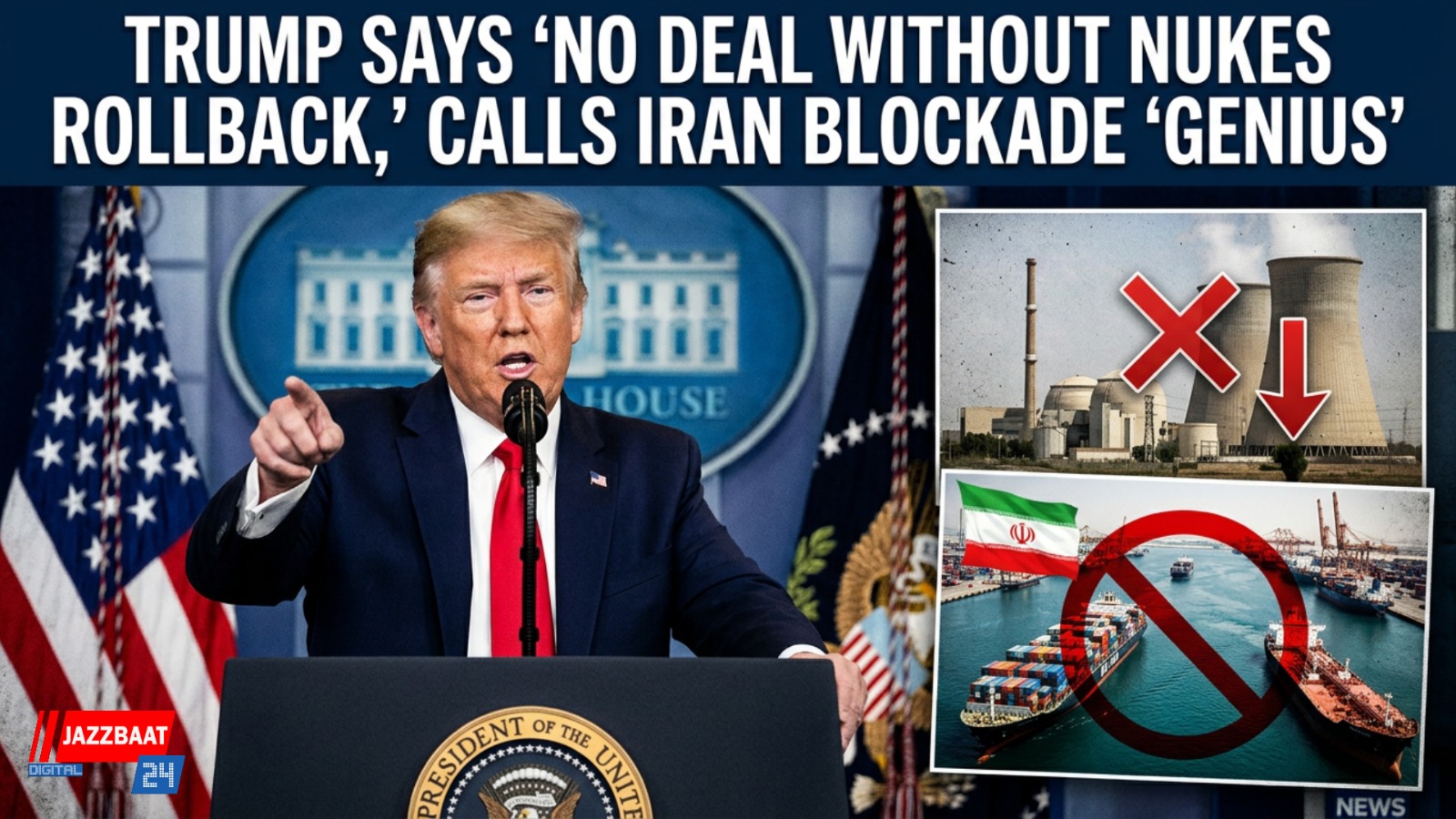
US President Donald Trump has doubled down on his hardline stance against Iran, declaring that there will be no agreement unless Tehran completely abandons its nuclear ambitions, while praising the ongoing US naval blockade as “genius.”
Speaking during recent interactions and interviews, Trump said the blockade has been “100% foolproof” and is exerting maximum pressure on Iran’s economy and military posture. He insisted that the strategy is more effective than direct military strikes, arguing that it forces Iran to negotiate from a position of weakness.
“The blockade is genius,” Trump said, adding that no deal would be possible unless Iran agrees to have “no nuclear weapons.”
The naval blockade, which began earlier in April, targets Iranian oil exports and restricts maritime traffic linked to Iranian ports, particularly around the strategically vital Strait of Hormuz. US Central Command officials say dozens of commercial vessels have already been turned back as part of enforcement efforts, highlighting the scale and effectiveness of the operation.
Despite mounting global concerns, Trump has rejected recent Iranian proposals aimed at easing tensions, including offers to reopen key shipping routes in exchange for lifting the blockade. Instead, he has maintained that Iran must first fully dismantle its nuclear programme before any negotiations can move forward.
The escalating standoff has significantly impacted global energy markets, with oil prices rising amid fears of prolonged disruption in one of the world’s most critical oil transit routes.
At the same time, US officials have indicated that diplomatic channels remain open, though talks are now largely being conducted remotely. Trump has also warned that military options, including targeted strikes, remain on the table if Iran fails to comply.
Iran, on its part, has signaled willingness to negotiate under certain conditions, even proposing a phased de-escalation plan. However, tensions remain high, with both sides unwilling to compromise on core demands particularly over Tehran’s nuclear programme.
The situation continues to evolve rapidly, with analysts warning that the outcome of this confrontation could reshape geopolitical dynamics in the Middle East, as well as global energy stability.