
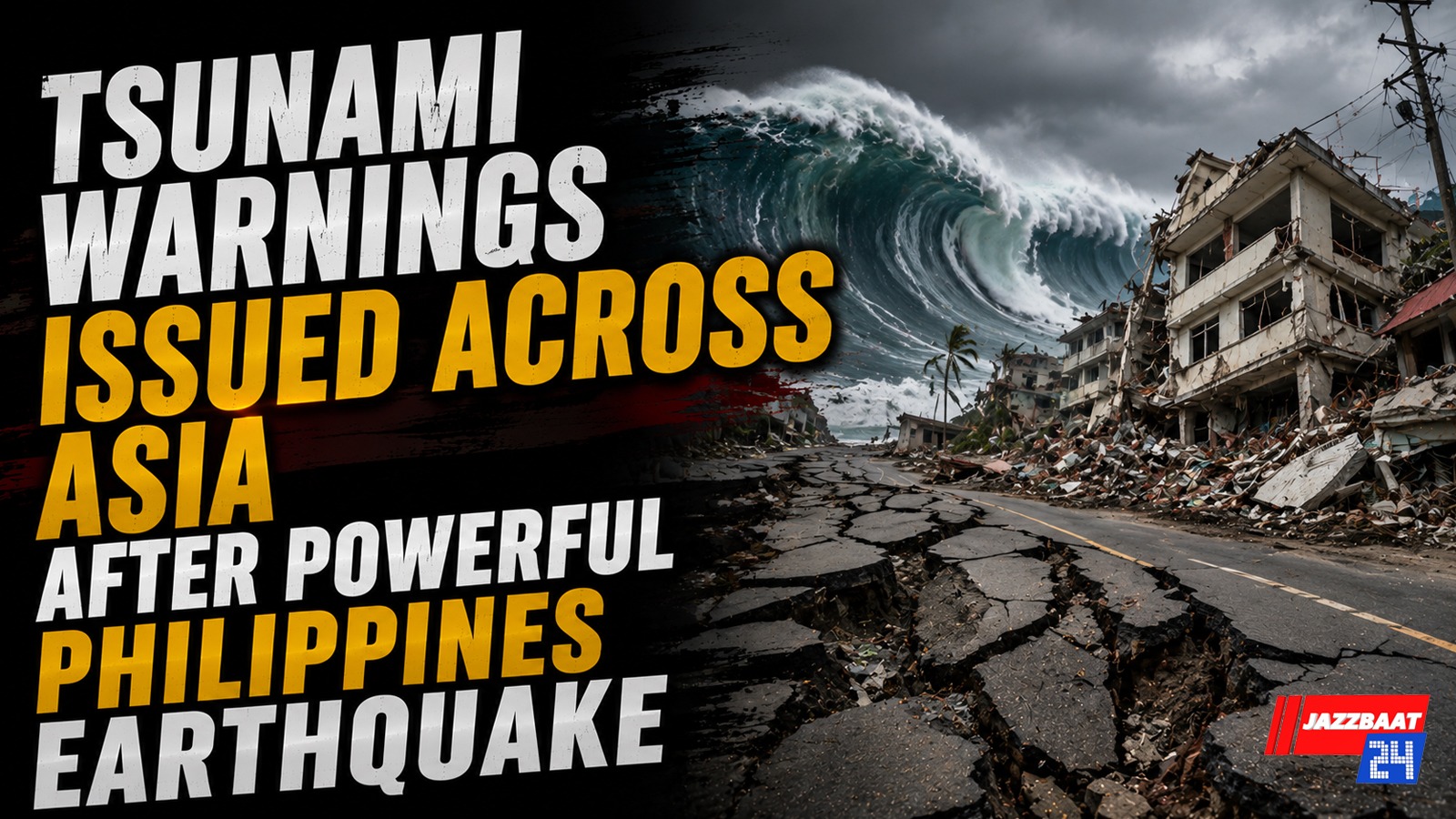
Manila, June 8: Several Asian countries issued tsunami warnings and coastal evacuation advisories after a powerful earthquake struck off the southern coast of the Philippines on Monday morning, triggering panic across the region and causing significant damage in affected areas.
According to international seismic agencies, the earthquake, measuring between 7.8 and 8.2 in magnitude according to various preliminary assessments, struck near the island of Mindanao in the southern Philippines. The epicentre was located offshore near Sarangani province at a relatively shallow depth, intensifying the impact of the tremors across a wide area.
The powerful quake caused buildings to collapse, roads to crack, and widespread disruptions to power and communication networks. Authorities reported multiple casualties and hundreds of injuries, with rescue teams rushing to search damaged structures for survivors. General Santos City was among the worst-hit areas, with several commercial and residential buildings sustaining heavy damage.
Following the earthquake, tsunami alerts were issued for several countries across Asia and the Pacific region. Emergency warnings were released in the Philippines, Indonesia, Malaysia, and Japan, while authorities in other coastal regions closely monitored sea levels and advised residents to stay away from beaches and low-lying coastal areas.
In Japan, officials urged residents along parts of the Pacific coastline to remain vigilant and move to higher ground if necessary. Indonesian authorities ordered precautionary evacuations in several coastal communities, particularly in northern Sulawesi, where tremors were strongly felt. Malaysia also activated emergency monitoring systems as a precaution against possible tsunami waves.
The Pacific Tsunami Warning Center initially warned that tsunami waves of up to three metres could affect some coastal areas. Later assessments suggested that the threat had begun to diminish, though authorities continued to urge caution due to the possibility of dangerous sea-level fluctuations and strong currents.
Philippine President Ferdinand Marcos Jr. ordered emergency response operations and directed government agencies to provide immediate assistance to affected communities. Schools were closed in several regions, evacuation centres were activated, and military units joined rescue and relief efforts.
The Philippines lies along the seismically active Pacific Ring of Fire, making it one of the world's most earthquake-prone regions. Authorities warned residents to remain alert for aftershocks as damage assessments and rescue operations continue across Mindanao and neighbouring provinces.