

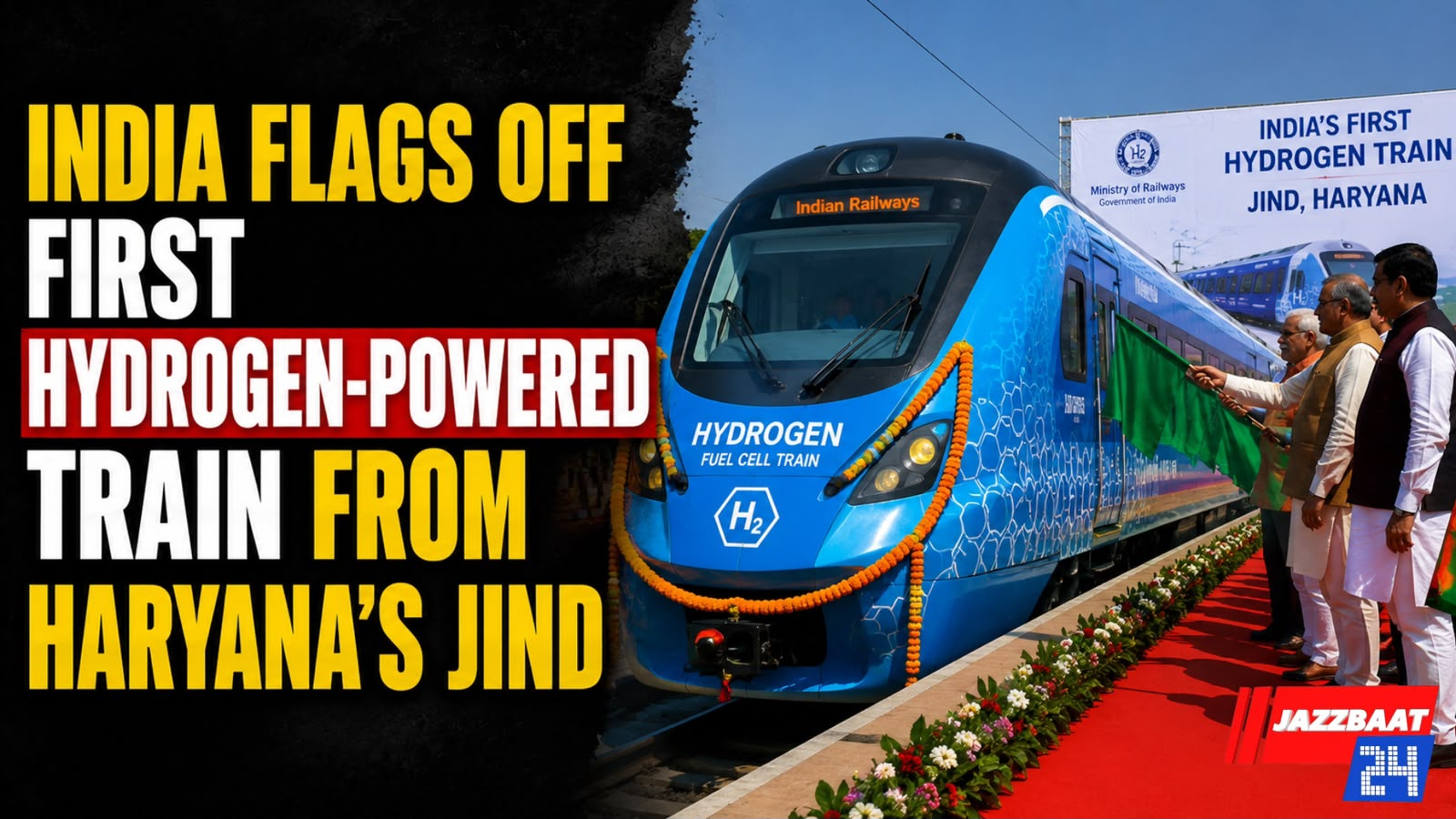
India marked a historic milestone in sustainable transportation on Friday as Prime Minister Narendra Modi flagged off the country's first indigenously built hydrogen-powered passenger train from Jind in Haryana. The launch places India among a select group of nations operating hydrogen-powered trains and represents a major step towards cleaner, zero-emission rail transport.
Named the "NaMo Green Rail," the train will operate on the 89-kilometre Jind–Sonipat section under Northern Railway. Powered by hydrogen fuel cells, the train generates electricity through a chemical reaction between hydrogen and oxygen, producing only water vapour as the by-product, making it an environmentally friendly alternative to diesel-powered trains.
The train features two hydrogen-powered driving cars and eight passenger coaches, with a capacity to carry around 2,600 passengers. It has an operational speed of about 75 kmph and is supported by India's largest hydrogen refuelling facility, established at Jind. The project has been developed under the "Make in India" initiative using indigenous technology.
Speaking at the launch event, Prime Minister Modi described the occasion as a landmark in the modernization of Indian Railways. He said Jind and Haryana had "permanently etched their names in the pages of history" by becoming the birthplace of India's first hydrogen-powered train. The Prime Minister also highlighted that the train reflects India's commitment to green energy, innovation, and self-reliance in advanced transportation technology.
Besides inaugurating the hydrogen-powered train, the Prime Minister launched and laid the foundation stone for development projects worth around ₹14,700 crore across Haryana. These include railway upgrades, highways, healthcare facilities, and other infrastructure aimed at boosting connectivity and economic growth in the state.
The launch forms part of India's broader National Green Hydrogen Mission and its goal of achieving net-zero carbon emissions by 2070. Indian Railways plans to evaluate the train's performance before considering wider deployment on other non-electrified routes across the country. Officials believe hydrogen-powered trains can significantly reduce dependence on diesel while offering a cleaner and more sustainable future for rail transportation.