

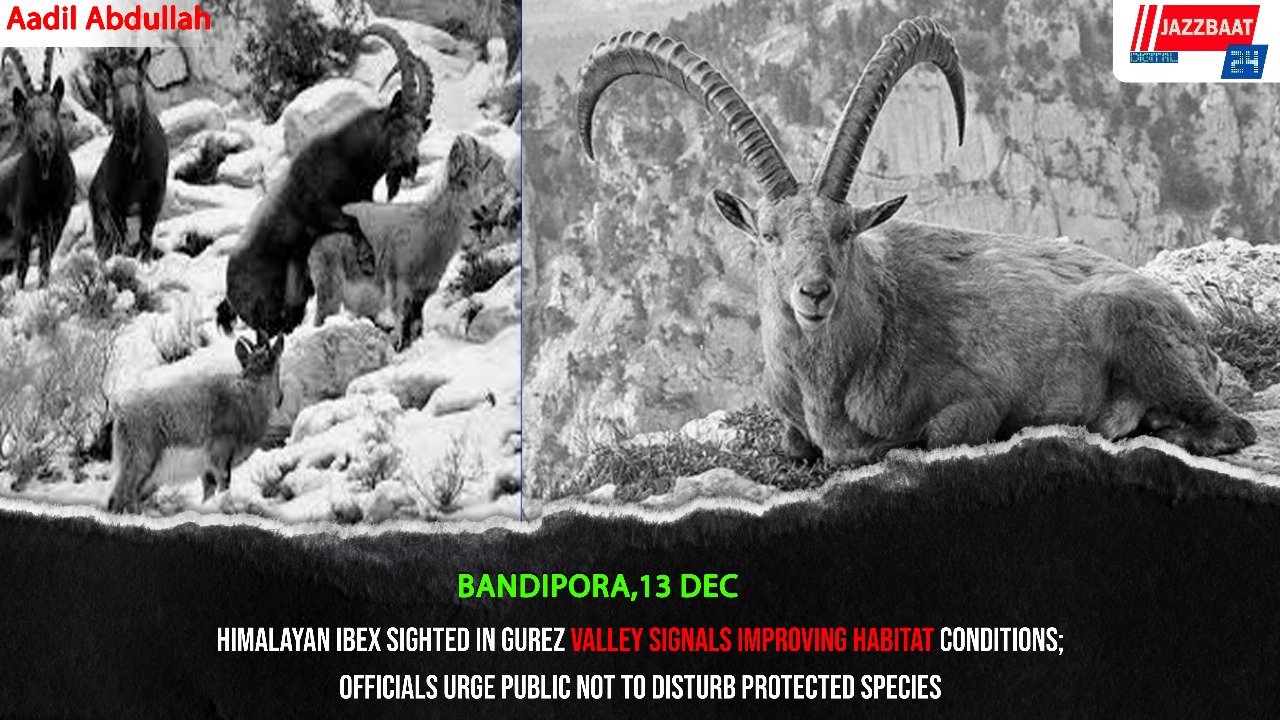
Bandipora,13 Dec: A Himalayan Ibex has been sighted in Chak Nallah of the Tulail area, a sensitive border region in the Gurez Valley of Bandipora district, drawing attention from wildlife officials, conservationists, and local residents. Officials said the species is commonly seen in groups during the winter months, but the recent sighting has gained significance due to the location and clear visibility of the animal.
The sighting, described as unusual for this part of North Kashmir, has sparked enthusiasm among wildlife enthusiasts and conservation experts. The Himalayan Ibex, known for its distinctive spiral horns and exceptional ability to navigate steep and rocky terrain, is regarded as a key indicator of a stable and healthy high-altitude ecosystem.
Officials familiar with the region said the presence of the endangered species reflects improving habitat conditions and comparatively reduced human disturbance in certain pockets of the Gurez Valley. The area’s rugged terrain, alpine vegetation, and limited human activity provide a favourable environment for the species to survive and reproduce.
Speaking to the media, Tanveer Ahmed Lone, Block Officer Wildlife Bandipora, confirmed the recent sighting in the Gurez Valley. He said that after the sighting, he received several calls from various media outlets seeking information. He clarified that this was not the first instance of a Himalayan Ibex being seen at Chak Nallah, noting that the region has witnessed such sightings on multiple occasions due to a healthy local population.
Tanveer further clarified that the animal sighted was not a Markhor. He explained that the Markhor is found only in North Kashmir’s Limber–Qazinag Wildlife Sanctuary and nowhere else in the region. In contrast, the Himalayan Ibex, locally known as “Jangli Bakri,” is widely present in the Gurez area. He added that the species naturally inhabits alpine and hilly terrains, which are abundant across the Gurez Valley.
He also noted that sightings of Himalayan Ibex in lower-altitude areas, both recently and in the past, are largely linked to changing climatic conditions. As weather patterns shift and snowfall begins, the animals tend to descend from higher altitudes to lower regions, making them visible in several parts of Gurez during the winter season.
Tanveer Ahmed Lone appealed to residents of the Gurez Valley not to disturb the natural habitat of the Himalayan Ibex. He said the animals have descended temporarily and will return to higher altitudes on their own. Emphasizing conservation, he stated that the Himalayan Ibex is a protected species listed under Schedule I of the Wildlife Protection Act, and any harm or harassment of the animal would amount to a violation of the law.
Local residents from nearby villages welcomed the sighting with pride, calling it a reflection of the Gurez Valley’s rich biodiversity and natural heritage. Some locals observed that community participation, along with carefully regulated eco-tourism, could play an important role in conserving endangered species while supporting sustainable livelihoods.
Meanwhile, officials of the Forest and Wildlife Department said the development is being taken seriously and that conservation strategies in the area may be reviewed to ensure the long-term protection of the Himalayan Ibex and its fragile habitat.