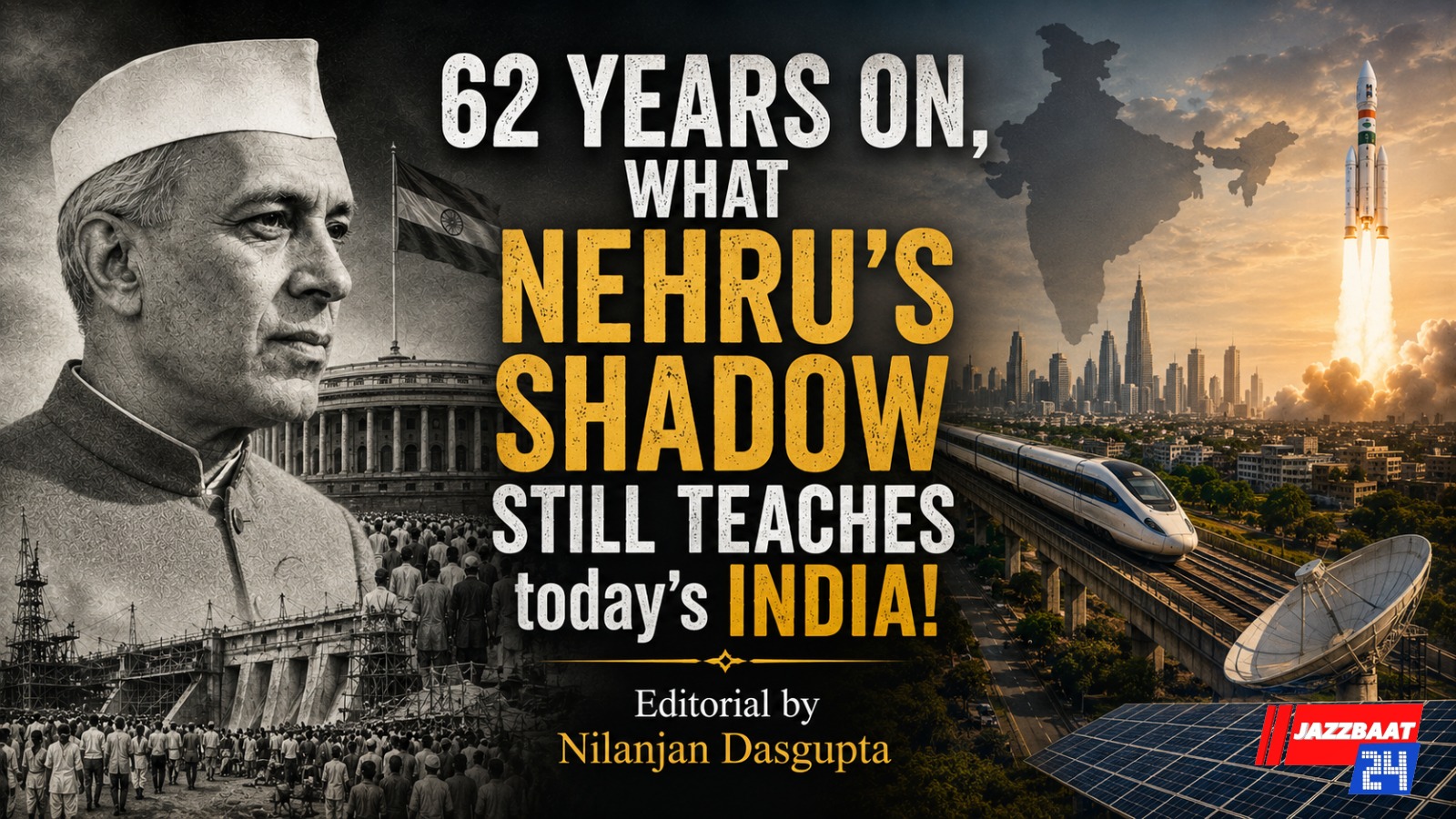
On the death anniversary of the man who helped shape the Republic, a reflection on power, democracy, and the unfinished journey of the Indian idea.
Sixty-two years after Jawaharlal Nehru’s death, India stands at a crossroads that is both familiar and new. The nation he helped lead out of colonial rule is no longer fragile or uncertain. It is one of the world’s fastest-growing economies, a rising geopolitical force, a technological powerhouse, and a country increasingly confident of its place in the global order. Yet beneath the glitter of economic statistics, electoral victories, and grand national ambitions lies a question that has haunted every generation since Independence, a question that Nehru himself grappled with as he stood before a newborn nation in 1947: What kind of India are we building? It is a question that transcends parties, ideologies, and political eras. It is the question that every Prime Minister inherits and every generation must answer.
History has never been kind to simple judgments, and Nehru remains one of the most debated figures in modern India. To some, he was the architect of democratic India; to others, he was a leader whose idealism often exceeded practical realities. His economic model, his handling of foreign policy, and his vision of state-led development continue to provoke fierce arguments. Yet great leaders are not remembered merely for the policies they implemented or the mistakes they made. They are remembered for the ideas they leave behind. Nehru’s greatest contribution was not a dam, a university, or a parliamentary speech. It was his belief that India could be more than a nation-state; that it could be a civilizational experiment where extraordinary diversity was not a weakness to be managed but a strength to be celebrated.
When India became independent, democracy was hardly the obvious choice. The country was wounded by Partition, scarred by communal violence, burdened by mass poverty, and confronted by enormous social divisions. Around the world, many doubted whether a nation so vast, so diverse, and so poor could sustain democratic governance. Yet Nehru placed his faith not in strongmen or centralized authority but in institutions. He believed that the Parliament, the judiciary, the free press, universities, scientific establishments, and constitutional values would become the pillars upon which the Republic would stand. More importantly, he believed that dissent was not a threat to democracy but one of its essential ingredients. The Republic was not designed to silence disagreement; it was designed to accommodate it.
India in 2026 is vastly different from the India Nehru knew. Under Prime Minister Narendra Modi, the nation has embraced a new political and economic confidence. Massive infrastructure projects have transformed connectivity, digital governance has altered the relationship between citizens and the state, and India’s global profile has expanded significantly. The government’s supporters view this era as one of national resurgence, efficiency, and decisive leadership. There is no denying that the scale of ambition visible in contemporary India reflects a nation eager to claim its place among the world’s leading powers. Yet every age of national confidence brings with it an equally important responsibility, the responsibility to ensure that strength does not come at the expense of democratic balance.
This is where Nehru’s legacy becomes particularly relevant. Not as a political weapon to be used against contemporary governments, but as a reminder of the principles that sustain a democracy beyond any one leader or party. Electoral mandates provide legitimacy, but they do not by themselves define the health of a republic. The true strength of a democracy is revealed in how it treats criticism, how it protects institutions from excessive concentration of power, and how it safeguards the rights of those who may find themselves outside the political mainstream. Democracies flourish not because everyone agrees but because everyone retains the right to disagree.
The idea of India has always been larger than its governments. It is an idea rooted in pluralism, where different languages, religions, cultures, and identities coexist under a shared constitutional framework. This pluralism has never been effortless. It requires patience, accommodation, and an acceptance that diversity often produces disagreement. Yet it is precisely this complexity that has distinguished India from many nations that emerged from colonial rule. The challenge for every government, regardless of ideology, is to preserve this delicate balance between unity and diversity. National confidence is important, but so is national cohesion. Economic growth is essential, but so is social trust. Development creates prosperity, but inclusion creates stability.
On Nehru’s death anniversary, therefore, the conversation should not revolve around statues, slogans, or partisan battles over legacy. Nations do not move forward by worshipping their founders, nor by erasing them from memory. They move forward by engaging honestly with their achievements and failures. Nehru was neither infallible nor irrelevant. He was a statesman who attempted to answer the defining questions of his time. Today’s leaders face a different set of challenges, but the underlying question remains remarkably unchanged. How can India become more prosperous without becoming less democratic? How can it become more powerful without becoming less tolerant? How can it remain united without demanding uniformity?
The rose that Nehru famously wore on his coat has long since withered into the pages of history. Symbols always fade. Political slogans come and go. Governments rise and fall. What endures is the Republic itself, a living, evolving, unfinished project that must constantly be renewed by those who govern it and those who hold it accountable. Sixty-two years after Nehru’s passing, the most meaningful tribute to his legacy is not reverence but reflection. For the future of India will ultimately be determined not by the memory of one man, but by whether the nation continues to ask the question he considered fundamental to its destiny: What kind of India are we building? The answer will shape not only the politics of our time, but the character of the Republic for generations to come.