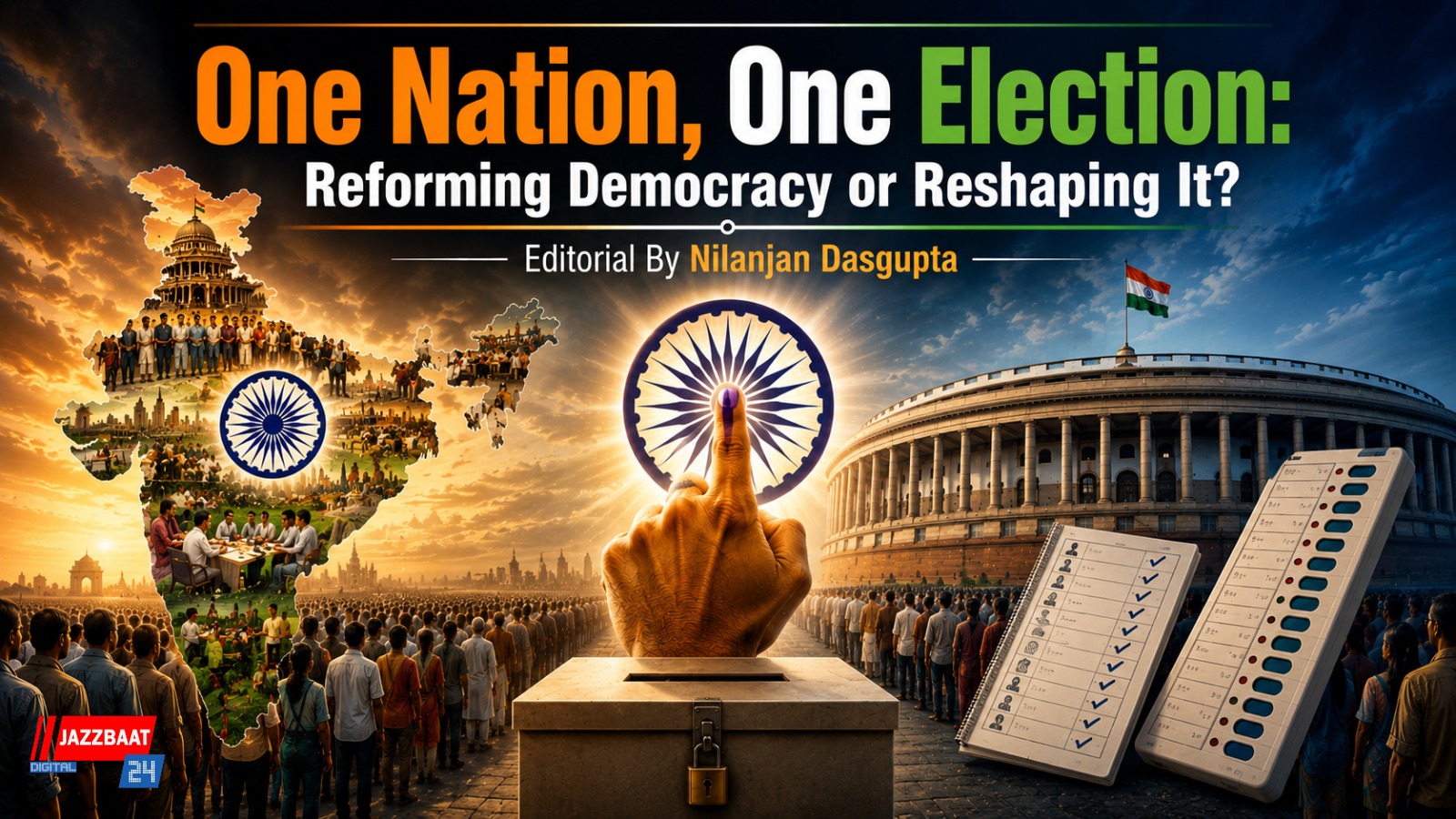
India’s democracy has always been noisy, expensive, emotional and gloriously chaotic. Every few months, somewhere in the country, voters line up outside polling booths to decide the fate of governments. For some, this constant election cycle is democracy in motion. For others, it has become an endless political campaign that drains public money, slows governance and keeps the nation trapped in permanent election mode.
Now comes the ambitious proposal known as “One Nation, One Election” the idea of holding Lok Sabha and all state assembly elections simultaneously across the country. Supporters call it the next great reform of Indian democracy. Critics warn it may quietly alter the federal soul of the Republic itself.
The proposal is not entirely new. India actually conducted simultaneous elections between 1951 and 1967. The system collapsed after several state governments fell early and the Lok Sabha itself was dissolved ahead of schedule, pushing the country into staggered electoral cycles. Since then, elections have become a year-round exercise.
The current government argues that this fragmented system weakens governance. Every election triggers the Model Code of Conduct, slowing administrative decisions and delaying development projects. Security personnel, teachers and government officials are repeatedly deployed for polling duty. According to policy discussions around the reform, simultaneous elections could significantly reduce administrative costs and manpower deployment.
There is also a political argument behind the proposal. National leaders claim frequent elections encourage short-term populism instead of long-term governance. Governments, they argue, remain trapped in campaign mode rather than policy mode. Simultaneous elections, supporters believe, would create political stability and allow governments to focus on development rather than electoral arithmetic.
Yet democracy is not merely an administrative exercise. It is also about accountability, diversity and timing.
That is where the sharpest criticism of “One Nation, One Election” emerges.
India is not a unitary state with one political mood. It is a federal union of vastly different regions, cultures and political priorities. Voters in Tamil Nadu may think differently from voters in Uttar Pradesh. A flood in Assam, unemployment in Maharashtra or agrarian distress in Punjab can shape local elections in completely different ways. Critics fear simultaneous elections could nationalise every political debate, reducing state issues to secondary concerns beneath the shadow of national personalities and central narratives.
Opposition parties have repeatedly argued that the reform could weaken regional parties and centralise political power. The Congress recently described the proposal as an attempt to undermine regional voices, while BJP allies defended it as a necessary reform for efficiency and stability.
The constitutional questions are even more serious.
India’s parliamentary democracy is built on the principle that governments survive only as long as they retain legislative confidence. Assemblies and Parliament can be dissolved before completing five years. That flexibility is not a flaw; it is a democratic safeguard. Experts argue that synchronising elections may require curtailing this flexibility through constitutional amendments that redefine legislative terms and create fixed electoral cycles.
The proposed reforms reportedly involve amendments to multiple constitutional provisions, including Articles 83, 85, 172 and 174. Suggestions include aligning assembly tenures with Lok Sabha elections and allowing newly elected governments to serve only the “remainder” of a term if an assembly collapses early. Critics ask a difficult question: if a government loses majority halfway through its tenure, should democratic accountability wait until the next synchronised election cycle?
The debate has become even more politically sensitive after recent national disputes over delimitation and representation. The failure of the women’s reservation-linked constitutional amendment earlier this year demonstrated how difficult it has become to secure consensus on structural democratic reforms requiring special parliamentary majorities.
There is another deeper concern that rarely enters official speeches.
Frequent elections, despite their cost, also act as frequent public audits of power. They give citizens recurring opportunities to punish arrogance, reward performance and shift political momentum. In many ways, India’s democracy survives not because elections are infrequent and stable, but because they are constant and disruptive. The political system remains permanently answerable to the voter.
That is why the “One Nation, One Election” debate cannot be reduced to a simple question of saving money or administrative convenience. It is ultimately a philosophical question: should democracy prioritise efficiency, or should it preserve friction, unpredictability and continuous accountability?
Supporters see synchronised elections as a leap toward a more disciplined and development-focused democracy. Opponents see the possibility of a quieter transformation one where federal diversity slowly bends before centralised political narratives.
Perhaps the real challenge is not deciding whether simultaneous elections are good or bad. The challenge is ensuring that any reform strengthens democracy without simplifying it beyond recognition.
India’s greatest democratic strength has never been order. It has always been participation. And any reform powerful enough to redesign elections must first answer a larger question: does it make the voter stronger, or merely make governance easier?