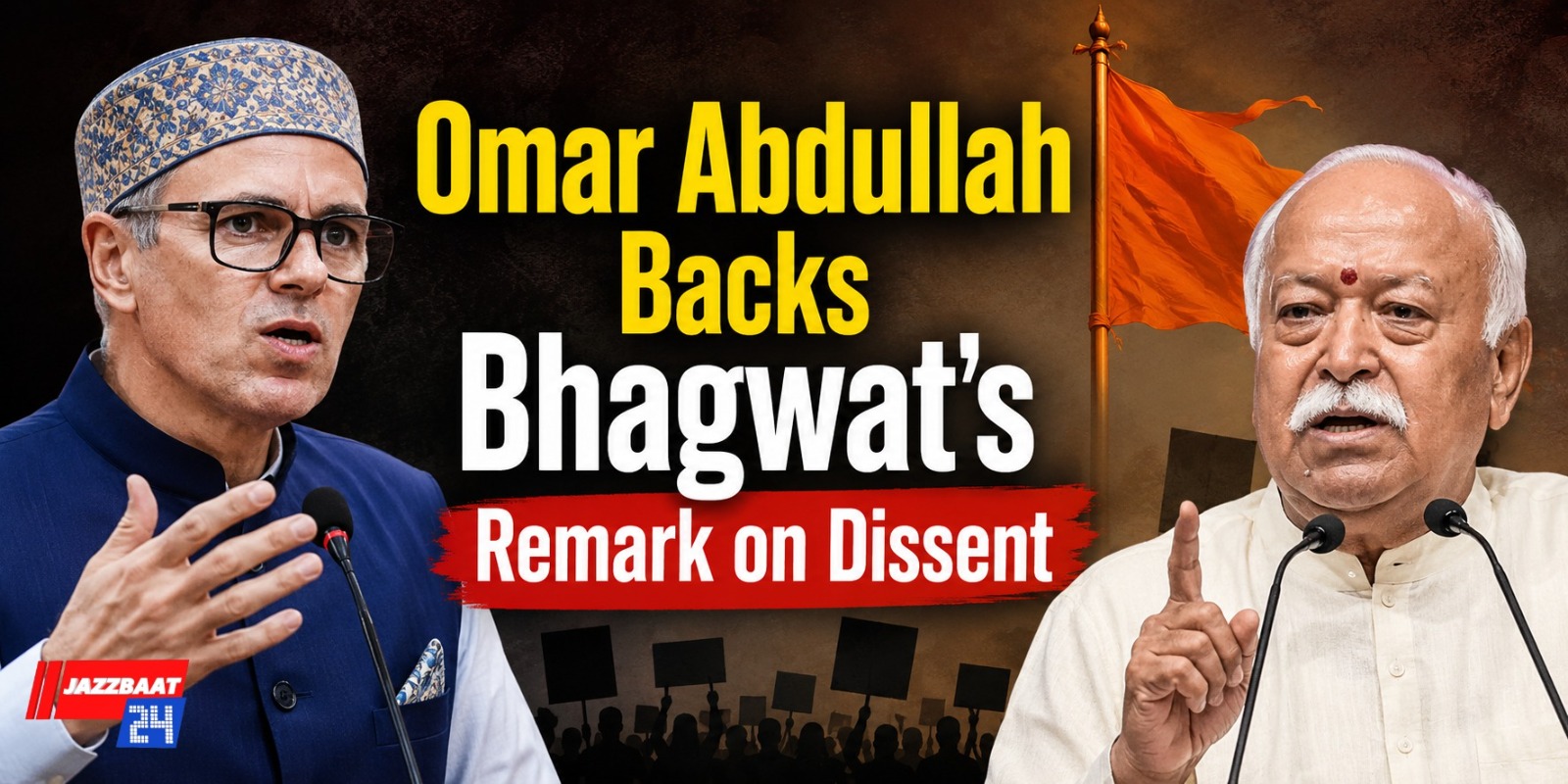
Jammu and Kashmir Chief Minister Omar Abdullah on Thursday welcomed remarks made by RSS chief Mohan Bhagwat on the importance of distinguishing between criticism of the government and criticism of the nation. Abdullah said that opposing the government should never be equated with being against the country, describing the statement as an important reminder in a healthy democracy.
Speaking to reporters, Abdullah said that in a democratic system, citizens and political parties have the constitutional right to question the government and hold it accountable. He stressed that criticism of government policies is a legitimate part of democracy and should not be viewed as an attack on the nation itself.
“The government and the country are not the same. Governments change through elections, but the nation remains. If someone opposes the policies of a government, it does not mean that person is against India,” Abdullah said while reacting to Bhagwat’s recent speech.
The Jammu and Kashmir Chief Minister said he agreed with Bhagwat’s observations that democratic debate should allow room for differing opinions. According to Abdullah, respecting dissent strengthens democratic institutions rather than weakening them. He added that people should be free to express disagreements without being branded as anti-national.
Bhagwat, during his recent address, had spoken about the need for dialogue, reasoning and acceptance of different viewpoints. He emphasised that differences of opinion are natural in a democracy and that society should encourage discussions instead of demanding unquestioned obedience. His remarks have drawn attention across the political spectrum.
Abdullah said such statements reinforce the idea that democracy thrives on debate and constructive criticism. He expressed hope that these principles would be reflected in political discourse across the country and that all stakeholders would respect the right of citizens to express their views peacefully.
Political observers believe Abdullah’s comments are significant as they come amid frequent debates over freedom of expression and the role of the Opposition in Indian democracy. While leaders from different parties have interpreted Bhagwat’s remarks in their own way, the statement has triggered wider discussions on democratic values, political accountability and the space for dissent.
The exchange has once again highlighted the ongoing debate over the relationship between the government, the Opposition and democratic institutions. As political parties continue to respond to Bhagwat’s speech, the discussion is expected to remain part of the national political discourse in the coming days.