

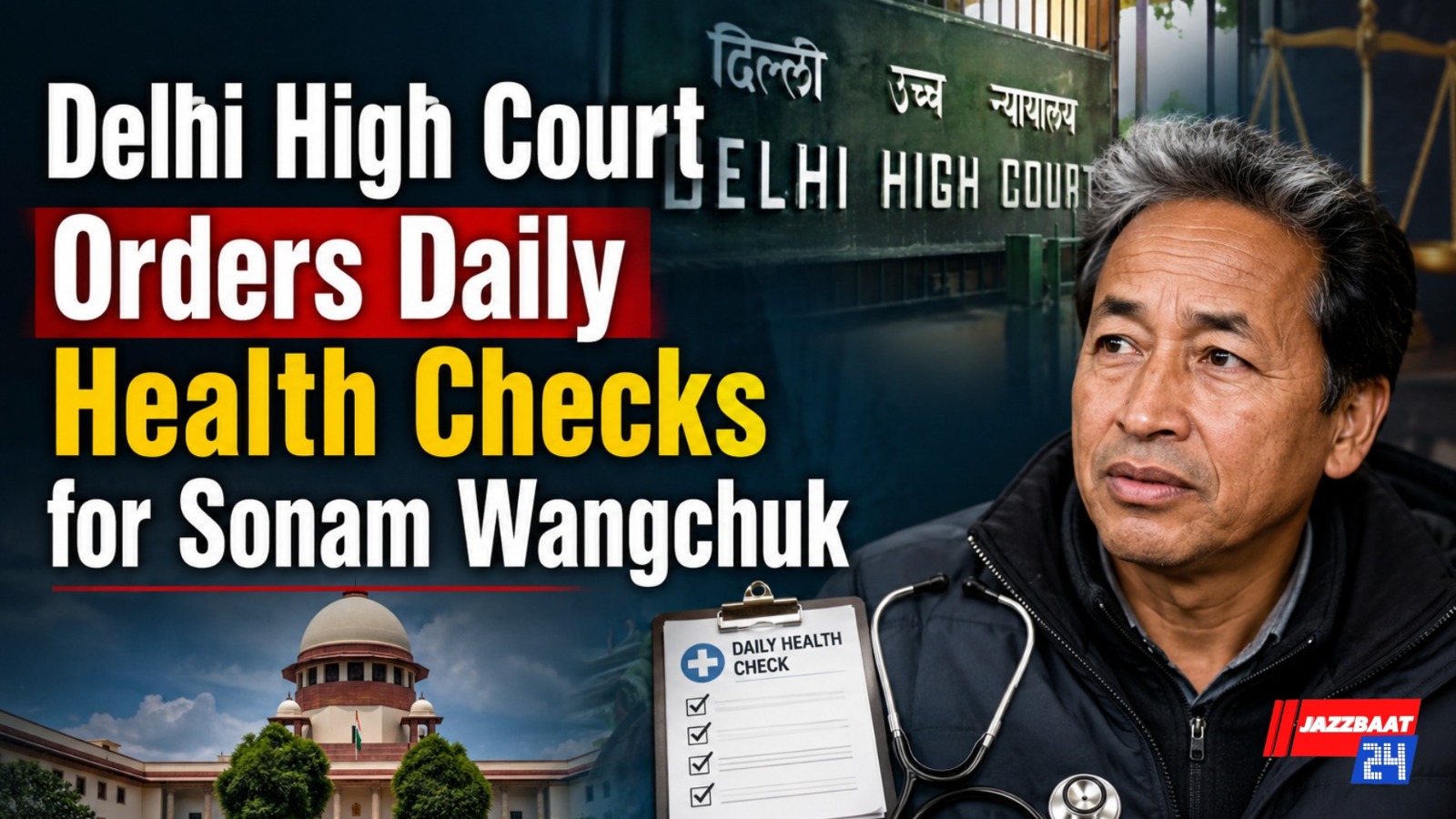
New Delhi: The Delhi High Court has directed government authorities to clinically monitor activist and education reformer Sonam Wangchuk every day as concerns grow over his deteriorating health during an indefinite hunger strike at Jantar Mantar.
A Division Bench comprising Chief Justice Devendra Kumar Upadhyaya and Justice Tejas Karia said that necessary medical treatment should be provided immediately if doctors find that Wangchuk’s condition requires intervention. The court observed that the life of every citizen is precious and authorities must make all possible efforts to protect it.
Wangchuk entered the 19th day of his hunger strike on Thursday, July 16. He began fasting on June 28 in solidarity with the youth-led Cockroach Janta Party protest, which is demanding the resignation of Union Education Minister Dharmendra Pradhan over alleged examination irregularities and paper leaks, including issues connected with the NEET examination.
The High Court issued the direction while hearing a public interest litigation filed by lawyer Rakesh Kumar Saini. The petition sought Wangchuk’s immediate hospitalisation and necessary medical treatment, including force-feeding if required to save his life.
Solicitor General Tushar Mehta, appearing for the Centre, informed the court that Wangchuk was already being regularly examined by government doctors and medical experts. He assured the Bench that appropriate medical assistance would be provided depending on the doctors’ assessment. After recording the assurance and issuing directions for daily monitoring, the court disposed of the petition.
Medical reports have raised serious concerns about Wangchuk’s condition. Doctors said that he had lost more than nine kilograms since beginning the fast. His blood sugar was recorded at 80 mg/dL, while his blood pressure stood at 105/61 mmHg when lying down and 101/65 mmHg while sitting. Although he remained mentally alert and adequately hydrated, doctors warned that the prolonged fast had entered a critical stage and could begin affecting his organs.
Wangchuk has so far refused to withdraw his protest, saying that ending the fast without a response from the government would send the wrong message. He has instead urged supporters to participate in the CJP’s proposed march to Parliament on July 20.
The court’s intervention means that authorities may shift Wangchuk to a hospital or provide other medical treatment if his condition worsens and doctors recommend urgent action.