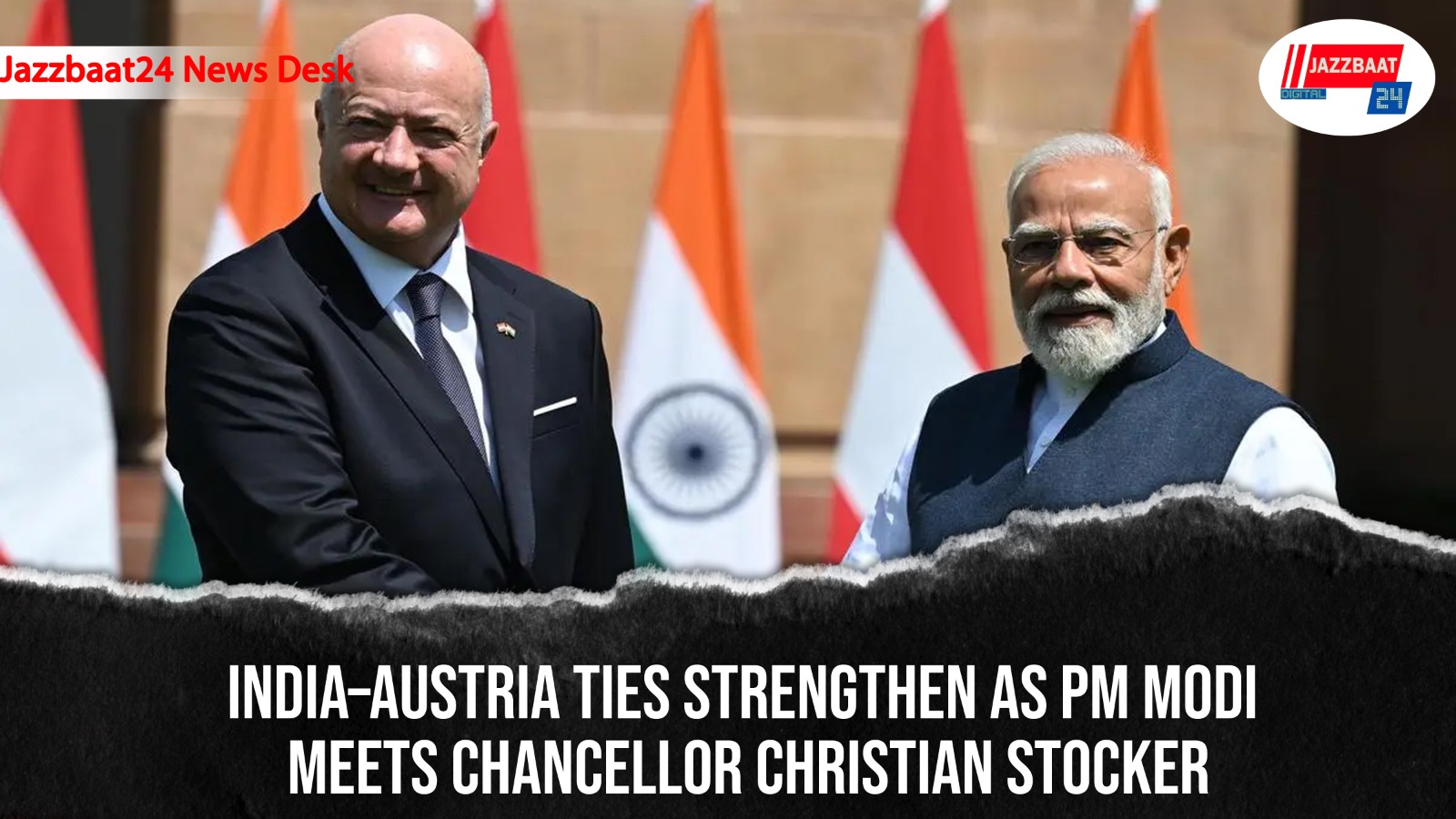
Christian Stocker visited India on his first official trip to Asia and held high-level talks with Prime Minister Narendra Modi in New Delhi, marking a significant step forward in bilateral relations between India and Austria.
The visit, which took place from April 14–17, 2026, is being seen as an important diplomatic engagement aimed at deepening cooperation in trade, technology, defence, innovation, and sustainable development. Chancellor Stocker’s trip is also his first official visit outside Europe since assuming office, highlighting the importance Austria is placing on its partnership with India.
During the bilateral meeting at Hyderabad House, both leaders reviewed the entire spectrum of India–Austria relations and discussed ways to expand collaboration in emerging sectors such as semiconductors, artificial intelligence, quantum technology, renewable energy, and biotechnology. They also exchanged views on regional and global issues of mutual concern, including multilateral cooperation and global economic stability.
A key highlight of the visit was the signing and exchange of several agreements between the two countries. These included memorandums of understanding in areas such as food safety, counter-terrorism cooperation, and defence-related dialogue mechanisms. Both sides also agreed to strengthen institutional frameworks to boost long-term economic and strategic cooperation.
Prime Minister Modi emphasized that India’s scale and technological growth, combined with Austria’s expertise in innovation and engineering, could create strong global solutions. He also noted that the partnership has moved beyond traditional diplomacy into a more forward-looking economic and technology-driven relationship.
Chancellor Stocker, in his remarks, described India as one of Austria’s most important partners outside the European Union. He highlighted the steady growth of bilateral trade, increasing Austrian investments in India, and the presence of around 160 Austrian companies operating in sectors such as infrastructure, automotive, renewable energy, and semiconductors.
He also stressed that in a rapidly changing global order marked by geopolitical tensions, strong partnerships like India–Austria relations are essential for stability, trust, and economic resilience.
The visit also included symbolic gestures of goodwill, with Chancellor Stocker paying tribute to Mahatma Gandhi at Rajghat.
the meeting is being viewed as a milestone in India–Austria relations, opening new avenues for cooperation and reinforcing both countries’ commitment to a stable, multipolar, and innovation-driven global partnership.