
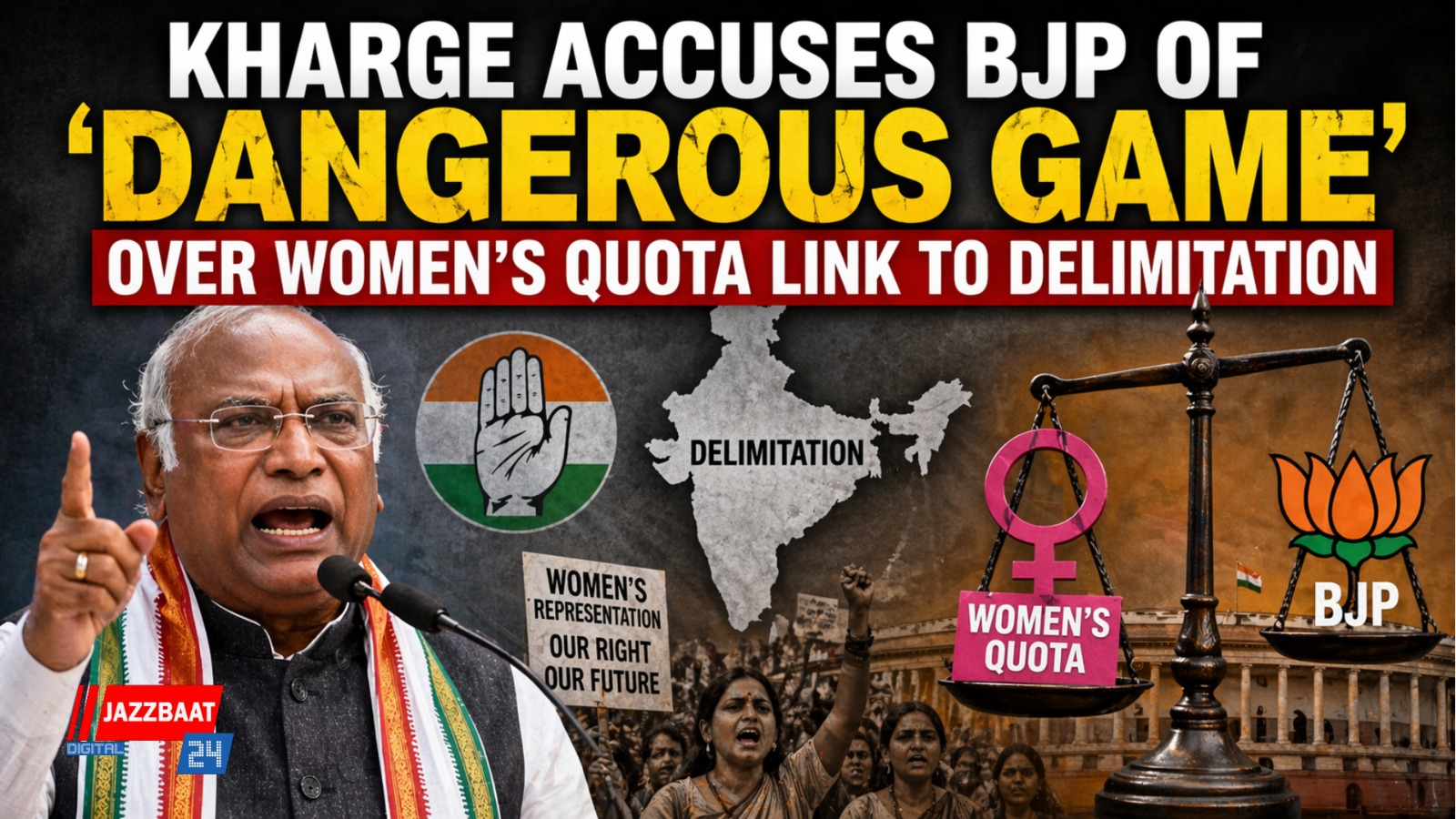
Congress president Mallikarjun Kharge on Tuesday accused the Bharatiya Janata Party (BJP) of playing a “dangerous game” by linking the implementation of women’s reservation in legislatures to the process of delimitation.
Addressing a public gathering in Tamil Nadu, Kharge criticised the Centre for delaying the rollout of the Women’s Reservation Bill, officially known as the Nari Shakti Vandan Adhiniyam. He argued that tying the reservation to a future delimitation exercise effectively postpones its benefits for women.
“The BJP is misleading the people. They have passed the bill but attached conditions that will delay its implementation. This is not genuine empowerment,” Kharge said, adding that women across the country are being denied timely representation in Parliament and state assemblies.
The legislation, passed in 2023, provides for 33% reservation for women in the Lok Sabha and state assemblies. However, its implementation is contingent upon the completion of the next delimitation exercise and a subsequent census, both of which are yet to take place.
Kharge further alleged that the move could disproportionately affect southern states like Tamil Nadu, which have controlled population growth more effectively. He warned that linking reservation to delimitation may alter political representation in a way that disadvantages certain regions.
The Congress leader’s remarks come amid a broader political debate over delimitation, with several opposition parties including the Dravida Munnetra Kazhagam raising concerns about its potential impact on federal balance and state-wise representation.
Meanwhile, the Bharatiya Janata Party has defended its approach, stating that the linkage ensures a fair and updated distribution of seats based on population data. BJP leaders argue that the Women’s Reservation Bill is a historic step toward gender equality and will be implemented at the appropriate time.
As the political battle intensifies ahead of key elections, the issue has become a major flashpoint, with both sides accusing each other of politicising women’s empowerment. The debate over reservation and delimitation is expected to remain central to the national political discourse in the coming months.