

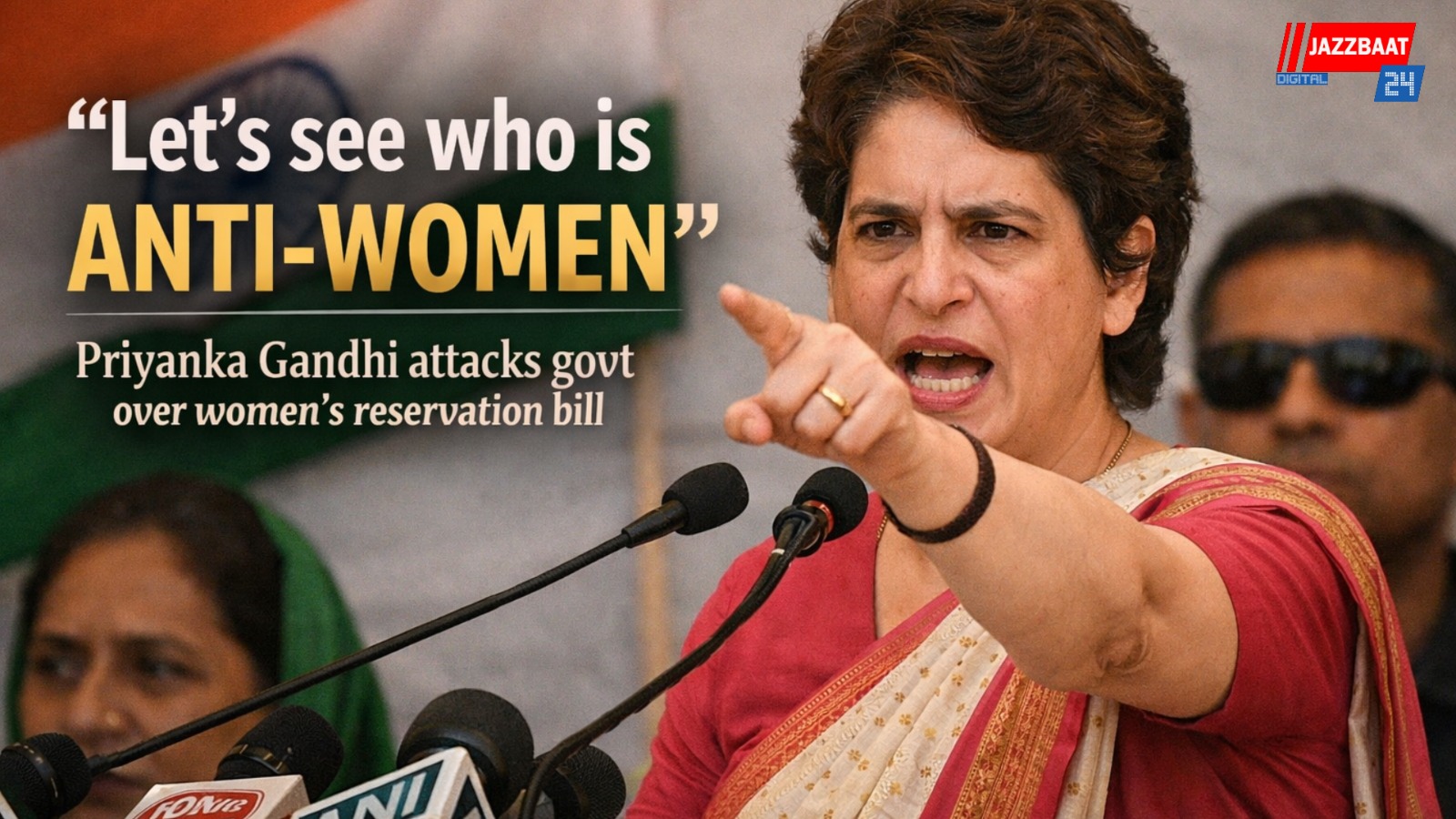
Congress leader Priyanka Gandhi Vadra on Friday launched a sharp attack on the government after the women’s reservation-related constitutional amendment bill failed to clear the Lok Sabha test, challenging the ruling party to bring back an “unlinked” version of the proposal.
During her speech in the Lok Sabha debate, Priyanka Gandhi said the Opposition was being unfairly portrayed as obstructing women’s empowerment and questioned the government’s political intent behind linking the women’s quota with the delimitation exercise.
“Let’s see who is anti-women,” she said, urging the government to reintroduce the women’s reservation bill without linking it to delimitation and other electoral restructuring measures. Her remarks came amid a heated parliamentary debate on the 131st Constitutional Amendment Bill, which sought to advance women’s representation in legislatures but became politically contentious due to its association with redrawing of constituencies.
The bill, which required a two-thirds majority, failed to pass in the Lok Sabha, triggering a fresh round of political exchanges between the ruling alliance and Opposition parties. While the government defended the proposal as a step towards greater women’s participation in politics, Opposition leaders argued that the linkage with delimitation complicated its intent and could impact federal balance.
Priyanka Gandhi said that the demand for women’s reservation has been long-standing and enjoys broad political consensus, but accused the government of creating conditions that made its implementation controversial. She also reiterated that women’s political representation should not be delayed or tied to “unrelated electoral adjustments.”
The debate also saw Opposition leaders alleging that the bill was being used to politically corner critics by branding them as “anti-women,” a charge the ruling side rejected. Priyanka argued that genuine empowerment cannot be achieved through “procedural confusion or political framing.”
The issue of women’s reservation in legislatures has been under discussion for decades, and a separate constitutional amendment passed earlier had already provided for 33% reservation for women, but its implementation was linked to future delimitation and census exercises.
With the latest parliamentary setback, the issue is expected to remain a key flashpoint in national politics, with both government and Opposition continuing to trade accusations over intent, timing, and political strategy.