

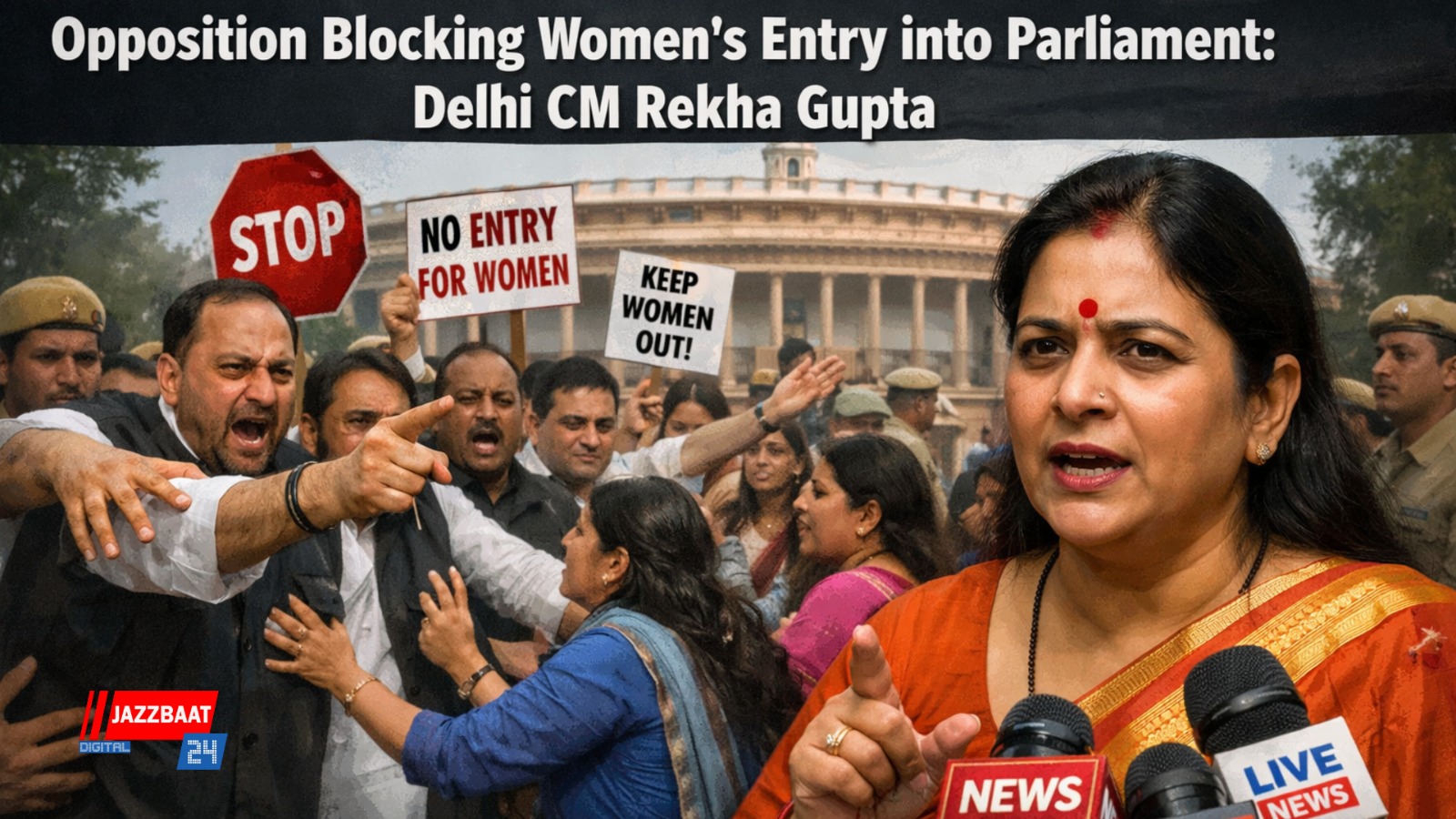
Delhi Chief Minister Rekha Gupta has strongly criticised opposition parties over the Women’s Reservation Bill, alleging that they have historically resisted efforts to bring more women into legislative bodies.
Speaking on Saturday, Gupta claimed that the opposition “never wanted women in Parliament and Assemblies” and had consistently opposed measures aimed at increasing women’s political representation. Her remarks came in the context of the ongoing political debate surrounding the Women’s Reservation Bill and related constitutional proposals in Parliament.
According to official proceedings, the government’s push to pass the constitutional amendment for reserving seats for women recently failed to secure the required two-thirds majority in the Lok Sabha. The bill, which was linked with broader electoral and delimitation reforms, received 298 votes in favour and 230 against, leading to its defeat.
Gupta alleged that opposition parties were not genuinely committed to women’s empowerment in politics. “The opposition had already decided they would never allow women to reach the Lok Sabha and the Legislative Assemblies,” she said, adding that women would continue to struggle and fight for their rightful representation.
She further argued that women, who make up nearly half of India’s population, deserve a stronger role in decision-making institutions. “These people do not want crores of women, who constitute half the country’s population, to ever reach the House,” she said, asserting that women would not give up their demand for political representation.
The remarks come at a time when the Women’s Reservation Bill has become a major political flashpoint between the ruling party and opposition blocs. While the government has defended the legislation as a historic step toward gender equality in politics, opposition parties have raised concerns over its linkage with delimitation and the possible impact on federal representation.
The debate has intensified national political discourse, with both sides accusing each other of misrepresenting the intent of the reform. The government maintains that the bill is aimed at ensuring 33% reservation for women in Parliament and state legislatures, while critics argue that procedural and structural concerns need to be addressed first.
As discussions continue, the issue of women’s representation in Indian politics remains at the centre of a larger constitutional and electoral debate, with strong views emerging from both ruling and opposition parties.