
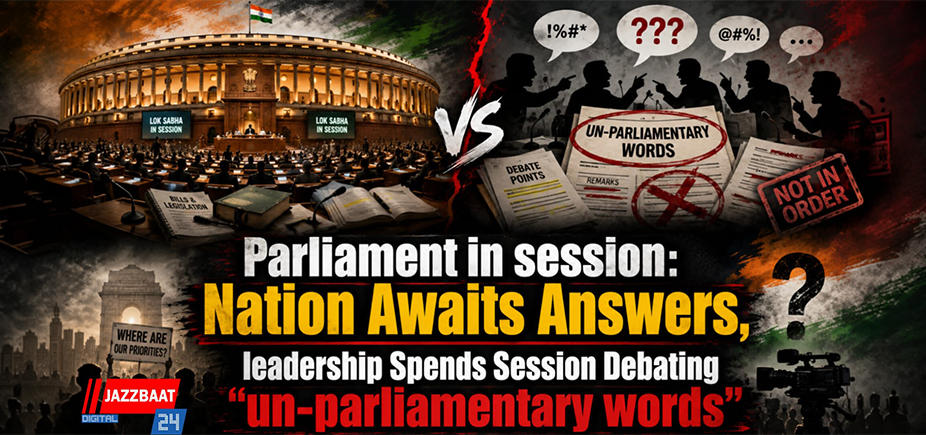
India’s Parliament is once again witnessing intense
political confrontation, but the question before the nation is whether the
House is spending enough time discussing issues that directly affect citizens.
Instead of focusing entirely on policy debates and public concerns, much of the
recent proceedings have been dominated by protests, accusations and arguments
over language and “un-parliamentary words”.
Parliament is the highest platform of democracy, where
elected representatives are expected to question the government, debate laws
and find solutions to national challenges. However, repeated disruptions have
raised concerns about whether important issues are receiving the attention they
deserve. The ongoing disputes over student protests, examination irregularities
and demands for accountability have created a tense atmosphere inside both
Houses.
The Opposition argues that raising uncomfortable questions
is its constitutional responsibility and that the government must respond to
issues concerning citizens. The ruling side, meanwhile, has maintained that
discussions can only happen within parliamentary rules and that disruptions
prevent meaningful debate. The Speaker has also emphasised that freedom of
speech inside Parliament comes with responsibility and must follow the
established rules of the House.
The controversy over “un-parliamentary words” reflects a
larger debate about political culture. Strong criticism and disagreement are
natural parts of democracy, but the focus should remain on facts,
accountability and solutions. Parliamentary debates should not become a
competition of slogans where the real concerns of people get pushed aside.
At a time when citizens are looking for answers on
education, employment, economic challenges, inflation and governance,
Parliament must rise above political battles. The government has the
responsibility to answer questions, while the Opposition has the duty to
present constructive alternatives.
Democracy does not become stronger through silence or
constant disruption. It grows when different voices come together to debate,
challenge and improve decisions. The people of India expect their
representatives to use Parliament as a place of serious discussion, not just
political confrontation.
The nation is watching. Beyond the headlines and heated
exchanges, citizens want results, accountability and a Parliament that works
for them. The true measure of a successful session will not be the number of
arguments made, but the number of issues resolved.