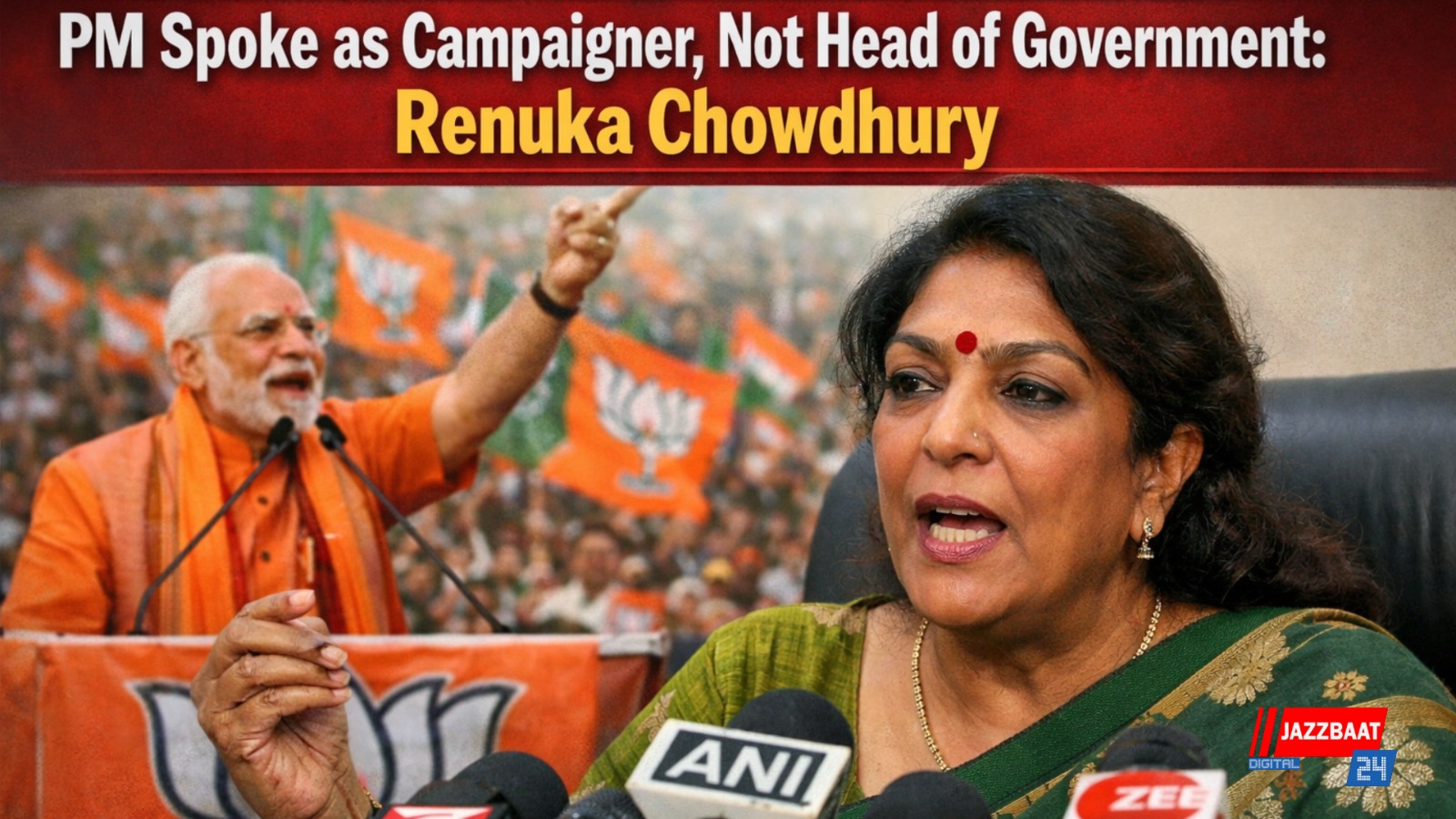
New Delhi: Congress MP Renuka Chowdhury on Saturday launched a sharp attack on Prime Minister Narendra Modi, alleging that his recent national address reflected a political campaign speech rather than a formal communication from the head of government.
Speaking to news agency ANI, Chowdhury said the Prime Minister “spoke not as the head of government but as a campaigner,” and accused him of turning an official address into a politically charged speech focused on attacking opposition parties.
She further claimed that the address repeatedly mentioned party politics and opposition criticism, while failing to adequately address key governance issues, particularly women’s representation and welfare. Chowdhury argued that the tone and content of the speech were inconsistent with the expectations from a national address delivered by the Prime Minister.
Referring to the long-pending Women’s Reservation Bill, she said that Parliament had already passed the legislation in 2023, but questioned why it has still not been implemented in the current Lok Sabha. According to her, if the government truly supported women’s empowerment, it should have ensured immediate implementation instead of continuing delays.
Chowdhury also alleged that the speech appeared to focus more on political messaging than on policy outcomes. She said that citizens expect clarity on governance issues, economic concerns, and social justice measures, rather than what she described as “political campaigning from a constitutional platform.”
Her remarks come amid heightened political tensions between the ruling BJP and opposition parties following recent parliamentary debates and public addresses on the women’s reservation issue and related constitutional amendments.
Earlier, several opposition leaders had also criticised the Prime Minister’s address, claiming it was politically motivated. However, the government has maintained that the speech highlighted important legislative developments and the need for accountability from opposition parties on key bills.
The latest exchange adds to the continuing war of words between the Congress and the ruling party, with both sides sharply differing over the intent and content of recent parliamentary and public communications.