
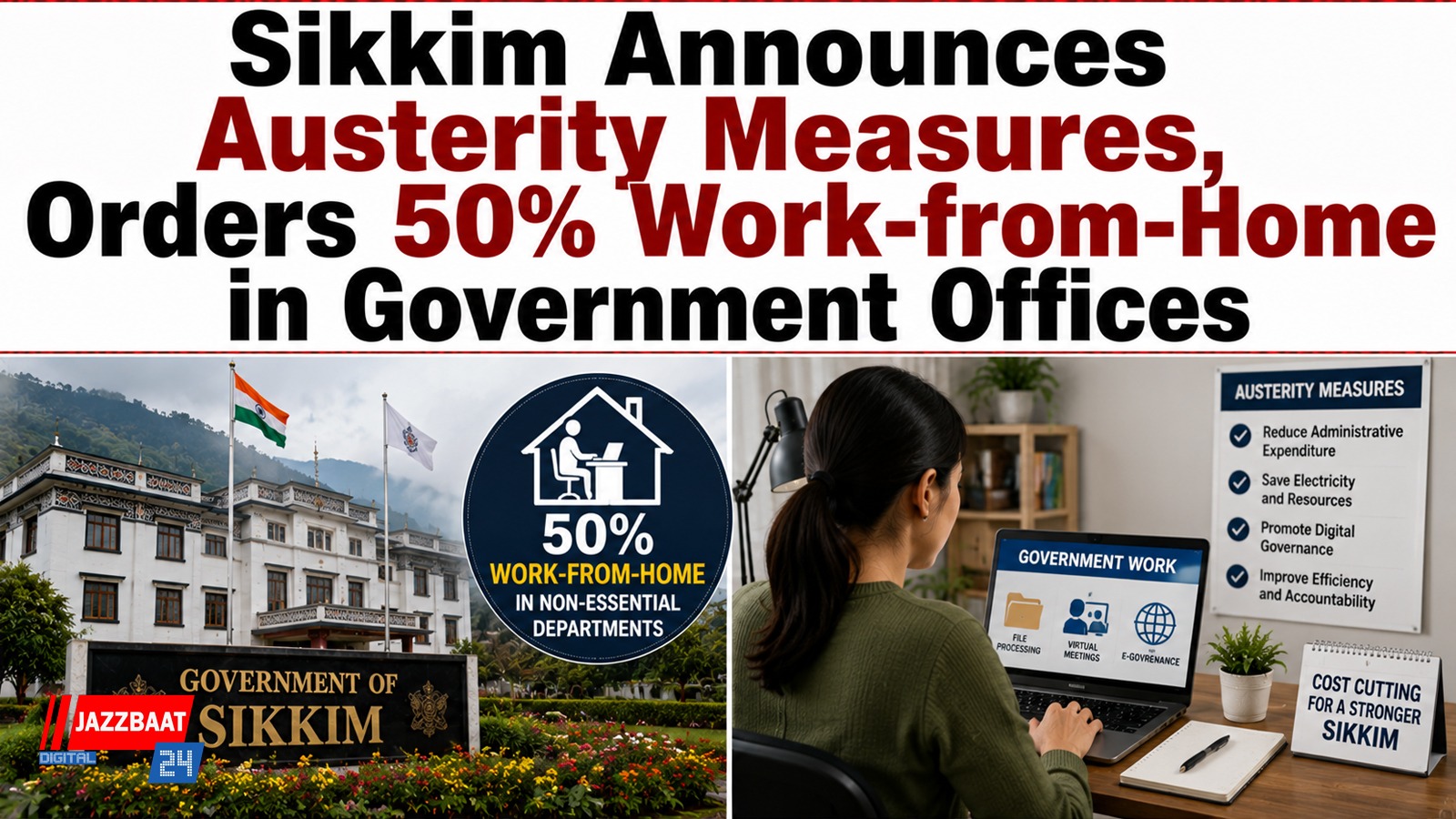
The Sikkim government has announced a series of austerity measures aimed at reducing administrative expenditure, including a directive mandating 50% work-from-home for government employees in non-essential departments. The decision comes as part of a broader effort to streamline public spending and improve efficiency in state administration.
According to an official notification, departments have been instructed to ensure that only half of the workforce is physically present in offices on a rotational basis, while the remaining employees will operate from home. Essential services, however, will continue to function normally without disruption.
The government said the move is intended to cut operational costs such as electricity, office maintenance, and transportation allowances, while also promoting digital governance and flexible working practices. Officials added that the policy will be reviewed periodically based on administrative needs and performance outcomes.
The directive also encourages departments to strengthen online workflows, including digital file processing, virtual meetings, and e-governance platforms, to ensure continuity of work despite reduced physical presence.
Sources in the state administration indicated that the austerity drive is part of a larger fiscal management strategy, as smaller northeastern states often face budgetary constraints due to limited revenue generation and heavy dependence on central grants.
While the decision is expected to ease financial pressure on the state exchequer, it has also raised questions about productivity monitoring and coordination among departments. However, officials maintained that modern digital systems will help maintain efficiency and accountability.
Employees have been advised to remain available during working hours and ensure timely completion of assigned tasks, with department heads responsible for monitoring performance under the new system.
The Sikkim government has emphasized that the measures are temporary and subject to revision depending on fiscal conditions and administrative outcomes in the coming months.
The announcement reflects a growing trend among governments to adopt hybrid work models and cost-cutting strategies in response to evolving economic challenges and digital transformation initiatives.