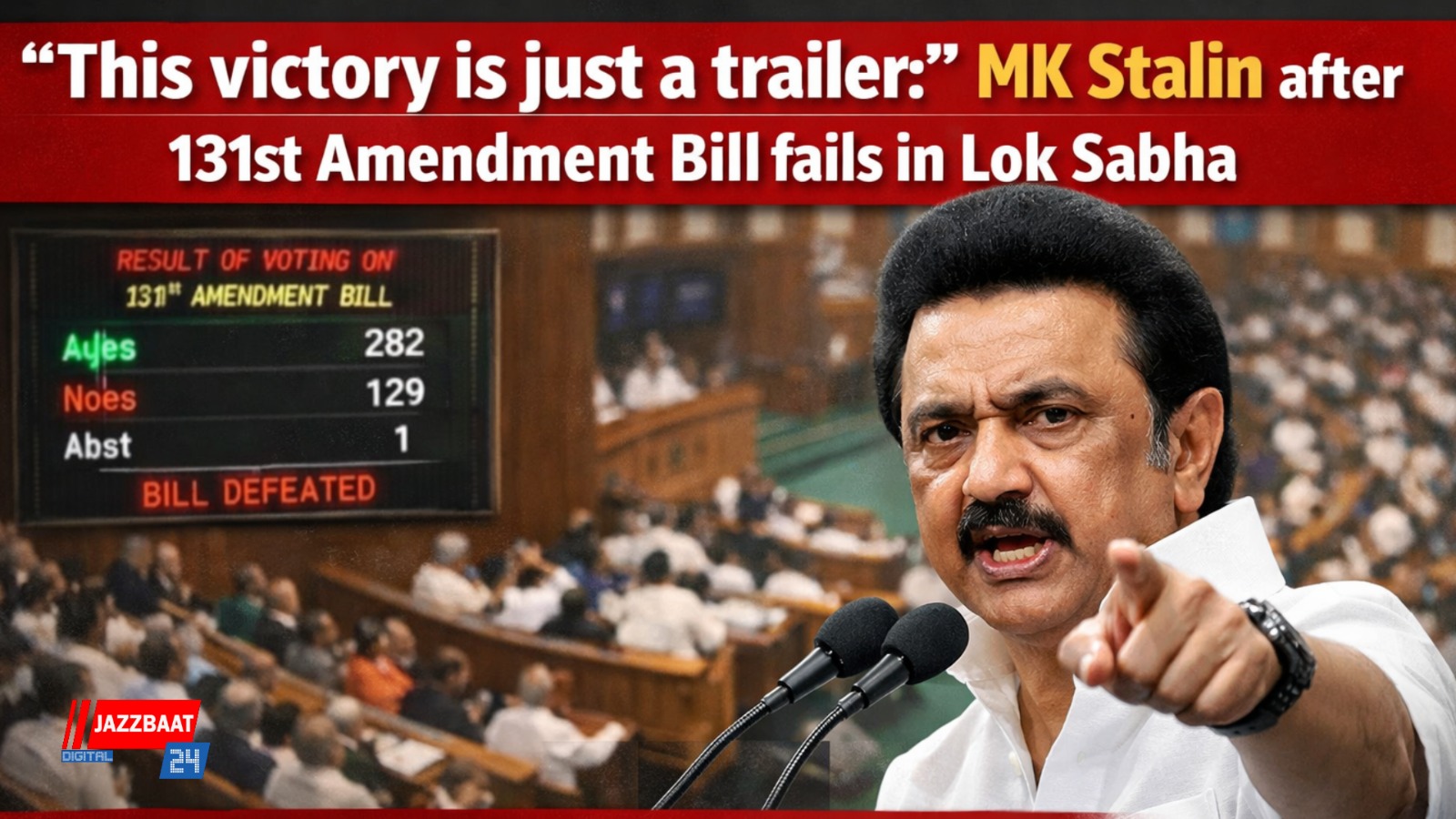
Tamil Nadu Chief Minister and DMK president M.K. Stalin on Friday described the recent political development in Parliament as “just a trailer,” after the proposed 131st Constitutional Amendment Bill reportedly failed to pass in the Lok Sabha.
Speaking to party workers and supporters in Chennai, Stalin said the outcome reflected growing resistance from opposition parties against what he called “centralised decision-making” and policies that affect states’ rights. He asserted that the result should be seen as an early indication of larger political shifts ahead.
“This victory is just a trailer. The real picture will unfold in the days to come,” Stalin said, adding that democratic forces across the country were uniting to protect federal principles and state autonomy.
According to party sources, the DMK leadership views the development in Parliament as a significant political moment, strengthening opposition unity on key constitutional and governance issues. Stalin said that Tamil Nadu has always played an important role in defending federalism and would continue to do so in the future.
He also criticised what he described as attempts to impose uniform policies without adequate consultation with state governments. Reiterating DMK’s stand, Stalin said that India’s strength lies in its diversity and that cooperative federalism must be respected in both letter and spirit.
“The voice of the states cannot be ignored. Any attempt to weaken federal structure will be opposed strongly,” he added.
The Chief Minister also used the occasion to motivate party cadres ahead of upcoming political challenges, saying that electoral and legislative battles must be fought with unity and determination. He urged DMK workers to take the message of the party’s ideology to the grassroots level.
Political observers note that Stalin’s remarks come at a time of heightened political activity in Tamil Nadu, with parties preparing for future elections and strengthening their positions on national issues. The DMK has consistently positioned itself as a strong voice for state rights in Parliament and outside.
While the details of the parliamentary proceedings continue to be debated, the development has already sparked political reactions across parties, with opposition leaders calling it a sign of shifting dynamics in national politics.
Stalin’s remarks are being seen as both a political message to supporters and a broader statement on the DMK’s stance in national-level debates.