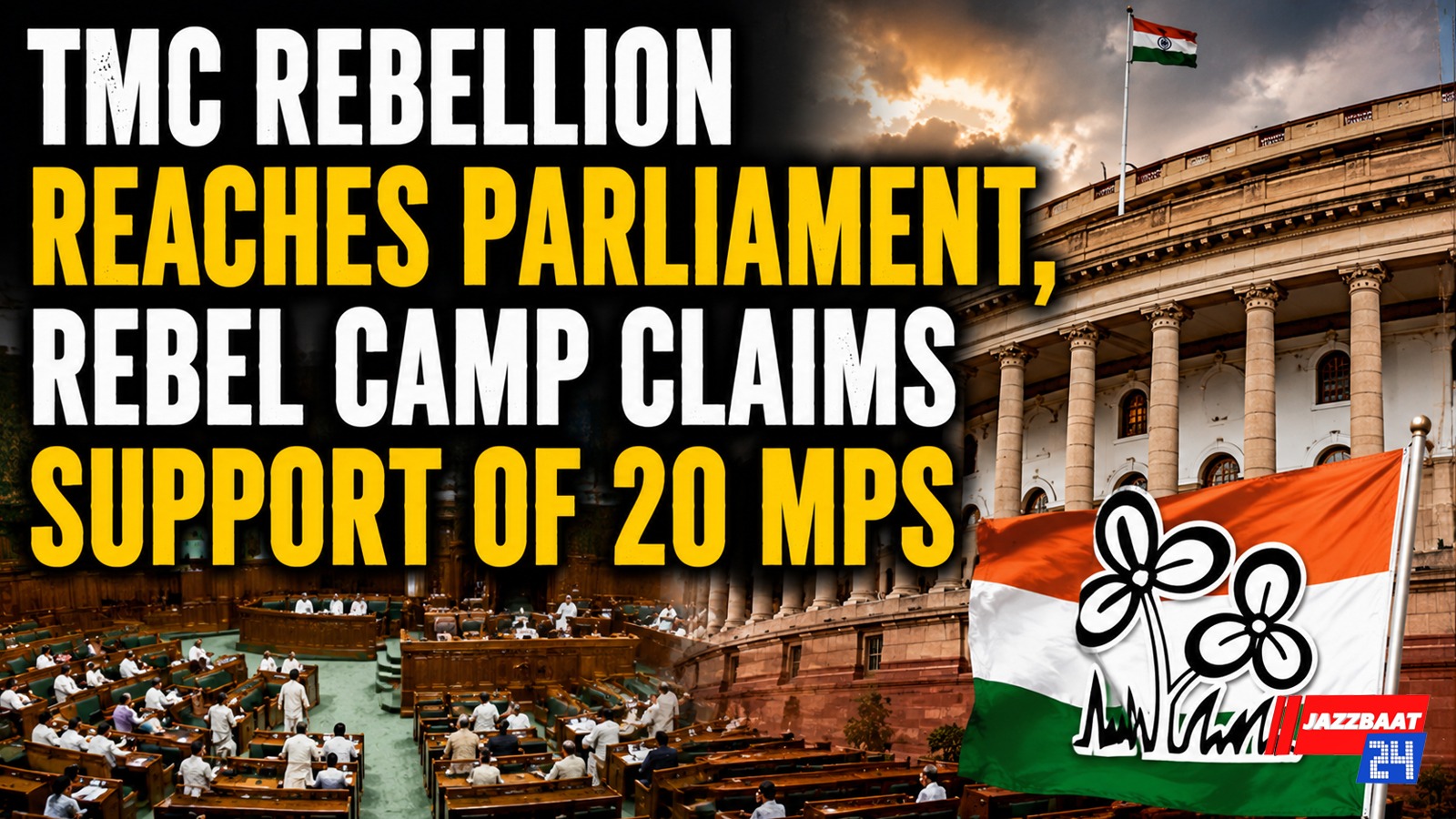
The political crisis within the Trinamool Congress (TMC) has deepened dramatically, with the rebellion that began in the West Bengal Assembly now spilling over into Parliament. A group of dissident TMC MPs has claimed the support of 20 Lok Sabha members and formally approached Lok Sabha Speaker Om Birla seeking recognition as a separate parliamentary bloc aligned with the BJP-led National Democratic Alliance (NDA).
The move is being led by Kakoli Ghosh Dastidar, a four-time Lok Sabha MP, who stated that nearly 20 TMC MPs have decided to support the NDA while not immediately joining the BJP. According to her, a letter carrying the signatures of the dissident MPs has already been submitted to the Speaker, and the group has sought separate seating arrangements in Parliament.
The development comes at a crucial time, with TMC chief Mamata Banerjee and party national general secretary Abhishek Banerjee in Delhi for an INDIA bloc meeting. Political observers view the rebellion as the biggest internal crisis faced by the party since its formation nearly three decades ago.
The numbers are significant because the TMC currently has 28 Lok Sabha MPs. If 20 MPs remain united, the rebel camp would cross the two-thirds threshold often cited in anti-defection discussions, potentially strengthening its legal position. However, TMC leaders have disputed both the numbers and the rebels' interpretation of parliamentary rules. Party leaders maintain that official changes in the parliamentary leadership, including the replacement of Kakoli Ghosh Dastidar as chief whip, were already communicated to the Speaker's office.
The crisis follows a major split in the West Bengal Assembly, where dozens of MLAs broke away from the party leadership. Rebel MLA leader Ritabrata Banerjee described the parliamentary revolt as a natural extension of the Assembly rebellion and claimed that dissatisfaction within the party continues to grow.
Adding to the pressure on the TMC leadership, senior Rajya Sabha MP Sukhendu Sekhar Roy resigned from both the party and the Upper House, citing governance concerns and accepting what he described as the people's verdict. His resignation has further fueled speculation that more leaders could distance themselves from the party in the coming days.
While the rebel MPs insist they are acting in the interest of West Bengal's development and the public mandate, TMC loyalists have strongly criticized the move, accusing the dissidents of betraying the mandate on which they were elected. With legal, political, and parliamentary battles now looming, the coming days are expected to determine whether the rebellion evolves into a formal split or remains an internal power struggle within one of India's largest regional parties.