
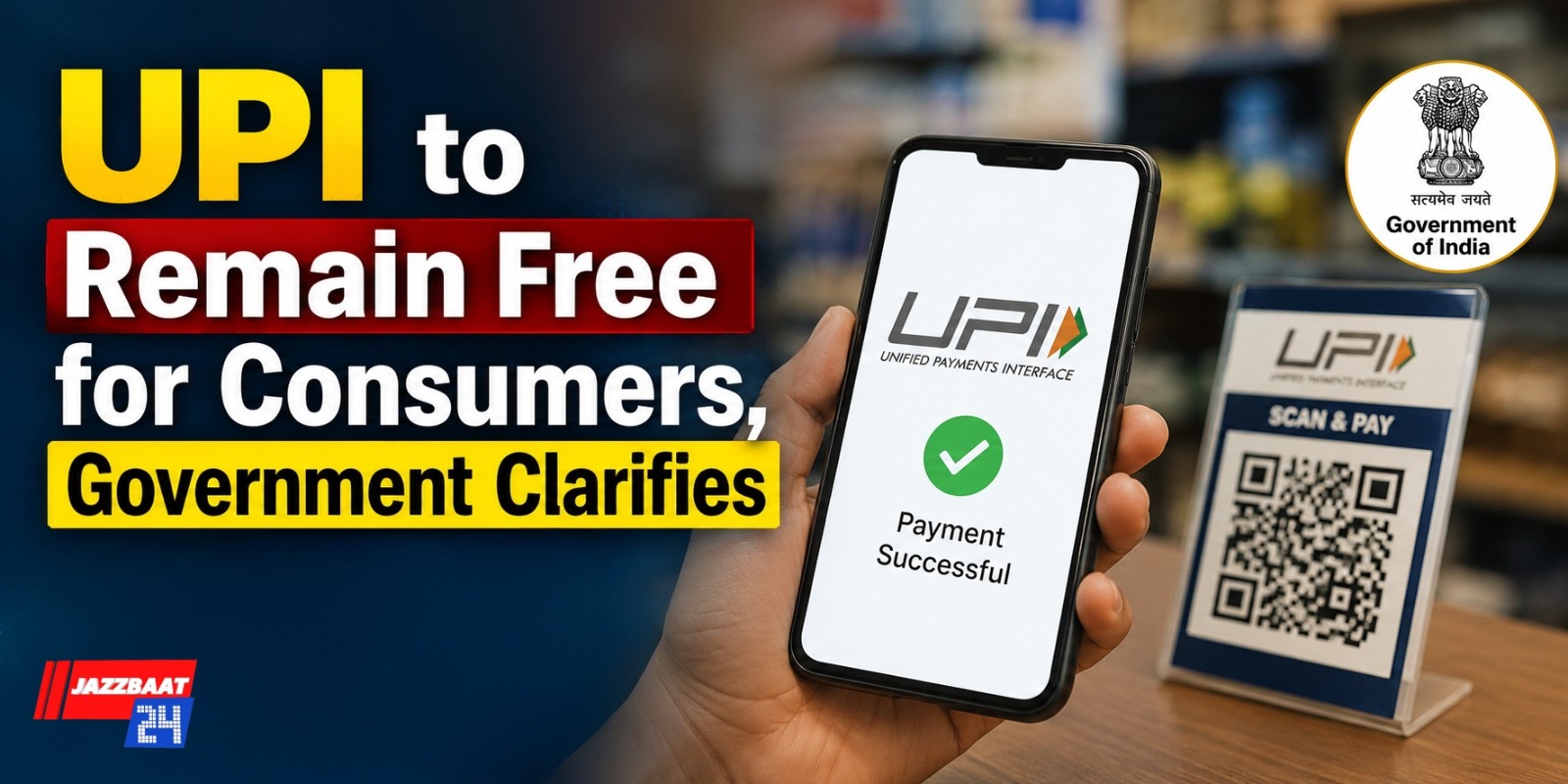
The government has moved to clear the confusion surrounding possible charges on Unified Payments Interface (UPI) transactions, saying consumers will continue to be able to make UPI payments without paying a transaction fee.
The clarification comes after recent discussions around the possibility of introducing a Merchant Discount Rate (MDR) on certain UPI transactions triggered concerns that ordinary users could soon have to pay for digital payments.
According to the government, there is no proposal to impose a charge directly on consumers for using UPI. Person-to-person payments will continue to remain free, while the vast majority of merchant transactions are also expected to remain outside any proposed fee structure.
The issue came into focus after Parliament passed an amendment to the Payment and Settlement Systems Act, 2007. The amendment provides a legal framework that could allow banks and payment-system participants to recover costs from certain merchant transactions. This led to speculation on social media and elsewhere that the government was preparing to make UPI payments chargeable.
Officials have sought to distinguish between a fee paid by merchants and a charge imposed on consumers. A possible MDR would be levied on selected merchant transactions rather than being added to a customer's UPI payment at the time of checkout. The government has indicated that any such mechanism, if introduced, would be limited and designed to support the long-term sustainability of the digital payments ecosystem.
The Payments Council of India has also reiterated that consumers and small merchants will continue to benefit from free UPI transactions. The clarification is particularly significant because UPI has become one of India's most widely used payment systems, handling billions of transactions every month.
Government data shows that nearly 55.49 crore users were onboarded on the UPI platform by June 2026. During the financial year 2025-26, UPI processed around 24,162 crore transactions, highlighting the enormous scale of the country's digital-payment network.
The government has repeatedly stressed the importance of keeping digital payments accessible. UPI's zero-cost model has played a major role in its rapid adoption across urban and rural India, allowing users to make instant bank-to-bank payments through smartphones without paying a separate transaction fee.
The latest clarification therefore means that consumers should not expect a new UPI service charge simply because of the recent legislative changes. Any future MDR arrangement would primarily concern the relationship between banks, payment service providers and eligible merchants.
the message from the government is clear, UPI payments will remain free for consumers, while discussions over limited merchant-side charges are aimed at addressing the costs of maintaining and expanding India's rapidly growing digital-payment infrastructure.