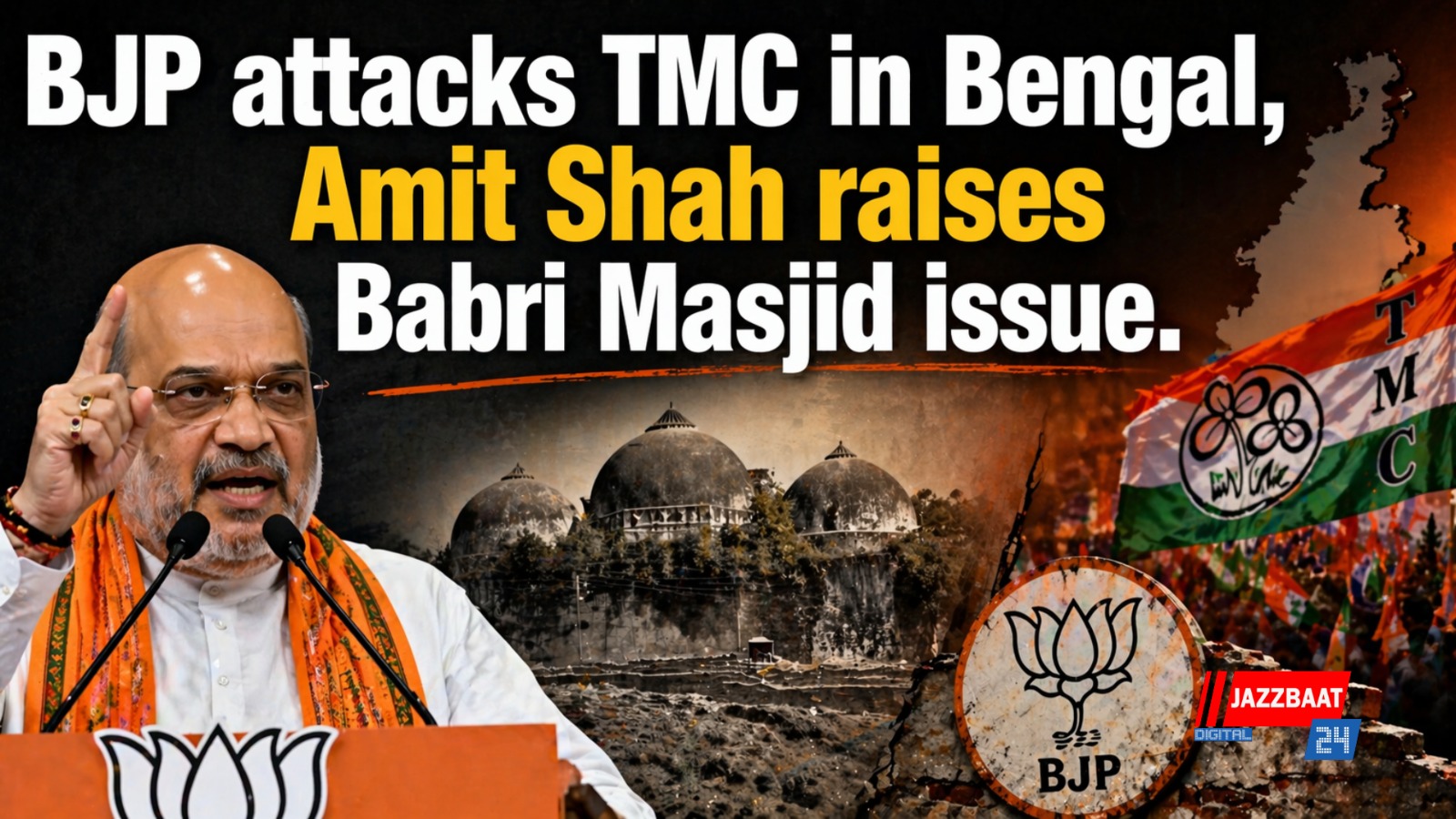
Senior BJP leader Amit Shah on Wednesday launched a sharp attack on West Bengal’s ruling party, asserting that the BJP would not allow any attempt to build a “Babri Masjid” in the state. Addressing a public rally amid the ongoing election atmosphere, Shah accused the Trinamool Congress (TMC) of appeasement politics and claimed that such issues were being used to polarise voters.
Without citing any specific proposal, Shah alleged that the TMC was encouraging divisive agendas for electoral gains. He said the BJP stands firmly for cultural and religious heritage, and warned that the party would strongly oppose any move that, in its view, threatens that identity.
Taking his criticism further, Shah accused the Trinamool Congress government of running a “syndicate raj” across the state. According to him, ordinary citizens, small businesses, and even government projects are being forced to operate under alleged syndicate control, where local groups linked to the ruling party dictate terms and extract money.
He claimed that corruption and lawlessness have become widespread under Chief Minister Mamata Banerjee, alleging that governance has weakened and that political patronage is shielding illegal activities. Shah also promised that if voted to power, the BJP would dismantle the alleged syndicate system and restore transparency.
The remarks come at a time when political rhetoric in West Bengal has intensified ahead of crucial elections. Leaders from both the BJP and TMC have been trading strong accusations, with issues of governance, corruption, and identity politics dominating campaign speeches.
The TMC, however, has repeatedly denied allegations of “syndicate raj” and accused the BJP of attempting to polarise voters through communal statements. Party leaders have maintained that development, welfare schemes, and social harmony remain their core focus.
Political observers note that statements like Shah’s are aimed at consolidating the BJP’s support base, particularly by invoking sensitive historical and religious references such as the Babri Masjid demolition, which continues to influence political discourse in India.
As campaigning gathers momentum, such sharp exchanges are expected to continue, shaping the narrative in one of the country’s most closely watched political battlegrounds.