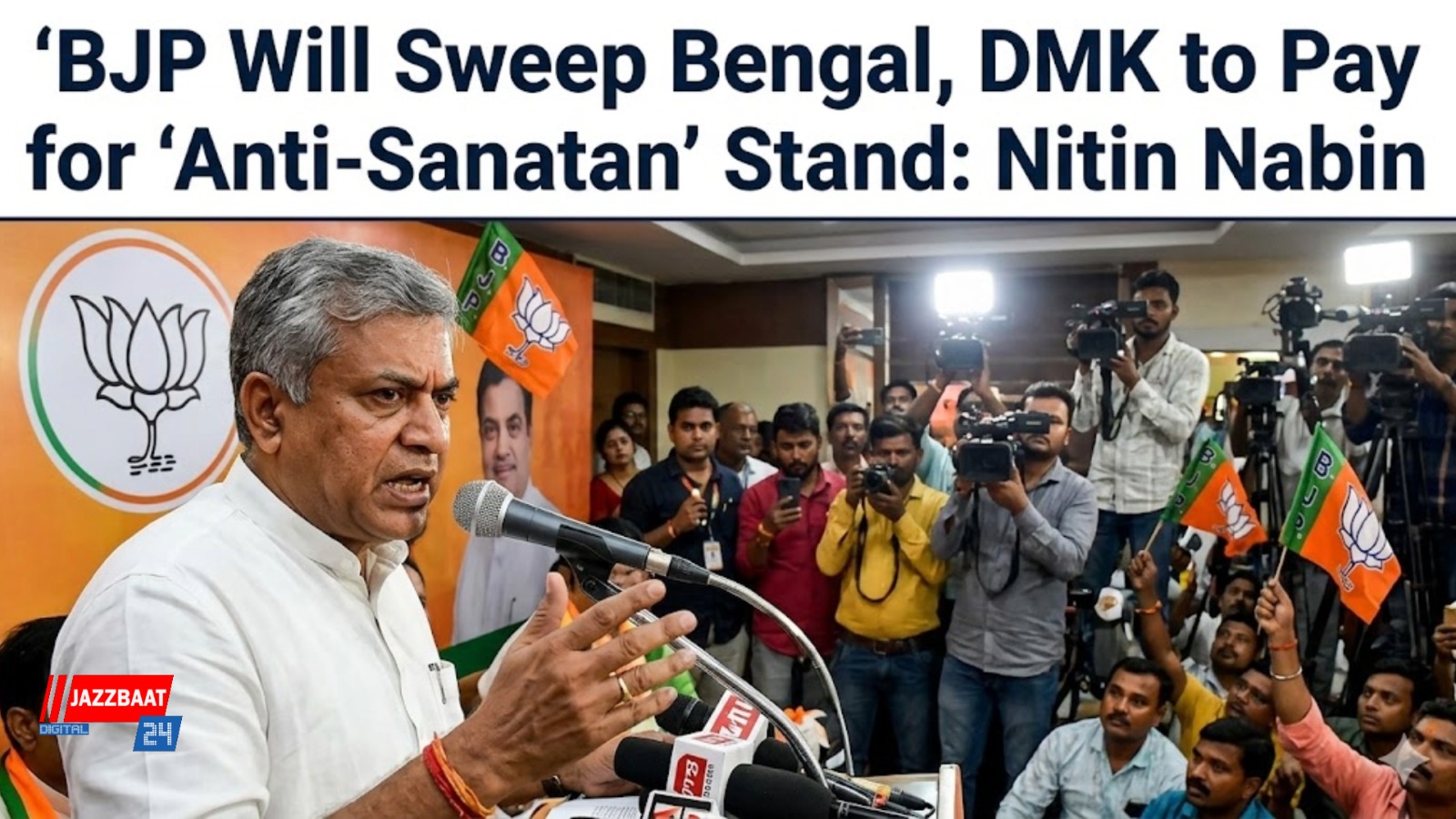
Senior Bharatiya Janata Party (BJP) leader Nitin Nabin on Thursday asserted that the party is set for a sweeping victory in the ongoing West Bengal Assembly elections, while also launching a sharp attack on the ruling Dravida Munnetra Kazhagam (DMK) in Tamil Nadu over its alleged “anti-Sanatan” stance.
Addressing party workers and the media, Nabin said that the high voter turnout across West Bengal reflects a strong desire for political change. He claimed that people are “voting against corruption, violence, and misgovernance,” and expressed confidence that the BJP will secure a decisive mandate in the state.
Taking aim at the ruling All India Trinamool Congress (TMC), he alleged that the state has witnessed deterioration in law and order and that voters are determined to bring an end to what he described as “years of misrule.” He added that BJP’s campaign, focused on development and governance, has resonated with the electorate across regions.
Shifting focus to southern politics, Nabin also criticized the Dravida Munnetra Kazhagam (DMK) government in Tamil Nadu, accusing it of promoting an “anti-Sanatan” ideology. He claimed that such a stance has hurt religious sentiments and warned that the people of Tamil Nadu would respond politically.
“The DMK will have to pay the price for its mindset against Sanatan values,” he said, adding that the BJP is expanding its base in Tamil Nadu by connecting with people on cultural and development issues.
The remarks come amid heightened political rhetoric as elections continue in both West Bengal and Tamil Nadu. BJP leaders have been aggressively campaigning in Bengal, projecting confidence of forming the government, while also targeting opposition parties in other states.
The TMC dismissed the BJP’s claims of a “sweep,” stating that the party is relying on rhetoric rather than ground realities. Leaders of the ruling party have maintained that their welfare schemes and governance record will ensure victory.
Meanwhile, the DMK also hit back, accusing the BJP of attempting to polarize voters by raising religious issues. Party leaders said Tamil Nadu’s electorate has consistently rejected such narratives and would continue to do so.
Political observers note that such statements reflect the intensifying campaign battle, with parties seeking to mobilize voters through a mix of development promises, cultural narratives, and sharp criticism of opponents as the elections progress.