
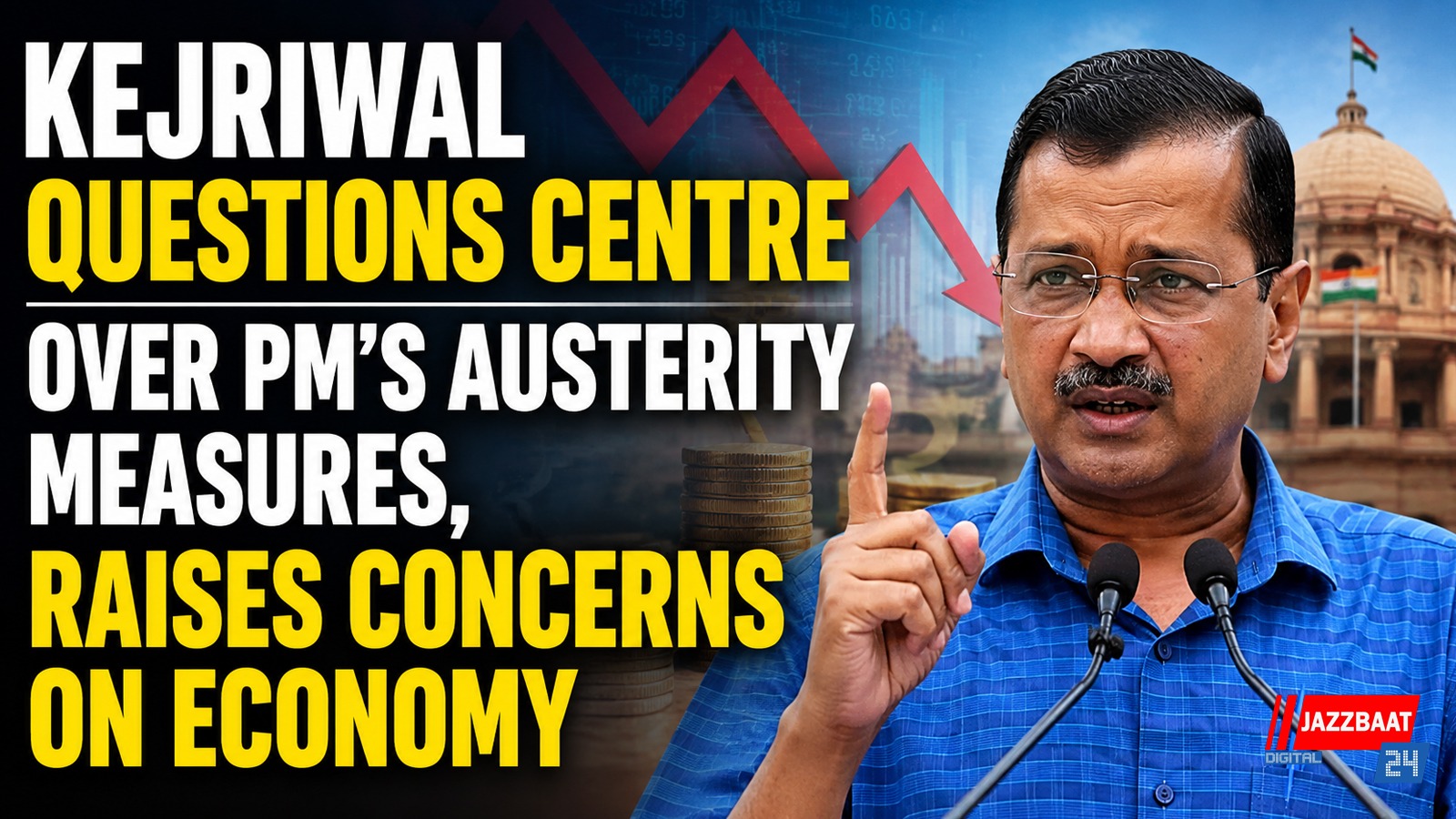
Arvind Kejriwal on Monday questioned the Centre over the reported austerity measures introduced by the Prime Minister’s Office, saying the steps appeared unusually stringent and that people deserved to know the true condition of the country’s economy.
Reacting to reports regarding expenditure control and cost-cutting directives within government departments, Kejriwal said such strict austerity measures generally indicate financial stress and economic concerns. He alleged that the government should clearly explain why these decisions were being taken and whether the country’s economic situation was worse than being publicly projected.
“The people of the country have the right to know the actual condition of the economy,” the Aam Aadmi Party leader said while criticising the Centre’s handling of economic issues. He claimed that if the economy was performing strongly, there would be no need for what he described as “the most stringent austerity measures.”
Kejriwal also accused the government of focusing more on publicity and image management while ordinary citizens continued to struggle with inflation, unemployment and rising living costs. He alleged that economic pressure was being felt across different sectors despite official claims of rapid growth.
The remarks came amid discussions over government instructions aimed at reducing non-essential expenditure, controlling official spending and ensuring financial discipline across departments. Such measures are often adopted by governments to manage fiscal pressures and prioritise spending in key sectors.
However, the Centre has maintained that expenditure rationalisation and financial discipline are standard administrative practices and do not necessarily indicate an economic crisis. Government officials have repeatedly highlighted India’s GDP growth figures, infrastructure expansion and increasing global investment as signs of economic strength.
Political reactions to the issue quickly intensified, with Opposition parties attempting to link austerity measures to broader concerns over economic management. Several Opposition leaders claimed that the government should provide greater transparency regarding fiscal challenges and public debt.
Meanwhile, BJP leaders defended the Centre’s economic policies and accused Opposition parties of spreading unnecessary fear about the economy. They argued that India remains one of the fastest-growing major economies in the world and that responsible expenditure management is a normal governance practice.
Economists noted that governments often introduce cost-control measures to maintain fiscal balance, especially amid global economic uncertainty and rising expenditure demands. However, they also observed that public perception can become sensitive when austerity steps are introduced during periods of inflation and employment concerns.
Kejriwal’s comments have added a political dimension to the debate over economic management, with the issue likely to remain part of the broader confrontation between the Opposition and the Centre in the coming weeks.