
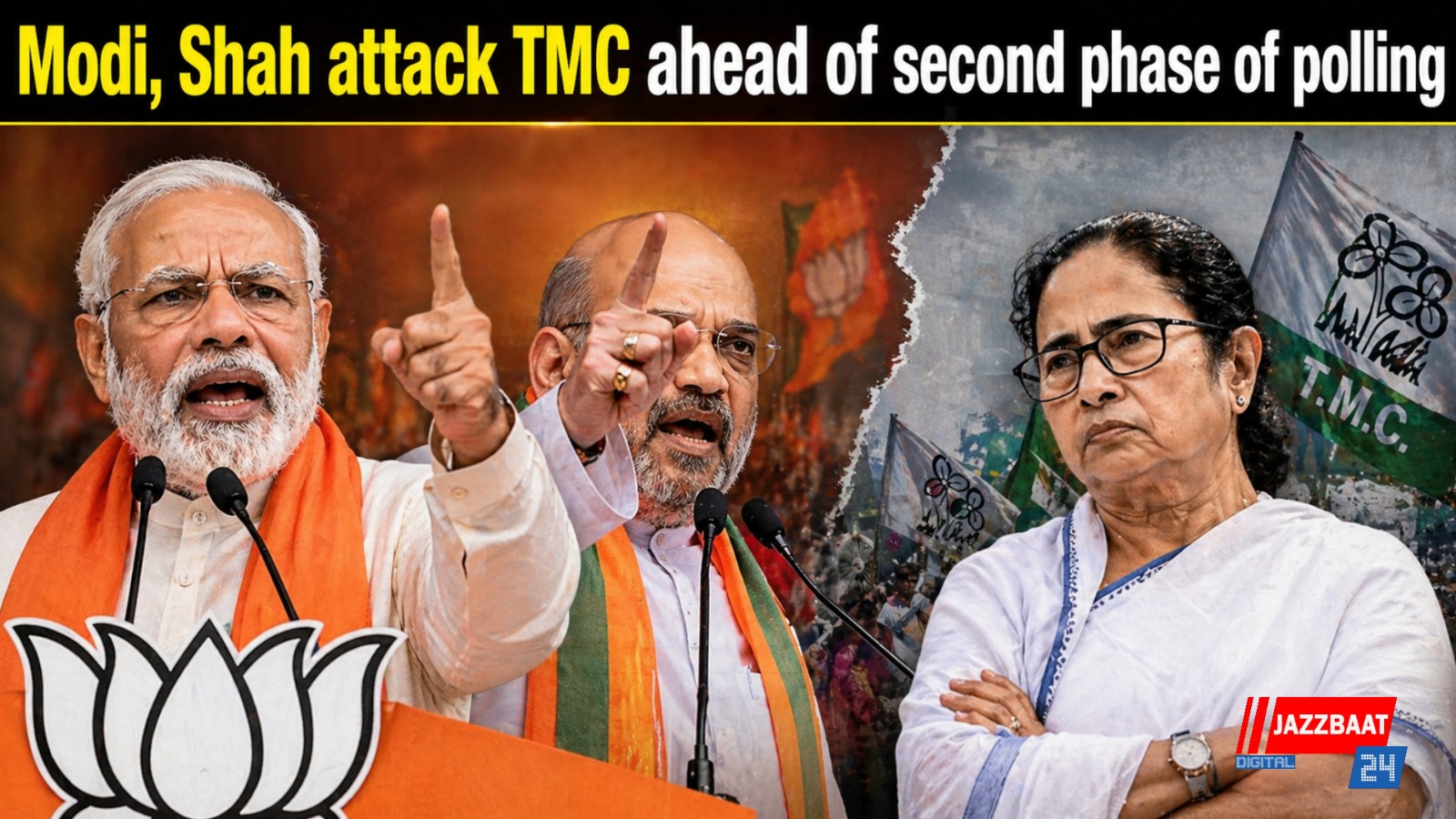
Prime Minister Narendra Modi and Union Home Minister Amit Shah on Sunday launched sharp criticism against the Trinamool Congress (TMC) as campaigning intensified ahead of the second phase of voting in the ongoing West Bengal Assembly elections.
Addressing public meetings and through campaign messages, both leaders targeted the ruling party in the state over issues of governance, law and order, and alleged corruption. They urged voters to support change, arguing that West Bengal needed a “new direction” for development and stability.
Prime Minister Narendra Modi said that the people of West Bengal were looking for better governance and opportunities, and accused the TMC leadership of failing to deliver on promises. He also raised concerns over what he described as “politics of violence and intimidation” in the state, claiming that democracy must function without fear.
Union Home Minister Amit Shah, in his campaign remarks, also intensified the attack on the ruling party. He alleged that the TMC had not allowed central welfare schemes to fully reach beneficiaries and accused the state administration of obstructing development initiatives. Shah urged voters to participate in large numbers and ensure what he called a “corruption-free and violence-free government.”
The TMC, however, strongly rejected the allegations and accused the BJP leadership of making misleading statements to influence voters. Party leaders said that the state government had implemented several welfare schemes and that West Bengal had witnessed steady progress in areas like health, education, and rural development.
As campaigning heats up, the second phase of polling has become a high-stakes political contest, with major national and regional leaders actively participating in rallies and outreach programs. Security has also been tightened in several constituencies where voting is scheduled, with election officials focusing on maintaining peace and order.
Political observers note that the exchange of sharp political attacks has further intensified the electoral atmosphere in the state. Issues such as employment, public welfare schemes, infrastructure development, and law and order continue to dominate campaign narratives.
The second phase of voting is expected to play a crucial role in shaping the momentum of the election. With both the ruling party and opposition making strong claims, voters are set to decide the direction of the contest in one of the most closely watched state elections in the country.