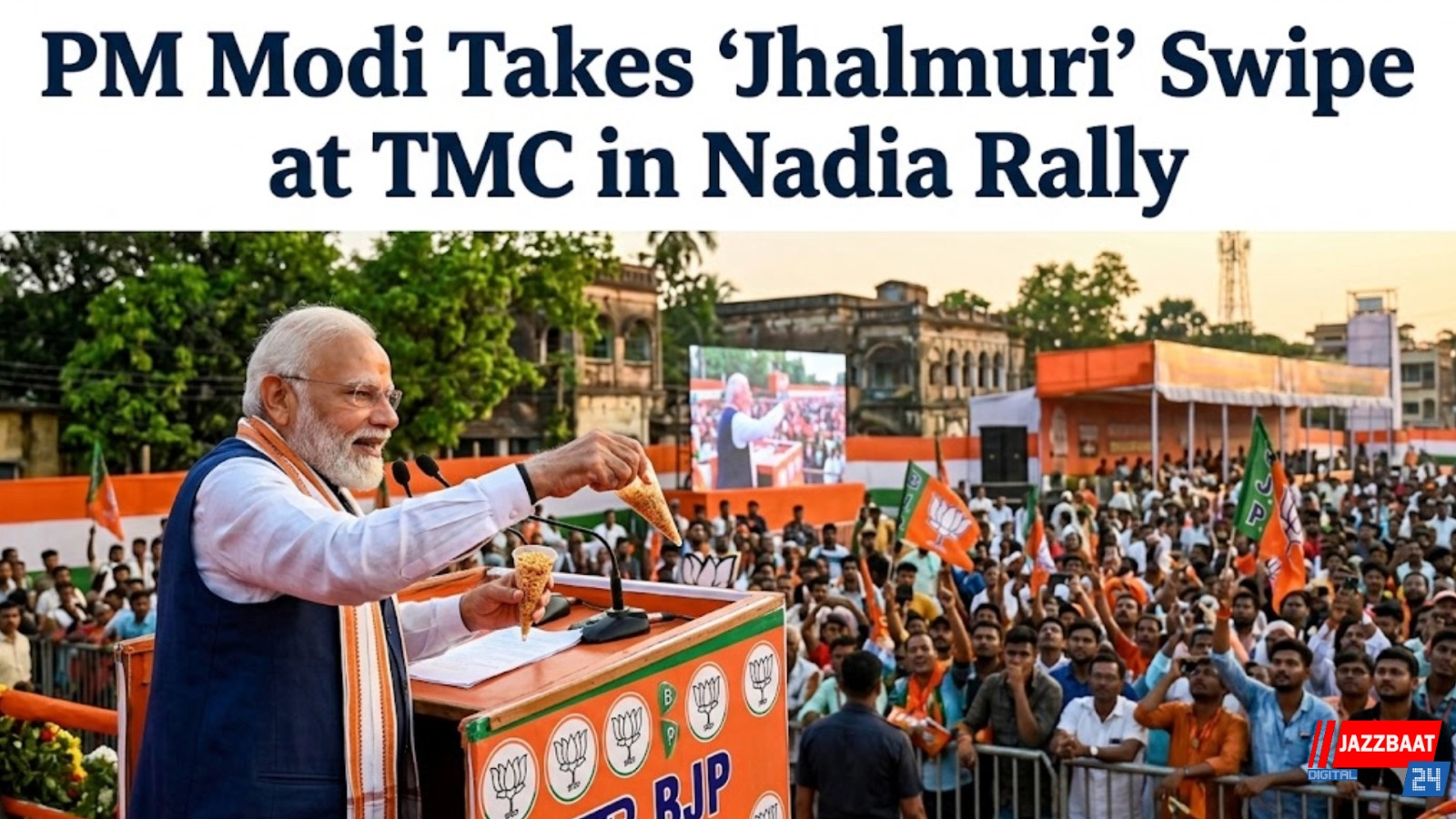
Prime Minister Narendra Modi on Thursday launched a sharp attack on the ruling All India Trinamool Congress (TMC) during a public rally in Nadia district, using a ‘jhalmuri’ analogy to criticize the party’s governance and political approach.
Addressing a large gathering, Modi accused the TMC of mixing corruption, appeasement, and misgovernance “like ingredients in jhalmuri,” a popular Bengali street snack. The remark drew loud reactions from the crowd, as the Prime Minister used the metaphor to suggest that the state government’s policies are a “mixture of problems” affecting common people.
Without naming individuals directly, Modi alleged that the ruling party thrives on “cut money culture,” lawlessness, and political violence. He claimed that the people of West Bengal are tired of what he described as “syndicate raj” and are looking for change in the ongoing Assembly elections.
The Prime Minister also highlighted central government schemes, asserting that the benefits meant for citizens are often obstructed at the state level. He urged voters to support the Bharatiya Janata Party (BJP), promising development, transparency, and better governance if the party is given a mandate in the state.
The TMC, led by Chief Minister Mamata Banerjee, hit back at the remarks, accusing the Prime Minister of making “insulting and superficial comments” about Bengal’s culture. Party leaders said that using ‘jhalmuri’ a beloved local food as a political jibe reflects a lack of understanding and respect for the state’s traditions.
They also countered BJP’s allegations by highlighting the state government’s welfare schemes and development initiatives, claiming that the people of Bengal would respond through their votes.
The rally in Nadia is part of Modi’s aggressive campaign push in West Bengal, where the BJP and TMC are locked in a high-stakes electoral battle. Political rhetoric has intensified in recent days, with both sides trading sharp barbs as polling progresses across phases.
As campaigning heats up, such symbolic remarks are increasingly being used to connect with voters emotionally while targeting opponents, underlining the fierce contest shaping the state’s political landscape.