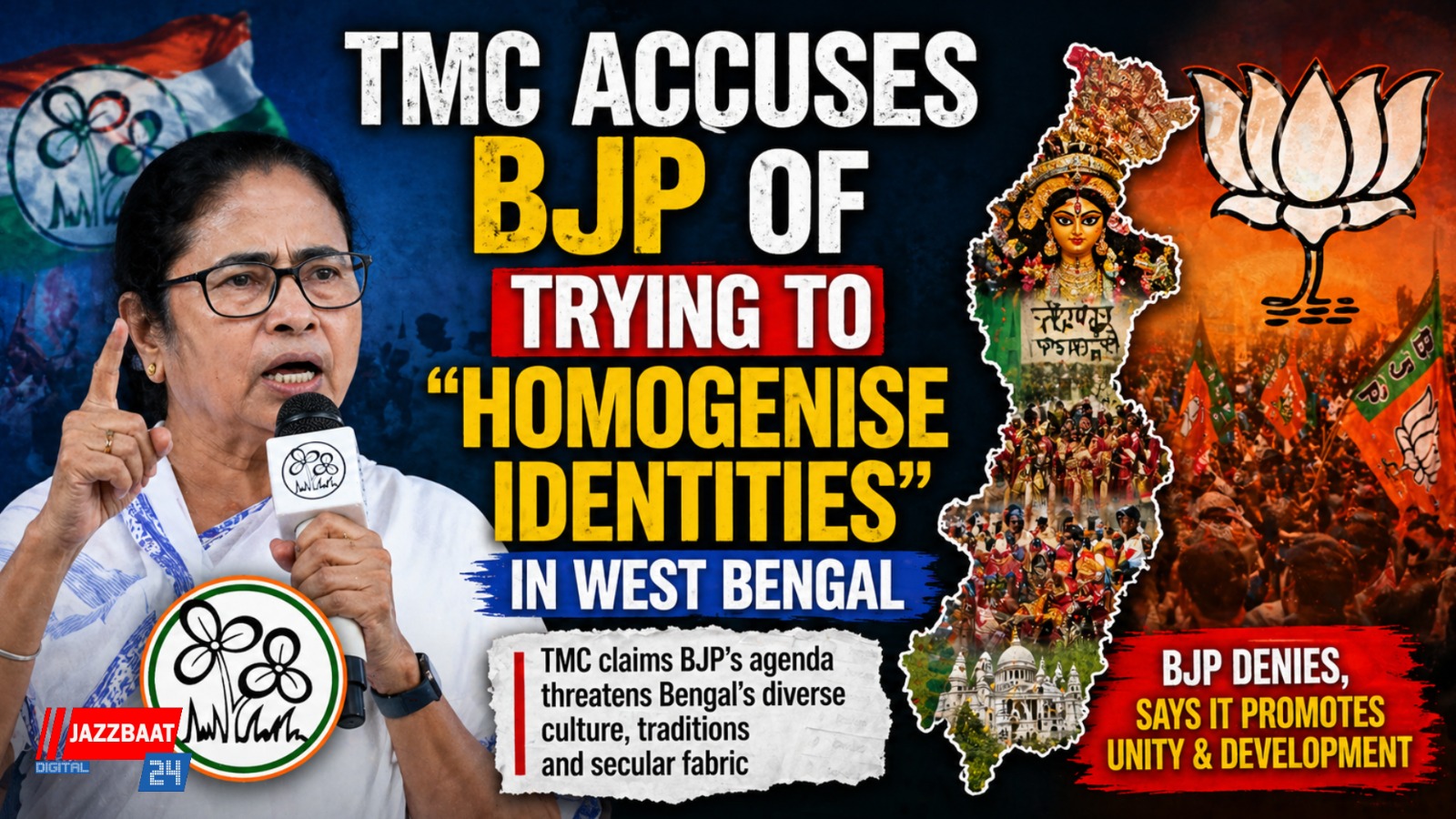
The political battle in West Bengal has intensified once again after the Trinamool Congress (TMC) launched a sharp attack on the Bharatiya Janata Party (BJP), alleging that the party aims to “dismantle West Bengal” and “homogenise identities” across the state. The remarks have added fresh heat to an already charged political atmosphere ahead of key electoral developments.
Speaking at a public event, leaders of the All India Trinamool Congress claimed that the BJP’s political approach in the state is not just about governance or development, but about reshaping the cultural and social identity of West Bengal. According to the party, such an approach undermines the region’s diversity, language traditions, and historical pluralism.
TMC leaders argued that West Bengal has always been known for its cultural richness, shaped by literature, art, music, and linguistic diversity. They alleged that attempts to impose a uniform identity would weaken this distinct character. “West Bengal is not just a geographical region; it is an identity built over centuries,” a senior party leader said during the address.
The criticism was directly aimed at the Bharatiya Janata Party, which the TMC accused of pushing what it described as an “ideological agenda” that does not reflect the socio-cultural reality of the state. The ruling party also claimed that such political narratives could deepen divisions among communities.
The BJP, however, has repeatedly rejected such allegations in the past, maintaining that its focus in West Bengal is on development, governance reforms, and ending what it describes as “corruption and misrule.” Party representatives argue that their policies are aimed at national integration and equal development across states, not cultural suppression.
Political analysts note that identity politics has become a central theme in West Bengal’s electoral discourse in recent years. Language, culture, and regional pride have often featured prominently in campaign speeches, with both major parties attempting to connect with voters on emotional and cultural grounds.
Observers also point out that such statements are likely to further polarize the political environment as parties intensify campaigning. With elections approaching, both TMC and BJP are expected to continue framing narratives that highlight ideological differences as well as governance records.
For now, the exchange of allegations reflects the deepening political rivalry in the state, where questions of identity, development, and governance remain closely intertwined in public debate.