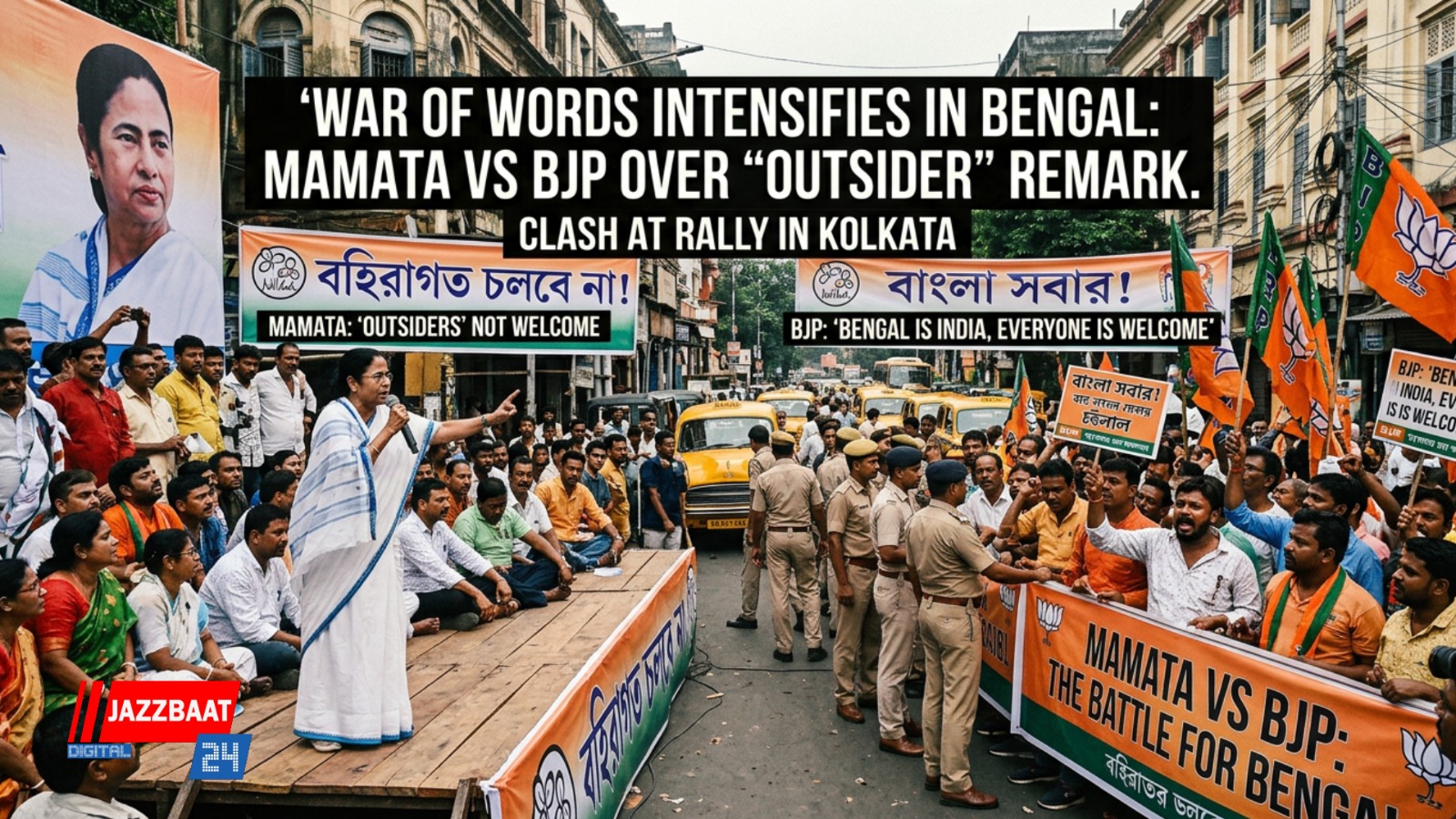
Kolkata: The political battle in West Bengal sharpened further on Friday as Chief Minister Mamata Banerjee launched a strong attack on the Bharatiya Janata Party (BJP), asserting that “Bengal will not be run by outsiders.” Her remarks triggered an immediate response from Union Home Minister Amit Shah, escalating the war of words ahead of the ongoing Assembly elections.
Addressing a public rally, Banerjee accused the BJP of attempting to impose external leadership on the state, framing the contest as a fight to protect Bengal’s identity, culture and autonomy. She urged voters to reject what she described as “outsider control” and instead support a government rooted in the state’s own socio-political fabric. Her campaign has increasingly emphasized regional pride and linguistic identity as key electoral themes.
Reacting sharply, Shah rejected the “outsider” label and said that every Indian has the right to work and participate politically in any part of the country. He accused the ruling Trinamool Congress (TMC) of trying to divide people for electoral gain and argued that the BJP represents a national vision that includes Bengal. Shah further claimed that the people of the state are looking for change and are not swayed by such rhetoric.
The exchange highlights a broader ideological clash between regional identity politics and the BJP’s pan-India narrative. While Banerjee has positioned herself as a defender of Bengali pride, the BJP leadership has countered by emphasizing national unity and development. The “outsider vs insider” debate has become a central talking point in the campaign, with both sides attempting to consolidate their respective voter bases.
Political observers note that such rhetoric could significantly influence voter sentiment, especially in rural and semi-urban constituencies where identity politics often plays a crucial role. The issue also ties into larger questions about federalism and the balance between regional autonomy and national integration.
With multiple phases of polling still underway, the sharp exchanges between Banerjee and Shah indicate that the campaign is entering a more aggressive phase. As both camps intensify their messaging, the outcome of the election is likely to hinge not only on governance issues but also on how effectively each side shapes the narrative around identity, belonging and political legitimacy in Bengal.