

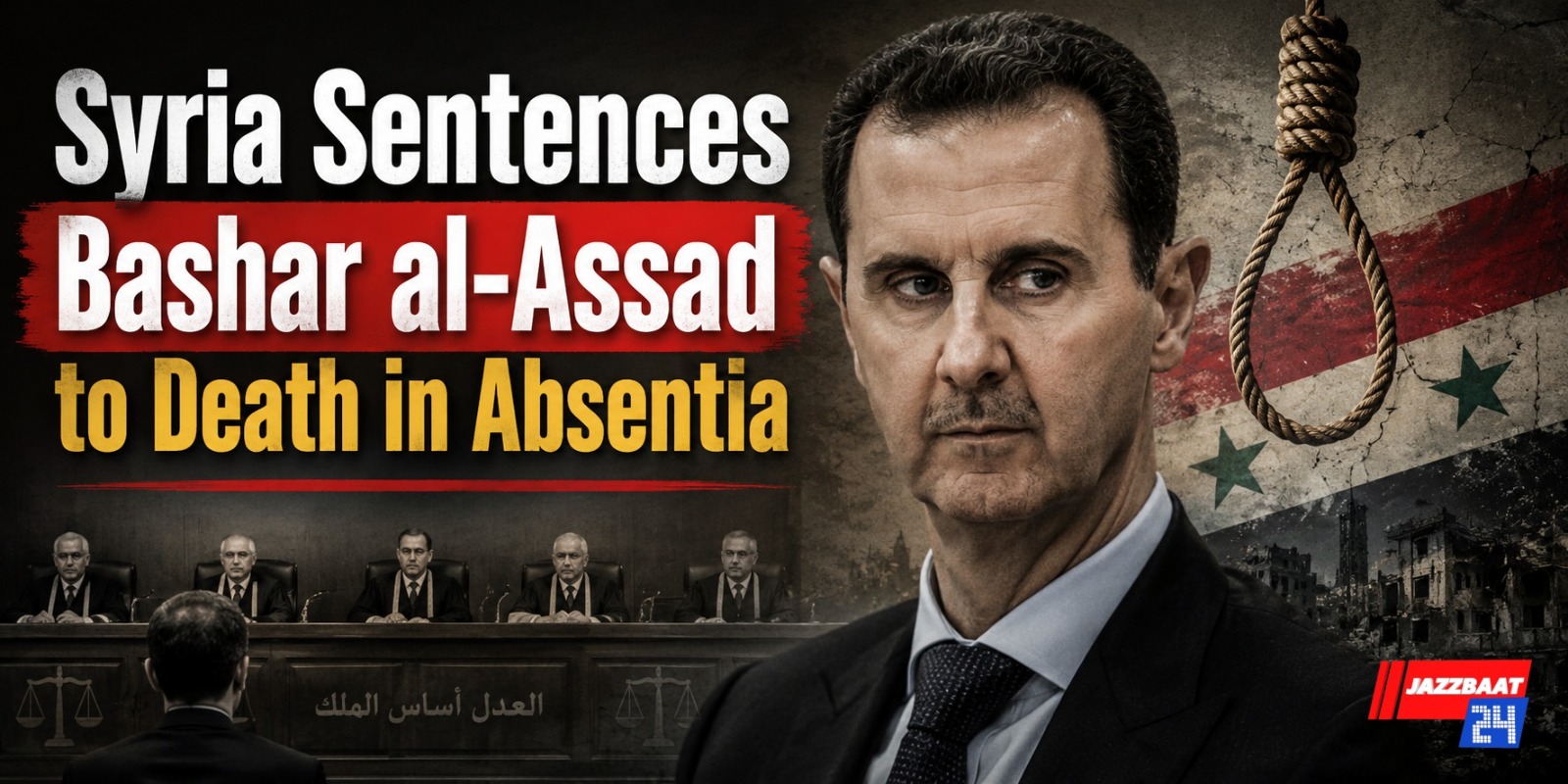
A Syrian court on Tuesday sentenced former President Bashar al-Assad to death in absentia, finding him responsible for crimes against humanity and war crimes committed during the country’s 14-year civil war. The landmark ruling comes nearly two years after Assad was removed from power and fled to Russia.
The Damascus court also handed death sentences to Assad’s younger brother, Maher al-Assad, and his cousin Atef Najib. The three were tried in their absence as they remain outside Syria. Assad and Maher are understood to be living in Russia, which has so far refused requests to extradite the former Syrian leaders.
According to reports, the court found Assad responsible for a series of grave abuses carried out during his government’s crackdown on opposition that began in 2011. The charges included premeditated murder, torture, arbitrary detention and other acts classified as crimes against humanity.
Najib, a former security official in the southern province of Daraa, was separately accused of involvement in the violent treatment of young protesters. The detention and torture of boys in Daraa, who had written anti-government graffiti in 2011, became one of the incidents that helped trigger the uprising against Assad’s rule.
The Syrian conflict that followed became one of the most devastating wars of the 21st century. Hundreds of thousands of people were killed, millions were displaced and large parts of the country were destroyed. Assad’s government was repeatedly accused by international investigators and rights groups of widespread torture, enforced disappearances, arbitrary arrests and attacks on civilians.
Assad ruled Syria for nearly 24 years after taking over from his father, Hafez al-Assad, in 2000. His government survived years of armed conflict with support from Russia and Iran, but ultimately collapsed in December 2024 after rebel forces rapidly advanced and captured Damascus. Assad subsequently left Syria and was granted refuge in Russia.
The death sentence is largely symbolic for now because Assad is outside Syrian custody. Under Syrian legal procedures, an in-absentia judgment can also be subject to a retrial if the convicted person is arrested or voluntarily appears before the court.
The ruling is nevertheless being presented by Syria’s transitional authorities as a major step toward holding senior figures of the former regime accountable. It also places renewed focus on the difficult process of transitional justice as Syria attempts to deal with the legacy of years of war, repression and mass displacement.