
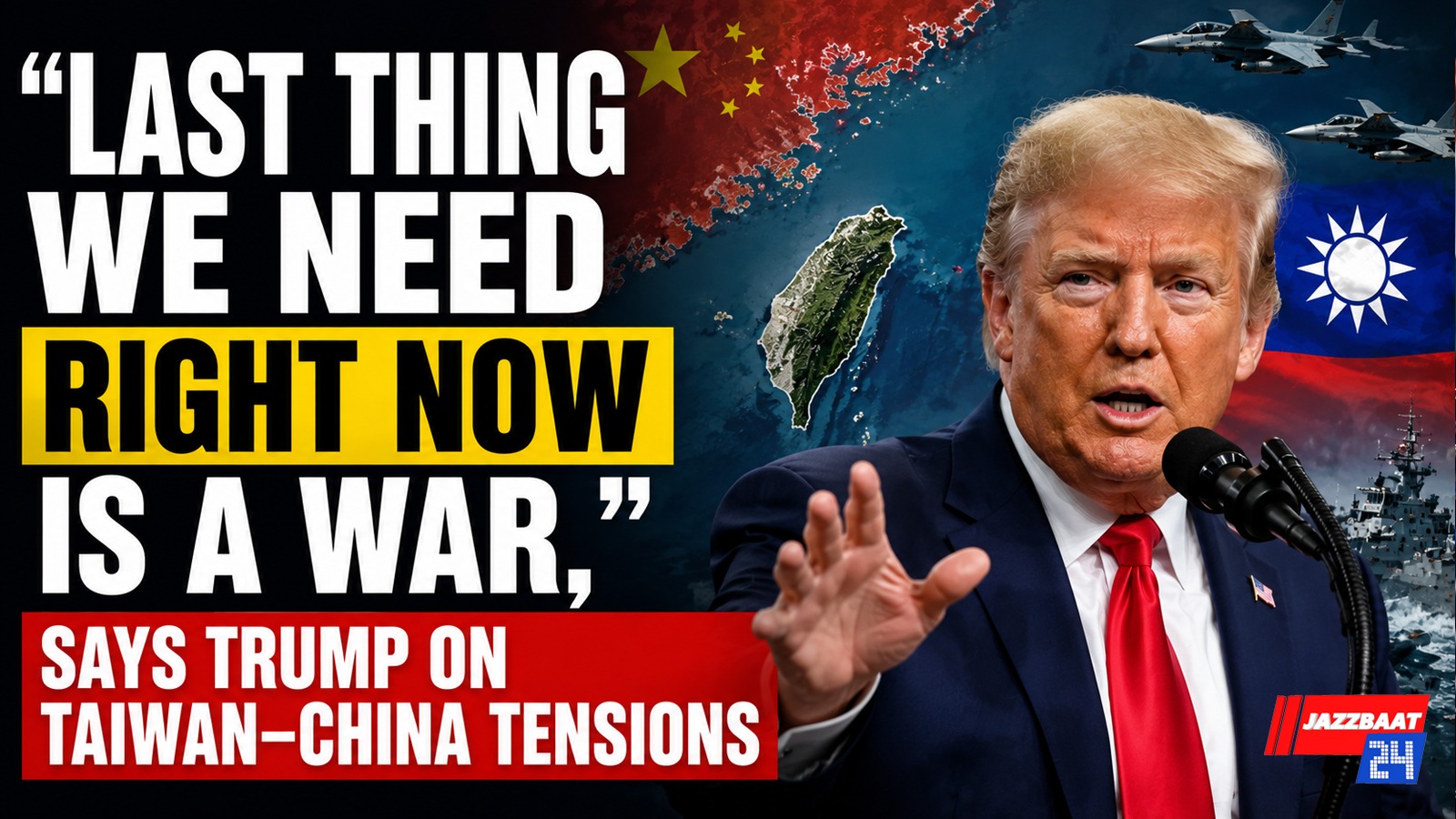
Former US President Donald Trump has commented on the rising tensions between China and Taiwan, saying that the world does not need another war at this time. His remarks come amid growing geopolitical concerns in the Indo-Pacific region over military activity and political strain between Beijing and Taipei.
Speaking during a recent public interaction, Trump stressed the importance of avoiding escalation and urged restraint from all sides. He said that global stability is already under pressure due to multiple ongoing conflicts, and a new war in the Taiwan Strait would have serious consequences for international peace and the global economy.
Trump’s comments focused on the need for diplomacy and dialogue, suggesting that major powers should prioritise negotiation over confrontation. He warned that any military conflict involving China and Taiwan could disrupt global trade, technology supply chains, and energy markets, affecting countries far beyond the region.
The Taiwan issue remains one of the most sensitive geopolitical flashpoints, with China considering the island a part of its territory, while Taiwan maintains its own government and democratic system. The United States has historically maintained a policy of strategic ambiguity while continuing to provide defensive support to Taiwan, which often leads to diplomatic friction with Beijing.
Trump also indicated that strong leadership and communication are essential to prevent misunderstandings from turning into open conflict. He said that while national interests must be protected, war should always be the last option in international disputes.
His remarks have drawn attention in global political circles, especially at a time when tensions in the region have seen periodic military drills, airspace incursions, and naval deployments by major powers. Analysts believe such statements reflect growing concerns within the US political establishment about avoiding another large-scale conflict.
China has repeatedly warned against foreign interference in what it considers internal matters related to Taiwan, while Taiwan continues to seek international support to maintain its autonomy and security.
The comments add to ongoing discussions in global diplomacy about how to manage rising tensions in the Indo-Pacific without triggering direct confrontation between major powers.