

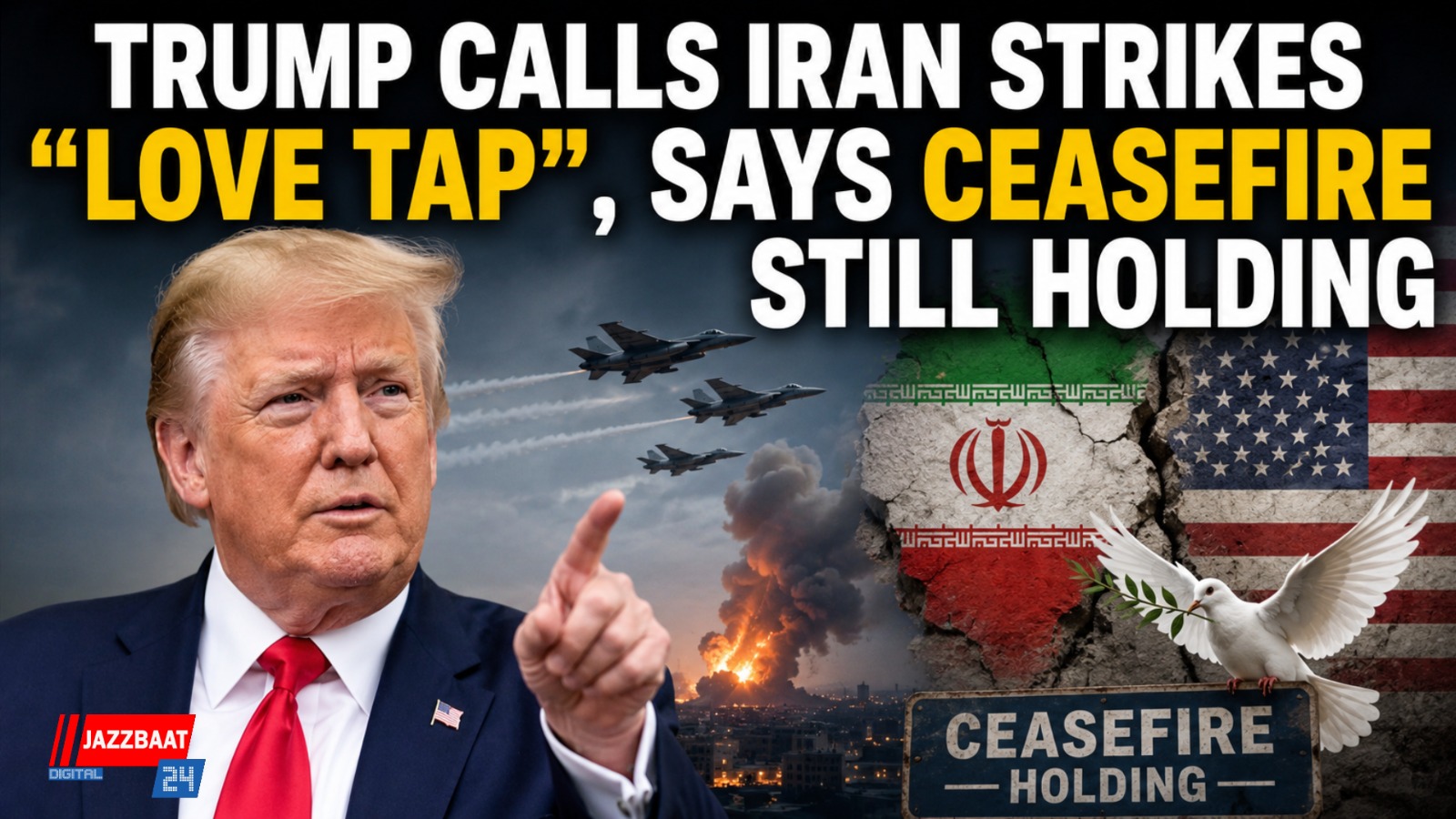
US President Donald Trump has downplayed the latest military exchange with Iran, describing recent American strikes as “just a love tap” while insisting that the ceasefire between Washington and Tehran remains in effect despite heavy tensions in the Strait of Hormuz.
The remarks came after one of the most serious confrontations between the two countries since the ceasefire was announced in April. According to the US military, Iranian forces launched missiles, drones and fast attack boats toward three American destroyers the USS Truxtun, USS Rafael Peralta and USS Mason operating near the Strait of Hormuz.
US Central Command said all incoming threats were intercepted and no American vessel was damaged. In retaliation, US forces carried out strikes on Iranian military infrastructure, including missile launch sites, drone facilities and surveillance positions near Bandar Abbas and Qeshm Port in southern Iran.
Iran, however, accused Washington of violating the ceasefire first by targeting an Iranian oil tanker and civilian-linked maritime assets in the Gulf region. Iranian state media claimed Tehran’s missile response caused damage to US naval units, though the Pentagon denied those claims.
Despite the exchange of fire, Trump continued to insist that the truce had not collapsed. Speaking to reporters and in media interactions, he said the fighting was “not heavy” and suggested both sides were still interested in avoiding a full-scale war.
The “love tap” comment quickly drew criticism from opposition leaders and foreign policy analysts, many of whom questioned how an active military confrontation could still be described as a ceasefire. Debate has also intensified in Washington over whether the White House is attempting to avoid congressional approval for military action under the War Powers Resolution.
Earlier this month, Trump formally informed Congress that hostilities with Iran had “terminated” after the April ceasefire agreement. However, the latest naval clashes have complicated that claim and renewed fears of a broader conflict in West Asia.
Meanwhile, diplomatic backchannel talks reportedly continue with mediation efforts involving regional countries, including Pakistan and Gulf states. Oil markets and global shipping companies are closely monitoring the situation as the Strait of Hormuz remains one of the world’s most strategically important energy routes.