
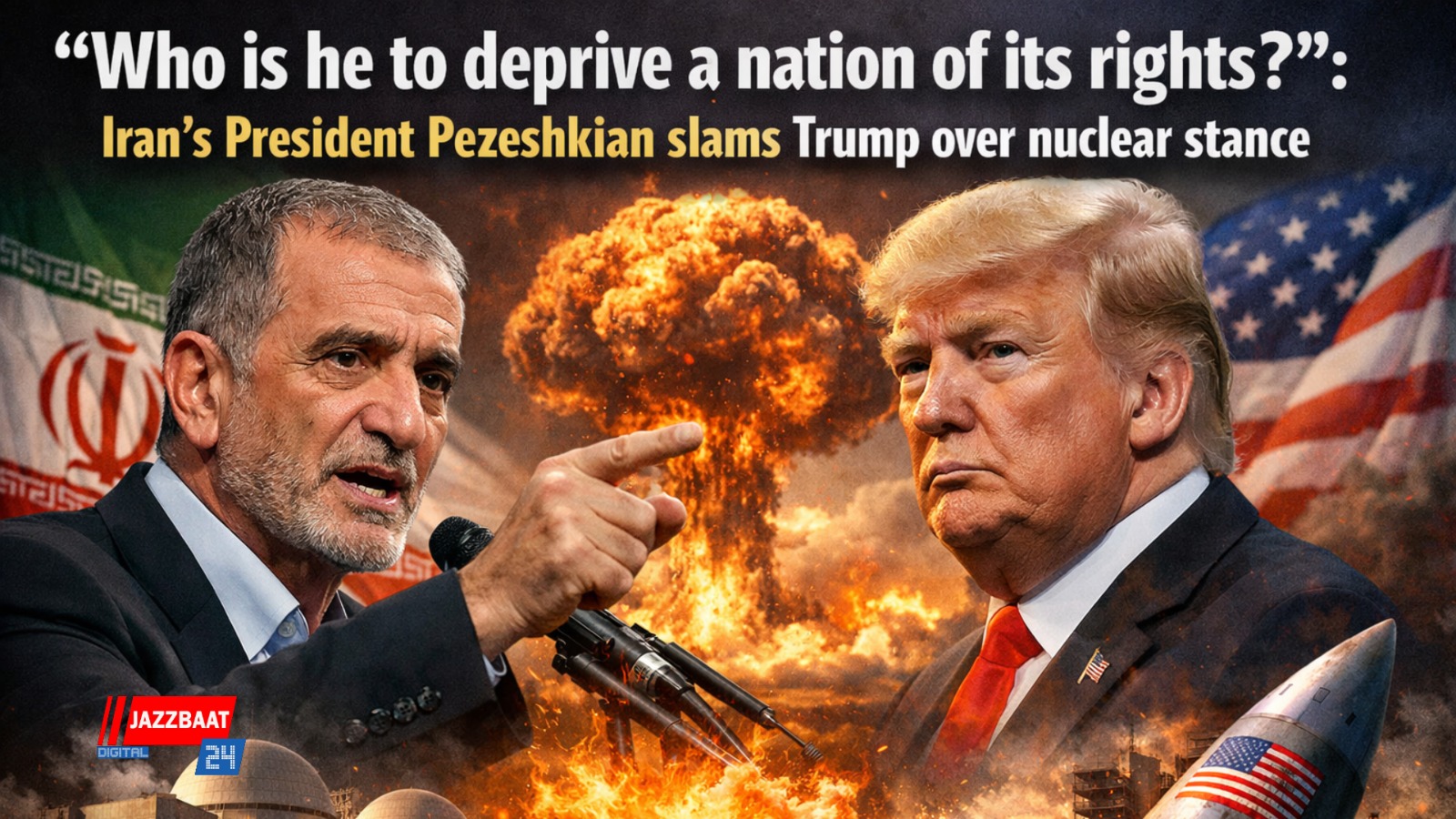
Tehran: Iranian President Masoud Pezeshkian has strongly criticised former U.S. President Donald Trump over Washington’s continued pressure on Iran’s nuclear programme, questioning the legitimacy of restricting Iran’s nuclear rights and calling such actions unjustified interference.
Speaking in remarks reported by Iran’s state-linked media, Pezeshkian said the United States has no authority to deny Iran what he described as its “lawful nuclear rights.” He directly challenged Trump’s position, asking, “Who is he to deprive a nation of its rights?” and accused Washington of applying political pressure without presenting valid legal or moral grounds.
According to official reports, Pezeshkian reiterated that Iran’s nuclear programme is strictly for peaceful purposes, including energy production and scientific development. He stressed that Iran does not seek nuclear weapons, but will continue to assert what it considers its rights under international agreements.
The comments come amid renewed tensions between Tehran and Washington over Iran’s nuclear activities, sanctions, and broader regional security issues. Recent diplomatic exchanges have shown little progress, with both sides maintaining firm positions on uranium enrichment and monitoring mechanisms.
Iranian officials have consistently argued that the country has the right under the Nuclear Non-Proliferation Treaty (NPT) to develop civilian nuclear technology. Pezeshkian’s remarks reflect a continuation of that long-standing position, while also signalling resistance to external political pressure.
The Iranian president also framed the issue as one of national sovereignty, suggesting that decisions about Iran’s scientific and technological development should not be influenced by foreign leaders. His comments were widely circulated by Iranian and international media outlets, highlighting ongoing friction in U.S.–Iran relations.
On the other hand, U.S. officials have previously expressed concerns that Iran’s nuclear programme could move beyond civilian use, and have pushed for stricter limits and monitoring. This has remained one of the central points of contention since the collapse of the 2015 nuclear agreement following the U.S. withdrawal in 2018.
Analysts say Pezeshkian’s latest statement reflects both domestic political messaging and Iran’s broader diplomatic strategy of asserting rights while keeping the door open for negotiations under different terms.
As tensions continue, the nuclear issue remains one of the most sensitive and unresolved aspects of Iran’s foreign relations with the West.