
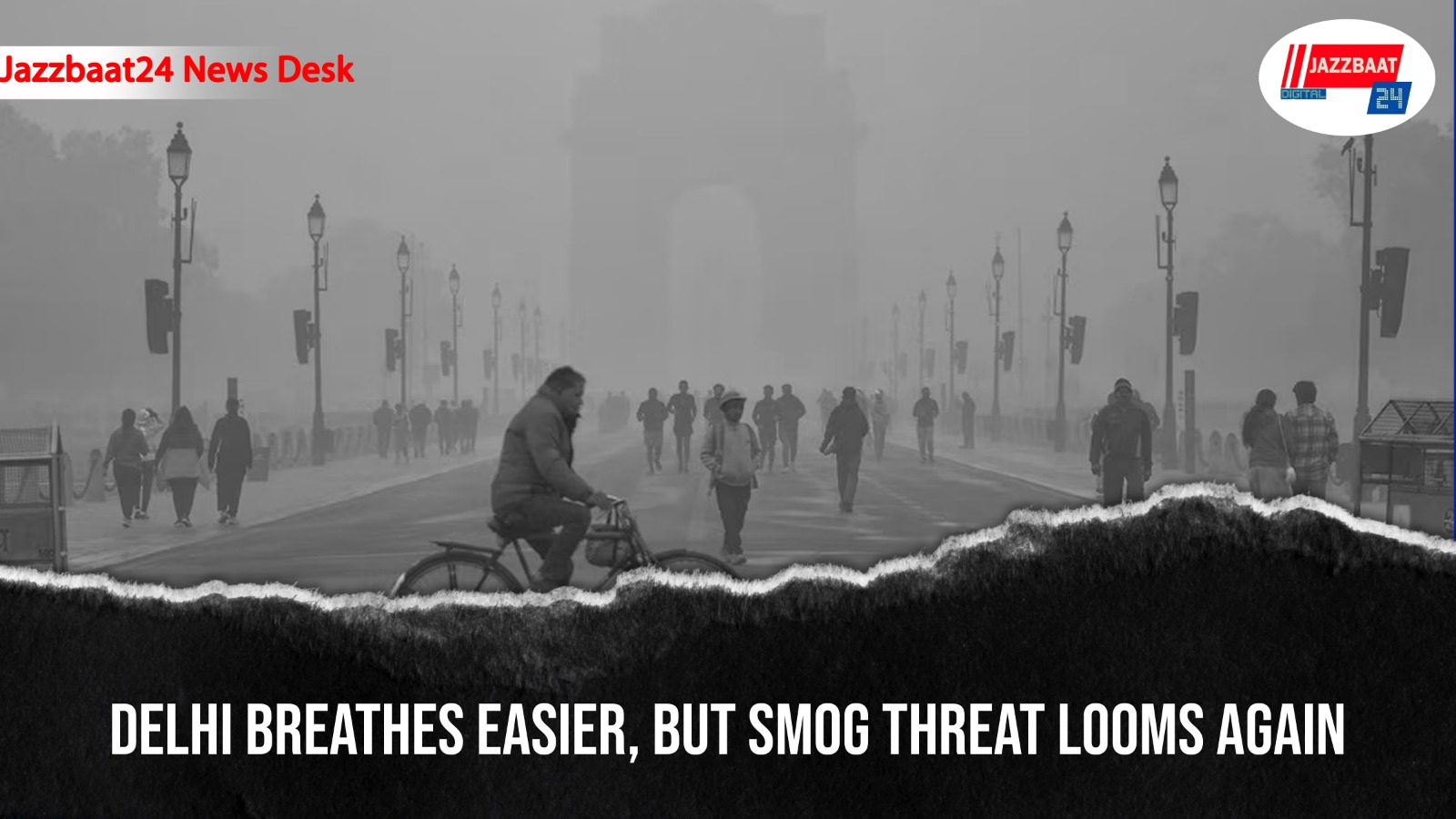
Delhi residents woke up to a welcome change on Saturday as air quality showed a noticeable improvement after weeks of choking smog. The city recorded an overall Air Quality Index (AQI) of 235 at 8 am, placing it in the ‘poor’ category but marking a sharp drop from Thursday’s ‘severe’ levels. As a result, authorities rolled back Stage III of the Graded Response Action Plan (GRAP), easing several restrictions across the capital.
According to data from the Central Pollution Control Board (CPCB), nine monitoring stations reported ‘moderate’ air quality. Mandir Marg recorded an AQI of 128, while Bawana and IGI Airport Terminal 3 stood at 145 and 148 respectively. However, pollution hotspots remained, with Jahangirpuri logging the worst AQI at 309, followed by Nehru Nagar (297) and Siri Fort (289).
The Commission for Air Quality Management (CAQM) attributed the improvement to strong surface winds of 15–20 kmph, which helped disperse pollutants. Delhi’s AQI dropped from 380 on Thursday to 236 by Friday evening, prompting the rollback of GRAP Stage III curbs. With this, private construction and demolition activities, mining operations, and the use of older BS-3 petrol and BS-4 diesel vehicles have been allowed to resume.
Despite the relief, authorities cautioned that the improvement may be short-lived. The Air Quality Early Warning System (AQEWS) has forecast a return to ‘very poor’ air quality from Sunday through Tuesday, with Delhi likely to face at least eight consecutive days of high pollution levels. Preventive measures under GRAP Stages I and II will remain in force, including restrictions on the entry of non-compliant interstate buses into the city.
Adding to the challenge, the India Meteorological Department has issued a yellow alert for moderate to dense fog over the weekend. Cold northwesterly winds are expected to lower minimum temperatures to between 6 and 8 degrees Celsius, potentially worsening pollution dispersion in the coming days.