
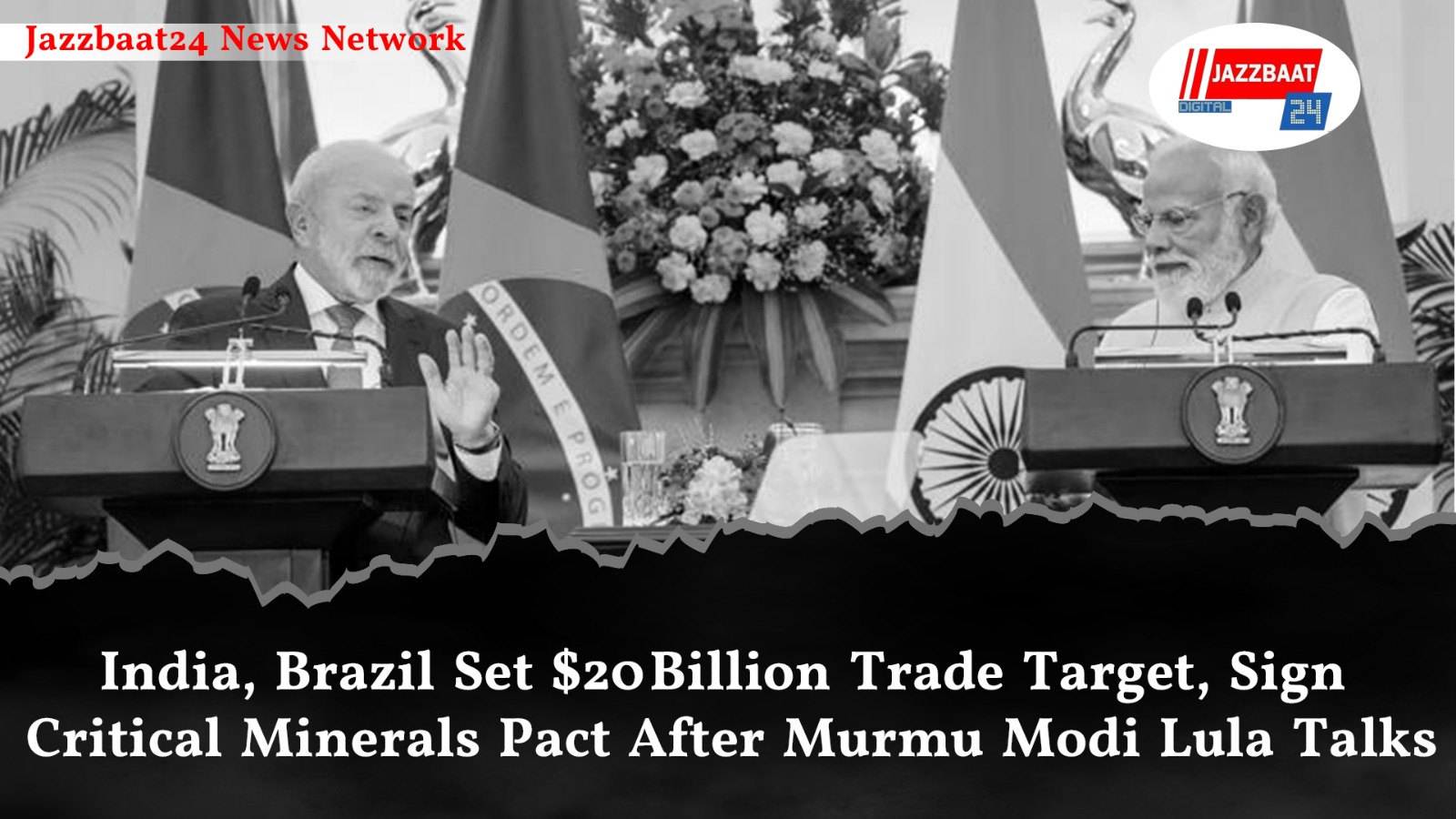
India and Brazil on Saturday agreed to deepen their strategic and economic partnership following high‑level talks involving Prime Minister Narendra Modi and Brazilian President Luiz Inácio Lula da Silva, with President Droupadi Murmu attending key parts of the discussions. The two countries set a bilateral trade target of over USD 20 billion in the next five years, aiming to substantially expand commerce and cooperation across multiple sectors.
During the meetings held in New Delhi, Modi and Lula emphasised strengthening ties in trade, critical minerals, defence, technology, digital infrastructure, energy and clean‑energy transitions. India and Brazil both major emerging economies and members of the BRICS grouping also signed a cooperation pact on critical minerals and rare earths, seen as vital for high‑tech industries, electric vehicles and renewable technologies.
“Our trade is not merely a number it is a reflection of trust,” Modi said at a joint press event, noting Brazil is India’s largest trade partner in Latin America. He reaffirmed the commitment to expand commerce well beyond current levels and highlighted cooperation to reduce supply‑chain vulnerabilities, particularly in strategic minerals.
The trade volume between the two nations stood at around USD 12–15 billion in recent years, underlining strong potential for growth. Brazil, rich in iron ore and other key minerals, is expected to play an important role in supporting India’s infrastructure and industrial ambitions. The leaders also witnessed the signing of several memoranda of understanding (MoUs) covering digital partnership, MSMEs, healthcare and other areas.
Both governments highlighted the broader Global South cooperation agenda, calling for stronger multilateral engagement and reforms of global institutions like the United Nations. Lula underscored the shared commitment to inclusive growth and deeper ties in technology, innovation and sustainable development.
The India‑Brazil talks mark a significant step in consolidating bilateral relations and demonstrate mutual intent to pursue a win‑win partnership in the face of global economic uncertainties and geopolitical shifts.