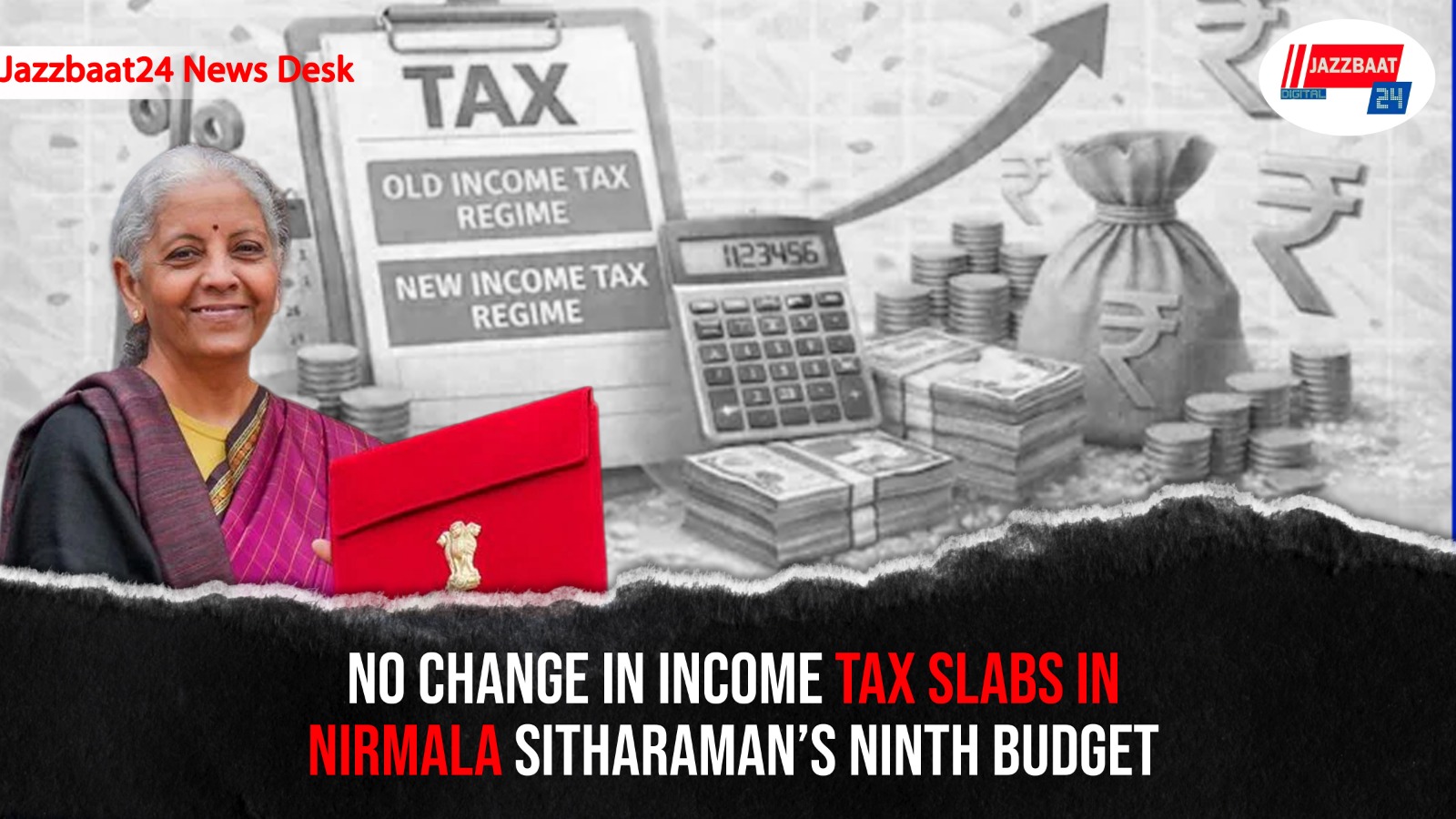
Finance Minister Nirmala Sitharaman on Sunday presented her ninth consecutive Union Budget, announcing that there will be no change in income tax slabs, a decision closely watched by millions of taxpayers across India. The announcement brings continuity to the tax structure introduced earlier, especially under the new income tax regime.
The Narendra Modi-led government had last year made a significant move by exempting income up to ₹12 lakh per year from tax under the new regime. This system offers lower tax rates but does not allow exemptions and deductions. That framework remains unchanged in Budget 2026.
Under the existing new regime, income between ₹4 lakh and ₹8 lakh is taxed at 5 per cent, ₹8–12 lakh at 10 per cent, and ₹12–16 lakh at 15 per cent. Higher slabs include 20 per cent tax on income between ₹16–20 lakh, 25 per cent for ₹20–24 lakh, and 30 per cent on income above ₹24 lakh.
A major announcement in the budget was the implementation of the Income Tax Act, 2025, which will come into force from April 1, 2026. This new law will replace the six-decade-old Income Tax Act of 1961. Sitharaman said the new legislation simplifies tax laws, removes ambiguities, and reduces the scope for litigation.
According to the finance minister, the new tax law is revenue-neutral and does not alter tax rates. However, it reduces the volume of text and number of sections by nearly 50 per cent. A key reform is the removal of the distinction between “assessment year” and “previous year,” replacing both with a single “tax year” concept.
Another taxpayer-friendly change allows individuals to claim TDS refunds even if income tax returns are filed after the deadline, without penal charges. The redesigned tax return forms, Sitharaman said, will make compliance easier for ordinary citizens.
In a boost to digital infrastructure, Sitharaman also proposed a tax holiday till 2047 for foreign companies providing global cloud services using data centres located in India, subject to specific conditions.