
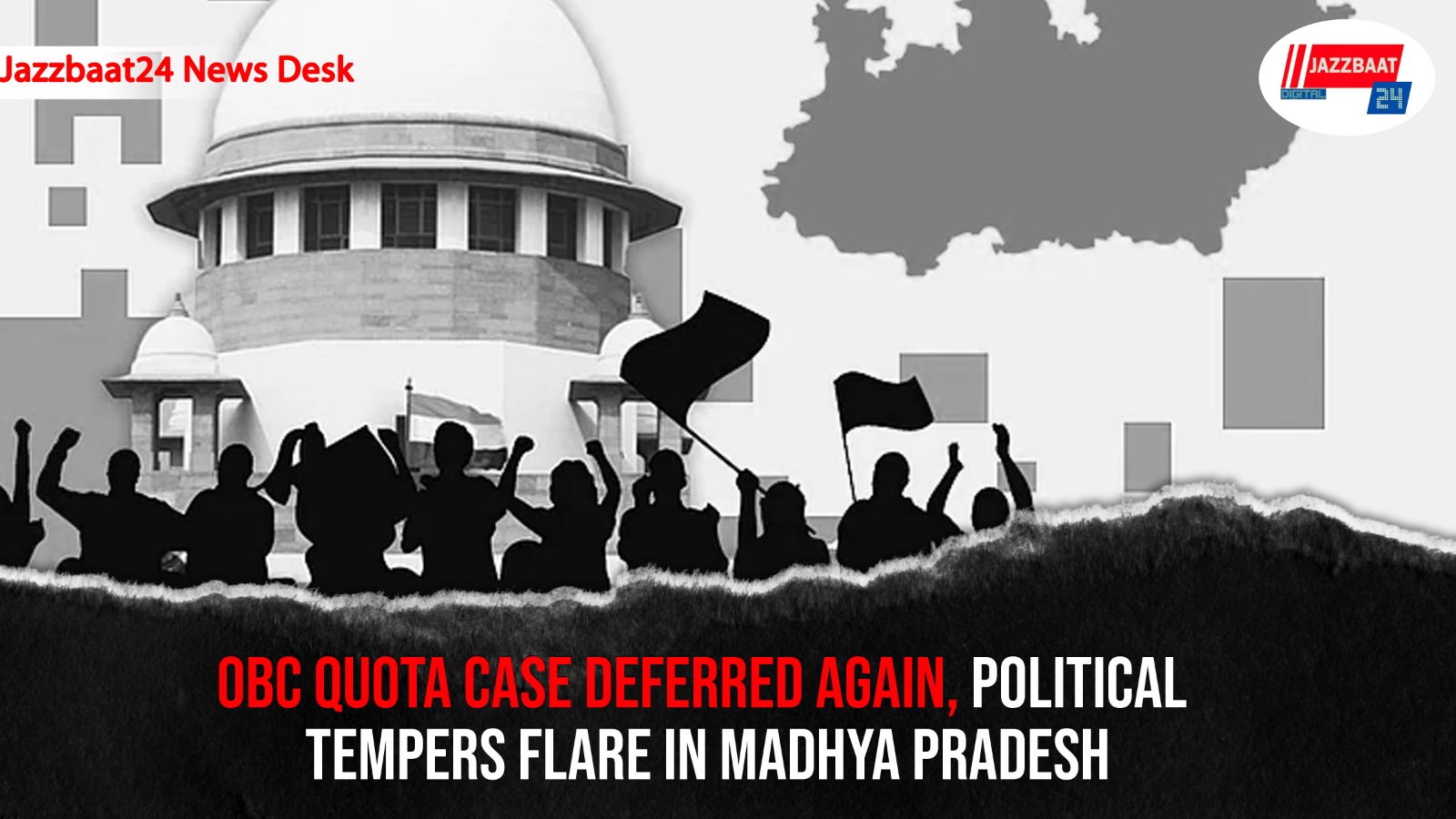
The political confrontation between the Congress and the BJP over the 27% Other Backward Classes (OBC) reservation in Madhya Pradesh intensified on Thursday after the Supreme Court once again postponed the hearing in the long-pending case.
The matter was adjourned after no lawyer representing the Madhya Pradesh government appeared before the bench of Justices P. Narasimha and Vijay Bishnoi. The court fixed the next hearing for February 4 and remarked that government lawyers “repeatedly seek time instead of arguing the case,” expressing displeasure over repeated delays.
All 16 petitions related to the enhanced OBC quota were listed for final hearing. Senior advocate Anoop George Chaudhary, appearing for the OBC community, sought urgent consideration of applications linked to the alleged withholding of 13% of posts. However, the bench declined to take up the matter in the absence of state counsel. A request to place the case at the top of the board was also rejected.
The Congress accused the BJP-led state government of deliberately delaying the proceedings to deny OBCs their constitutional rights. Former Chief Minister Kamal Nath said the repeated adjournments exposed the government’s lack of seriousness and alleged that the BJP was intentionally complicating the issue for political gain.
The BJP rejected these allegations, claiming that senior law officers were present and accusing the Congress of trying to mislead the OBC community with what it called “false narratives.”
The Supreme Court had earlier directed that OBC reservation cases from Madhya Pradesh and Chhattisgarh be heard on a day-to-day basis, treating them as a priority. In previous hearings, the court had warned against repeated adjournments, noting that thousands of young aspirants were being affected.
Significantly, neither the High Court nor the Supreme Court has stayed the law granting 27% OBC reservation. However, recruitment processes continue with 13% of posts reportedly being withheld, creating uncertainty for candidates.
As the legal battle drags on, the issue has turned into a high-voltage political flashpoint, with both major parties trading blame while OBC aspirants remain caught in the middle.