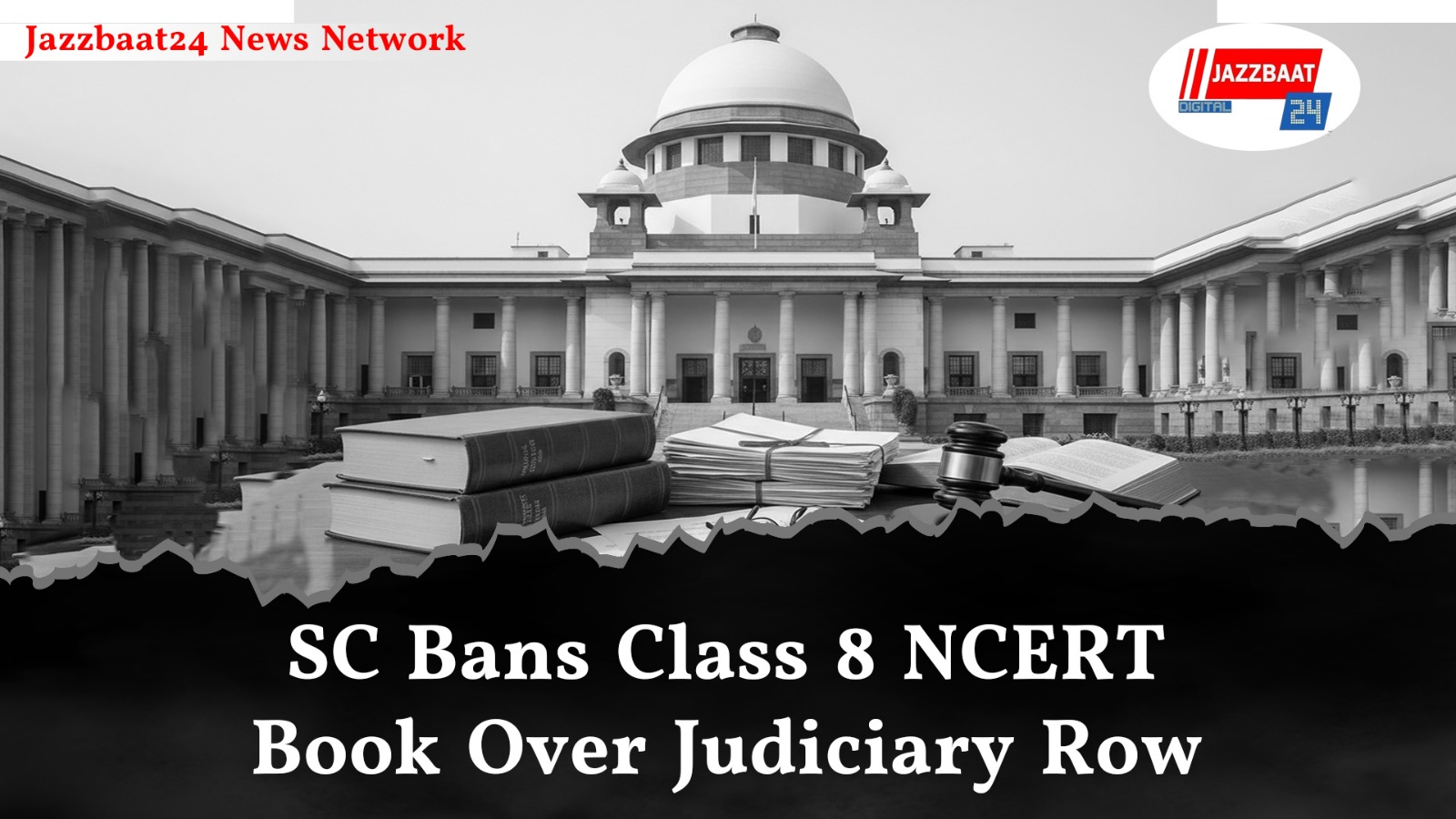
A controversy surrounding a school textbook has escalated after the Supreme Court of India imposed a complete ban on the circulation of a Class 8 social science book published by National Council of Educational Research and Training (NCERT). Following the court’s directive, the Union Ministry of Education has asked relevant ministries to ensure that the book is no longer circulated through digital platforms or electronic media.
Officials said the education ministry has written to both the Ministry of Electronics and Information Technology and the Ministry of Information and Broadcasting, instructing them to immediately stop the digital dissemination of the controversial textbook. Authorities have already begun removing physical copies and halting any further reprinting of the book.
The move came after the Supreme Court strongly criticised the content of the textbook, which included references to corruption within the judiciary. The court described the material as “offending” and ordered a blanket ban on the book’s publication, reprinting and online distribution. It also directed that all existing copies both physical and digital be seized.
The chapter in question discussed challenges faced by the judicial system, including corruption, a backlog of cases and the shortage of judges. The court, however, expressed serious concern over the way the issue was presented, saying it appeared to undermine the credibility of the judiciary.
Reacting to the controversy, Union Education Minister Dharmendra Pradhan expressed strong displeasure over the inclusion of the disputed content. He assured that accountability would be fixed and appropriate action would be taken against those responsible for drafting the chapter.
The education body later issued an apology for what it described as “inappropriate content.” It also confirmed that the textbook had been removed from its official website following the court’s remarks.
Officials said the book will now be rewritten in consultation with relevant authorities to ensure that the revised version aligns with acceptable academic and institutional standards.
The controversy has sparked a broader debate over how sensitive institutions and issues should be discussed in school textbooks. While some argue that students should be exposed to critical discussions about governance and institutions, others believe that such topics must be handled carefully to avoid undermining public trust.
For now, authorities have moved swiftly to comply with the court’s order, ensuring that the banned textbook is removed from both classrooms and digital platforms across the country.