

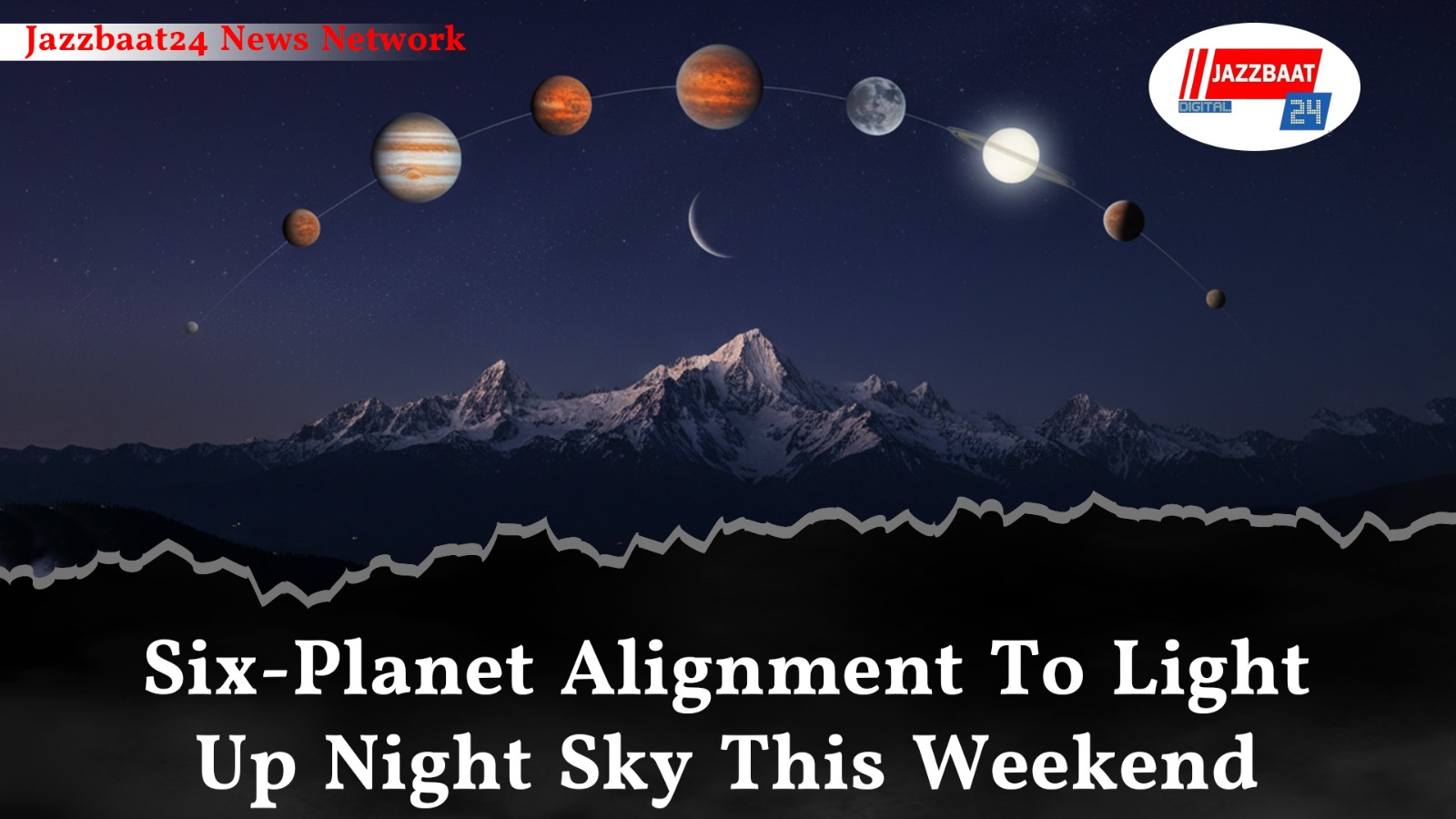
Skywatchers across India are set for a rare celestial treat this weekend as six planets will appear together in the evening sky shortly after sunset. The phenomenon, often called a “planetary parade,” will be visible on February 28 and in the following days if weather conditions remain clear.
The event occurs when several planets appear on the same side of the Sun and align along the path known as the ecliptic the flat plane in which Earth and most planets orbit the Sun. Although the planets are not perfectly lined up in space, they appear clustered together from Earth, creating the illusion of alignment.
Astronomy enthusiasts will be able to spot Mercury, Venus, Jupiter and Saturn with the naked eye. However, viewing Uranus and Neptune will require binoculars or a telescope because they are much dimmer.
Experts say the best time to watch the spectacle will be around 30 minutes after sunset. Observers should look toward the western horizon where the planets will gradually appear as the sky darkens.
Among the six planets, Jupiter is expected to be the easiest to identify due to its strong brightness. It will appear in the southern part of the sky after sunset and can be spotted not far from the Orion constellation. Venus will also shine brightly near the western horizon and should be easy to recognise.
Mercury and Saturn will appear lower in the twilight sky, close to the horizon. Higher up, Uranus and Jupiter will be more distinct, while Neptune will remain faint and require optical equipment for clear viewing.
Astronomers say a simple way to distinguish planets from stars is by observing whether they twinkle. Stars tend to flicker because of atmospheric disturbances, while planets usually shine steadily without noticeable twinkling.
Planetary alignments like this are not extremely rare, but they do not happen every year, making them exciting events for sky enthusiasts and amateur astronomers. In some years, even more planets can appear together in the sky.
For the best viewing experience, experts recommend choosing a location away from heavy city lights. Rooftops, open fields or areas with a clear view of the western sky will improve visibility. Observers are also advised to wait until the Sun has fully set before looking for the planets, as looking directly at the Sun can damage the eyes.
If skies remain clear, people across India should have a good chance to witness this beautiful cosmic display over the weekend.