

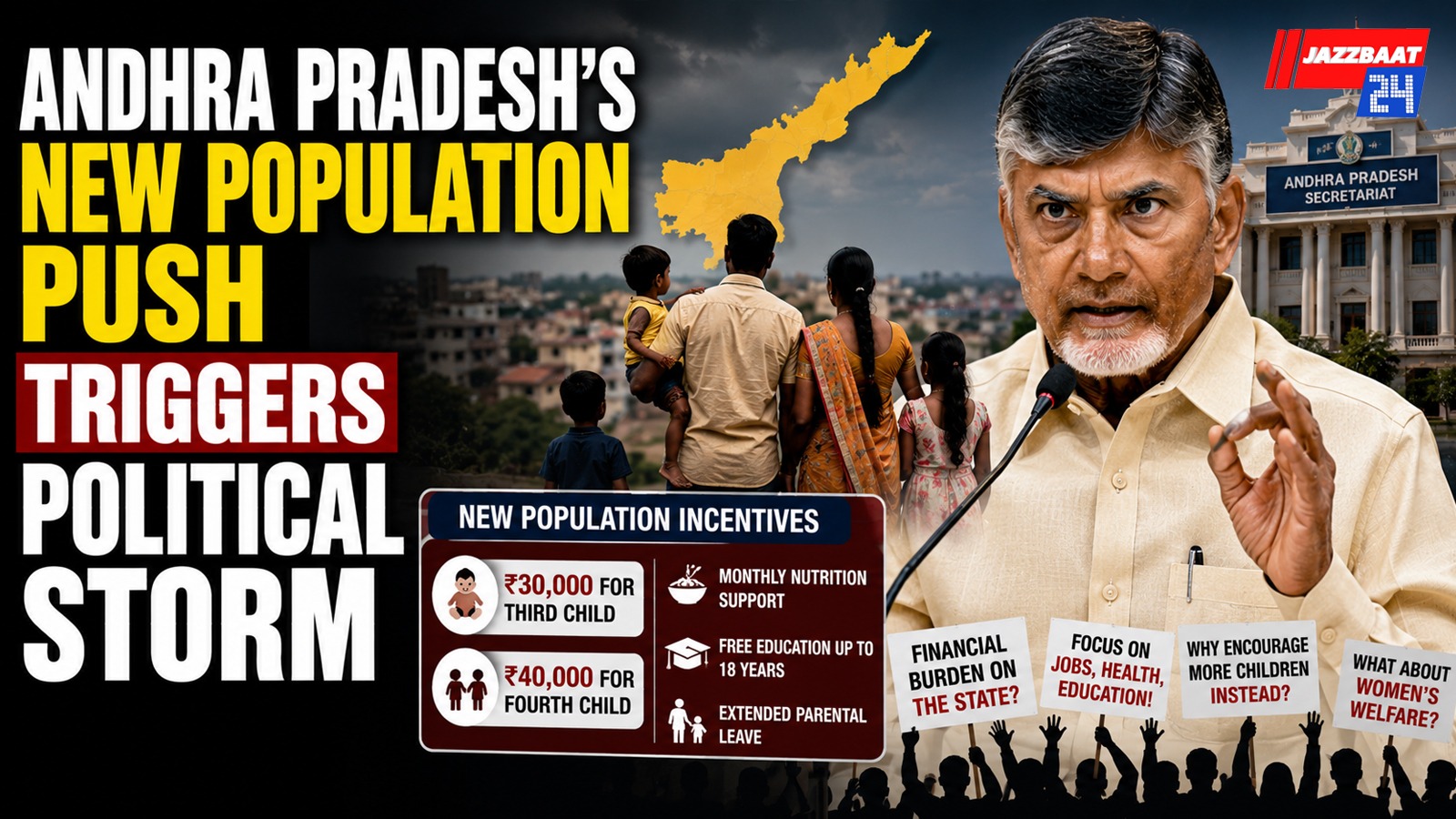
The Andhra Pradesh government has announced a new population incentive policy offering financial benefits to families having a third and fourth child, triggering a sharp political debate across the country. Chief Minister N. Chandrababu Naidu said the move is aimed at addressing the state’s falling fertility rate and ageing population concerns.
Under the proposed scheme, families will receive ₹30,000 for the birth of a third child and ₹40,000 for a fourth child. The government is also considering additional benefits, including monthly nutritional support for children, free education up to 18 years, and extended parental leave provisions.
Speaking at a public meeting in Srikakulam district, Naidu said the state was shifting its focus from “population control” to “population care.” He warned that Andhra Pradesh’s Total Fertility Rate (TFR) has fallen to nearly 1.5, well below the replacement level of 2.1 needed to maintain demographic balance.
The Chief Minister argued that declining birth rates could lead to a shrinking workforce and increased pressure from an ageing population in the coming decades. Drawing comparisons with countries like Japan and South Korea, he said India should avoid a future demographic crisis caused by low birth rates.
However, the announcement has sparked criticism from opposition leaders and social commentators. Critics questioned whether the state, already facing financial pressures, could realistically support such welfare promises. Some opposition parties argued that the government should focus more on employment, healthcare, education, and women’s welfare instead of encouraging larger families.
The debate has also reopened discussions around population-based delimitation and political representation. Several leaders from southern states have expressed concerns that states which successfully controlled population growth over the years may lose political influence if parliamentary seats are redistributed purely on population figures in the future.
Experts say Andhra Pradesh’s proposal reflects a growing shift in demographic thinking among some southern states, where declining fertility rates are now being viewed as an economic and political challenge rather than a success story. While supporters see the move as long-term planning, critics believe the policy could place additional strain on public finances and welfare systems.