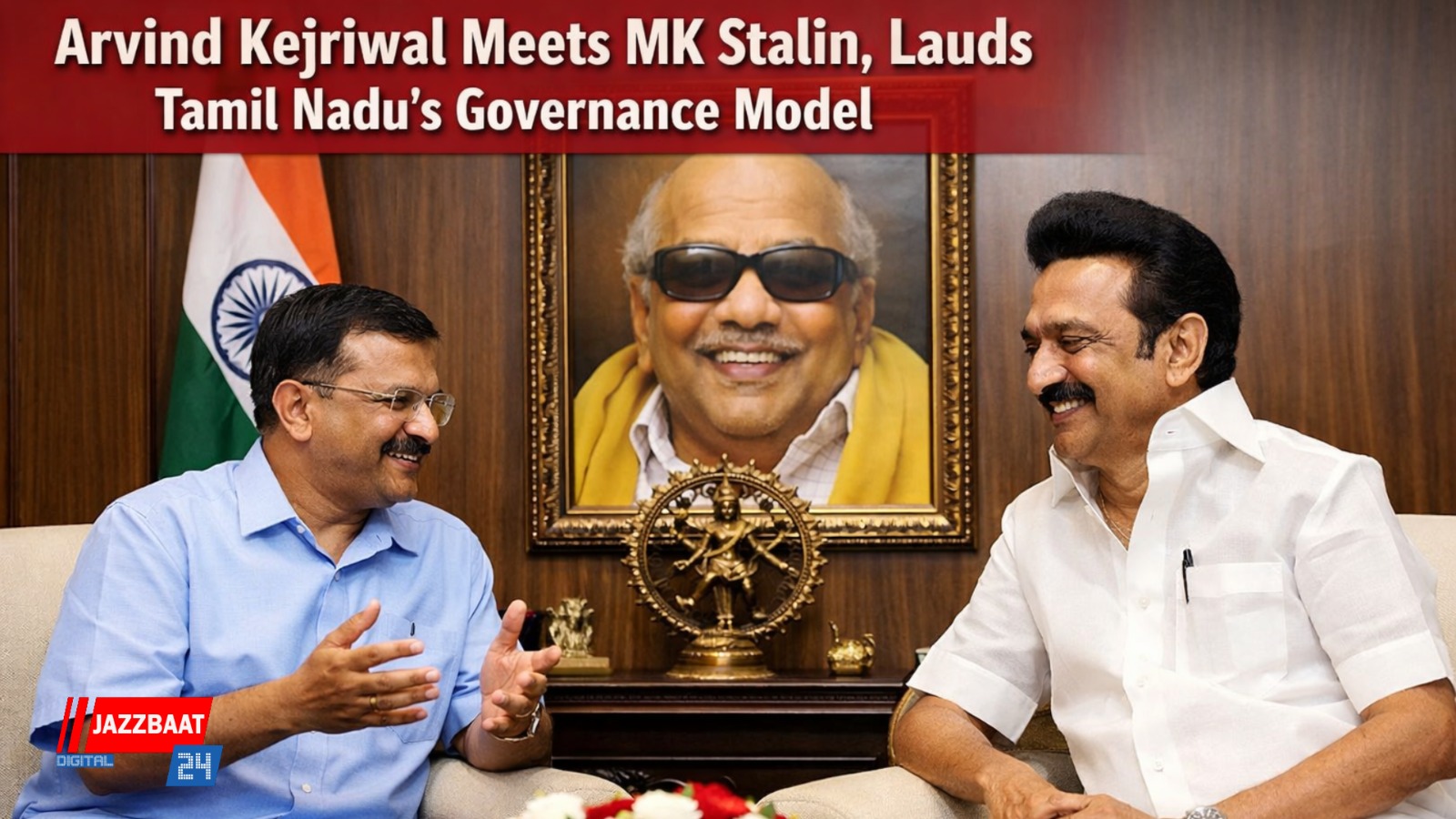
Delhi Chief Minister Arvind Kejriwal met Tamil Nadu Chief Minister M.K. Stalin on Monday, in a high-profile political interaction that highlighted cooperative federalism and exchange of governance ideas between two major Indian states.
During the meeting, Kejriwal praised the governance model of Tamil Nadu, describing it as progressive and people-centric. He particularly appreciated the state’s focus on education, public welfare schemes, and social development initiatives, saying that several of Tamil Nadu’s policies offer useful lessons for other states.
The meeting between Arvind Kejriwal and M. K. Stalin took place in Chennai and included discussions on education reforms, healthcare delivery systems, urban development, and strengthening public service infrastructure. Both leaders reportedly exchanged views on how state governments can innovate within their constitutional powers to improve governance outcomes.
Kejriwal highlighted Tamil Nadu’s achievements in school education, particularly improvements in enrollment, infrastructure, and mid-day meal schemes. He also noted the state’s emphasis on equitable access to healthcare and welfare programs targeted at economically weaker sections.
Stalin, on his part, welcomed the interaction and emphasized the importance of federal cooperation among states with diverse political backgrounds. He said that exchanging best practices between states helps strengthen democracy and improves governance efficiency across the country.
The meeting is being seen as part of a broader trend of opposition-ruled states engaging with each other on policy matters, especially on issues where they seek to present alternative governance models. Political observers say such interactions also reflect increasing coordination among regional leaders on national policy discussions.
Both leaders also reportedly touched upon the need for states to have greater financial autonomy and adequate resource allocation from the Centre to effectively implement welfare schemes. They emphasized that strong states contribute to a stronger nation.
The interaction concluded on a positive note, with both sides expressing willingness to continue dialogue on governance innovation and policy cooperation in the future.
The meeting has drawn attention in political circles, as it brings together two prominent leaders from different regional and political contexts, united by a shared emphasis on state-led development models.