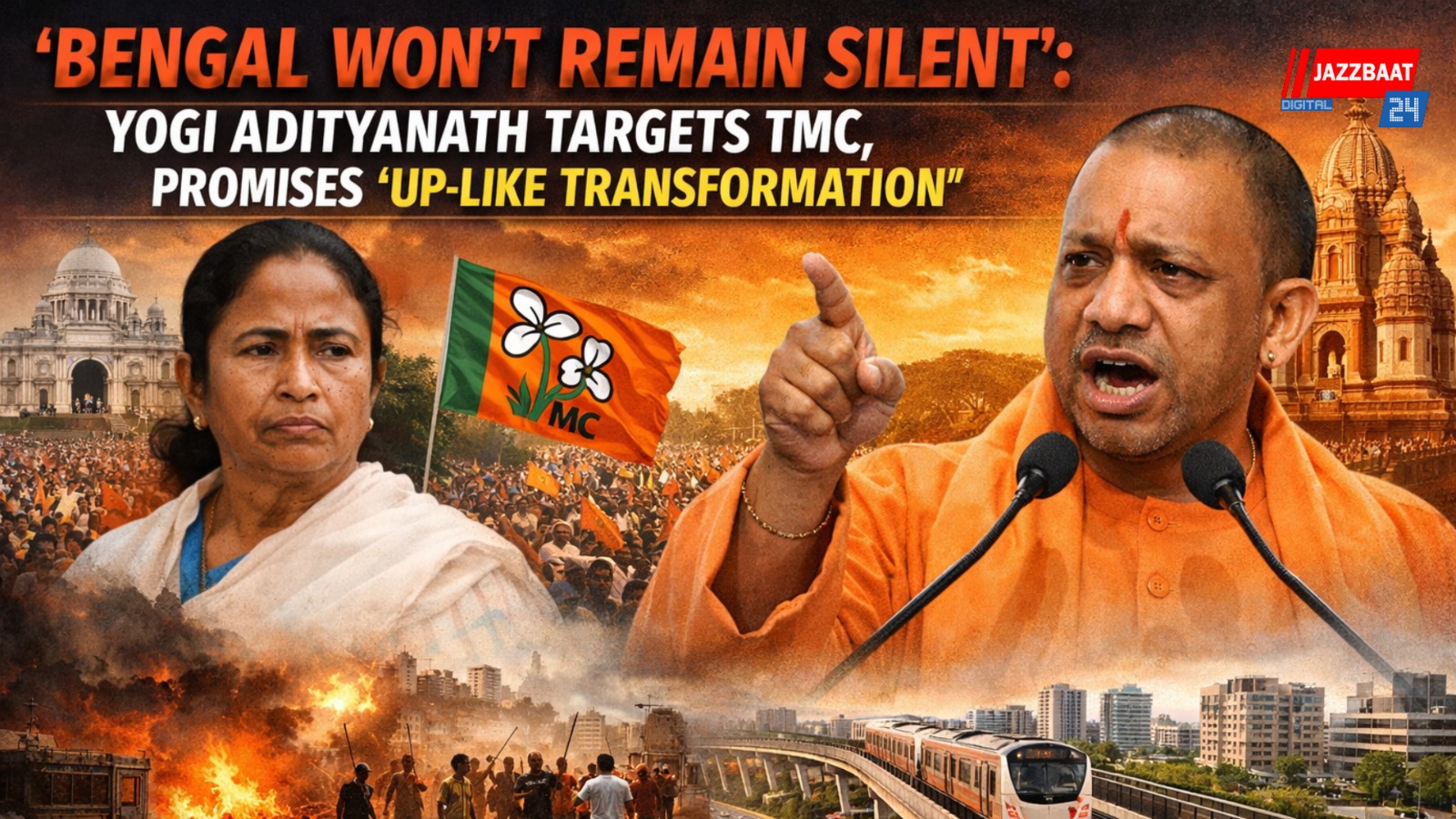
In a sharp political attack ahead of the elections, Yogi Adityanath on Sunday launched a scathing critique of West Bengal’s ruling party, the Trinamool Congress (TMC), asserting that “Bengal will not remain silent anymore” and promising a transformation similar to what he claims to have achieved in Uttar Pradesh.
Addressing a public rally in the state, the Uttar Pradesh Chief Minister accused the Trinamool Congress government of fostering corruption, lawlessness, and political violence. Without mincing words, he alleged that democratic institutions in Bengal are under pressure and that people are yearning for change.
Adityanath drew comparisons between West Bengal and Uttar Pradesh, highlighting what he described as improved law and order, infrastructure development, and governance reforms under his leadership. He promised that if given the opportunity, a similar model could be implemented in Bengal to ensure safety, economic growth, and administrative transparency.
“Just as Uttar Pradesh has changed, Bengal too can witness a new dawn,” he said, urging voters to reject what he termed as “appeasement politics” and “misrule.” His remarks come at a time when political campaigning in the state has intensified, with parties leaving no stone unturned to mobilize support.
The BJP leader’s comments also included criticism of alleged violence during elections and post-poll periods in Bengal. He claimed that the voices of the common people have often been suppressed and insisted that the upcoming polls would be a turning point.
Meanwhile, leaders of the Trinamool Congress have strongly refuted these allegations, accusing the BJP of attempting to import “divisive politics” into the state. They maintain that Bengal has its own cultural and political identity, which cannot be compared with any other state.
The exchange of sharp political rhetoric underscores the high-stakes nature of the electoral battle in West Bengal. With national leaders stepping into the fray, the campaign is increasingly taking on a national dimension, with governance models, development claims, and ideological narratives at the center of the debate.
As the election season progresses, such confrontations are expected to intensify, shaping public discourse and influencing voter sentiment across the state.