
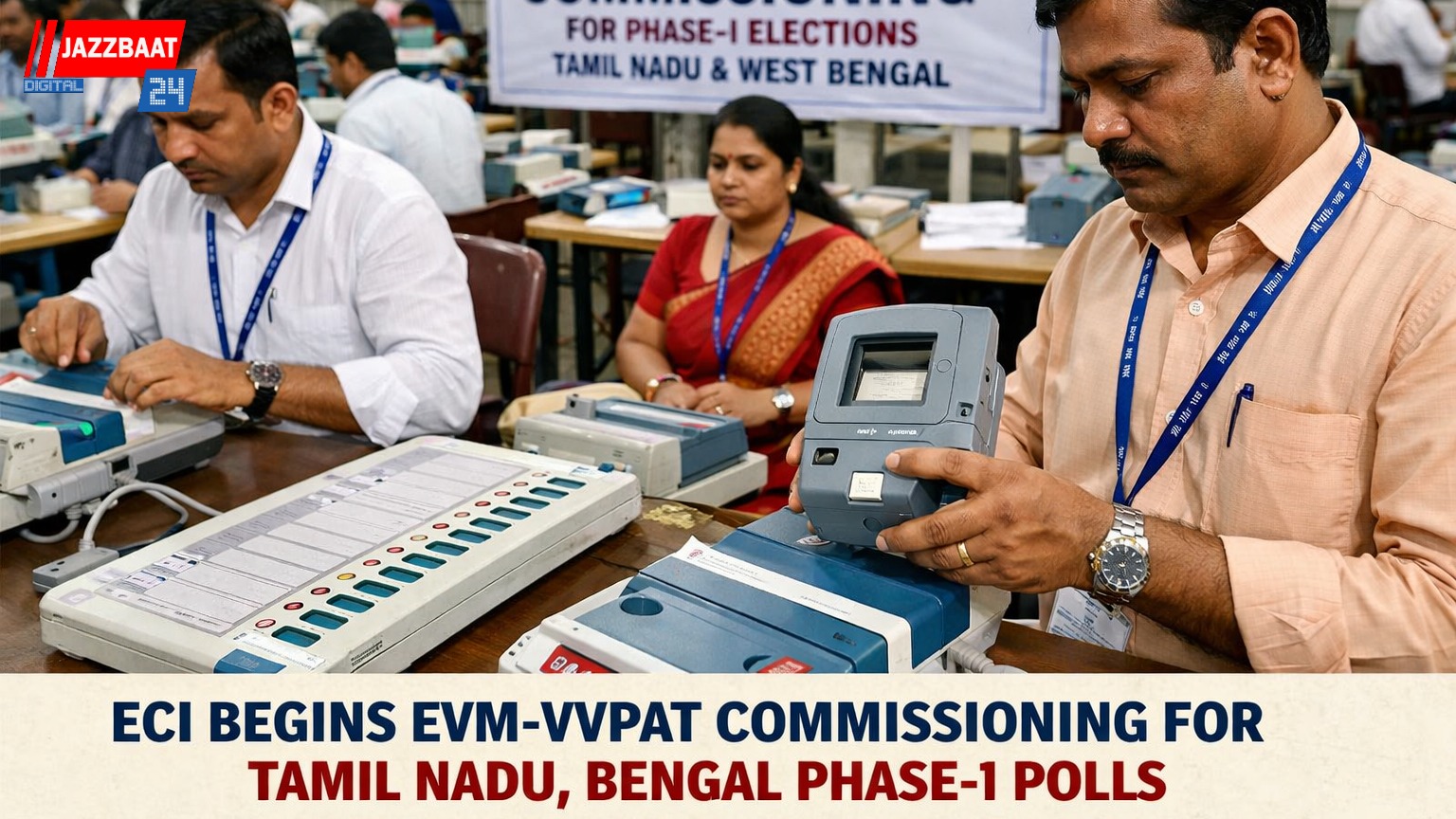
The Election Commission of India (ECI) has begun the commissioning of Electronic Voting Machines (EVMs) and Voter Verifiable Paper Audit Trail (VVPAT) units for constituencies going to polls in Phase 1 of the upcoming Assembly elections in Tamil Nadu and West Bengal. The move marks a crucial step in the final preparations ahead of voting scheduled for April 23.
According to officials, the commissioning process started on April 16 across multiple constituencies and is being conducted in the presence of candidates, their authorised representatives, and General Observers appointed by the Commission. This transparent procedure is aimed at building trust among stakeholders and ensuring the integrity of the electoral process.
The commissioning exercise involves configuring EVMs and VVPATs for specific constituencies and candidates. Once completed, a mandatory mock poll will be conducted on 5% of randomly selected machines, where up to 1,000 votes will be cast to verify accuracy. Notably, candidates and their representatives are allowed to carry out these mock polls themselves, adding an extra layer of accountability.
Before commissioning, the machines underwent a two-stage randomisation process using the EVM Management System. In the first stage, machines were randomly allocated from district warehouses to Assembly constituencies. In the second stage, they were further assigned to individual polling stations. This method is designed to eliminate any possibility of manipulation and ensure fairness.
The scale of the operation is significant. Tamil Nadu will see polling across 234 Assembly seats with around 75,064 polling stations, while Phase 1 in West Bengal will cover 152 constituencies with approximately 44,378 polling stations. These numbers highlight the extensive logistical effort involved in conducting elections in two politically crucial states.
Following allocation, constituency-wise lists of EVMs and VVPATs have been shared with political parties and candidates. The machines are then securely stored in strong rooms under constant surveillance, often in the presence of party representatives, ensuring transparency at every stage.
The commissioning process comes after the ECI announced the election schedule on March 15 for multiple states, including Tamil Nadu and West Bengal. With this phase now underway, election authorities are entering the final stage of readiness before polling day.
Officials emphasise that the multi-layered system including randomisation, mock polling, and strict storage protocols is designed to uphold the credibility and reliability of India’s electoral system. As campaigning intensifies, the successful execution of these technical procedures remains key to ensuring free and fair elections in both states.