

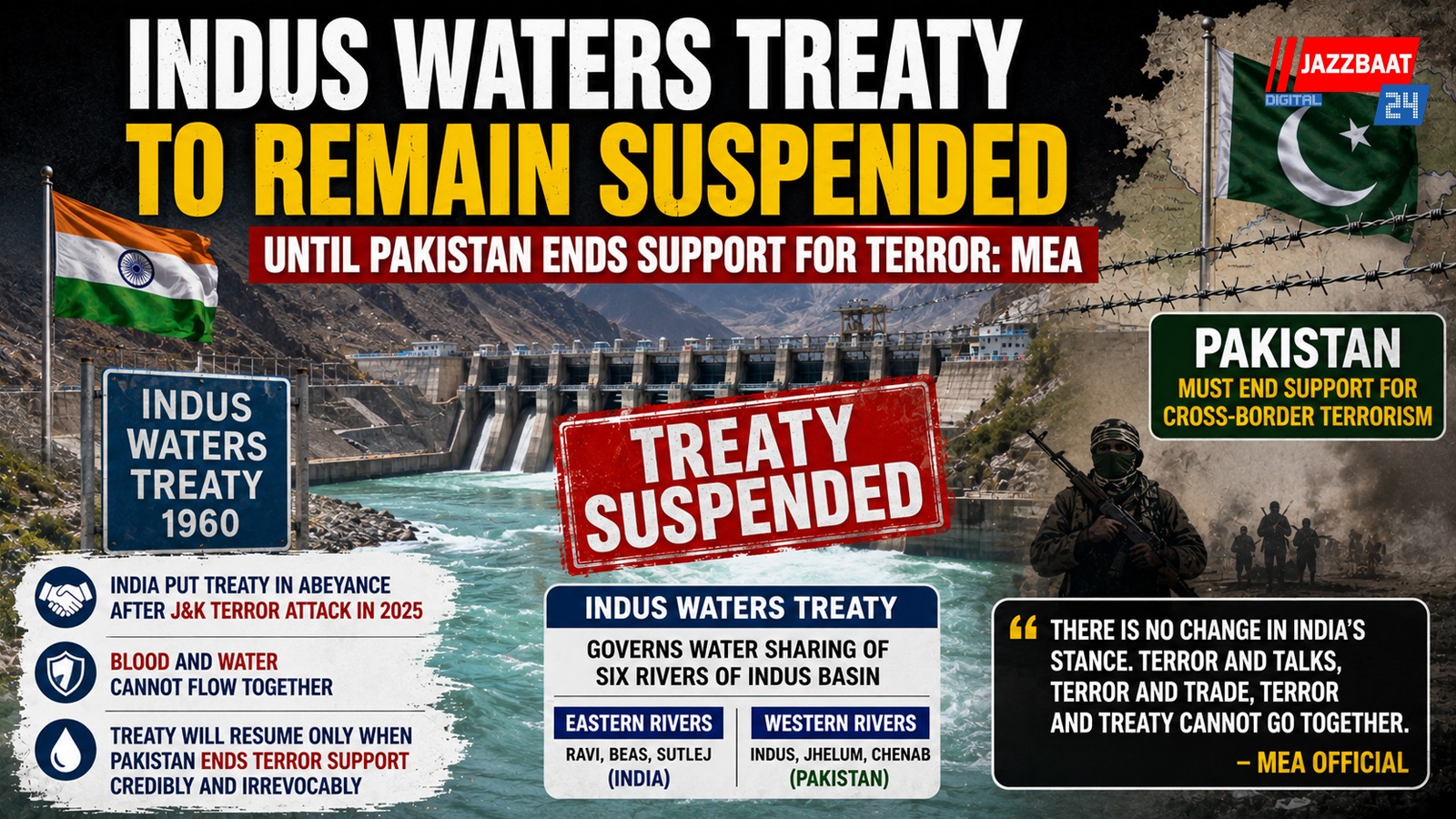
The Ministry of External Affairs (MEA) has reiterated India’s firm position that the Indus Waters Treaty with Pakistan will continue to remain in abeyance, linking any future consideration of the agreement to Pakistan’s action against cross-border terrorism.
According to MEA officials, India’s stance is unchanged: the treaty, originally signed in 1960 and long considered one of the most resilient water-sharing agreements in the world, will not be restored unless Pakistan “credibly and irrevocably” ends its support for terrorism directed against India. The statement comes amid continued diplomatic friction between the two neighbours following a series of security incidents that New Delhi has attributed to Pakistan-based groups.
Officials said India took the step of putting the treaty in abeyance after a major terror attack in Jammu and Kashmir in 2025, which led to a sharp deterioration in bilateral relations. Since then, India has maintained that “blood and water cannot flow together,” signalling that cooperation on river water sharing cannot be separated from security concerns.
Recent remarks by Indian representatives at international forums have reinforced this position. India has argued that Pakistan’s alleged use of terrorism as an instrument of state policy undermines the trust and spirit on which the treaty was built.
The Indus Waters Treaty governs the distribution of six rivers of the Indus basin between the two countries, with Pakistan receiving the majority share. Despite multiple conflicts over the decades, the agreement had largely survived until recent years, when rising tensions and accusations of cross-border militancy led to a breakdown in dialogue.
Pakistan, on its part, has repeatedly called for the treaty’s full restoration, warning that any disruption in water flows could severely impact agriculture and livelihoods. India, however, has maintained that normalisation of relations is not possible without concrete action on terrorism.
Diplomatic sources indicate that there is currently no timeline for talks on restoring the treaty, as security concerns continue to dominate bilateral engagement. The MEA’s latest statement underscores that the issue remains closely tied to India’s broader counter-terrorism policy and regional security priorities.