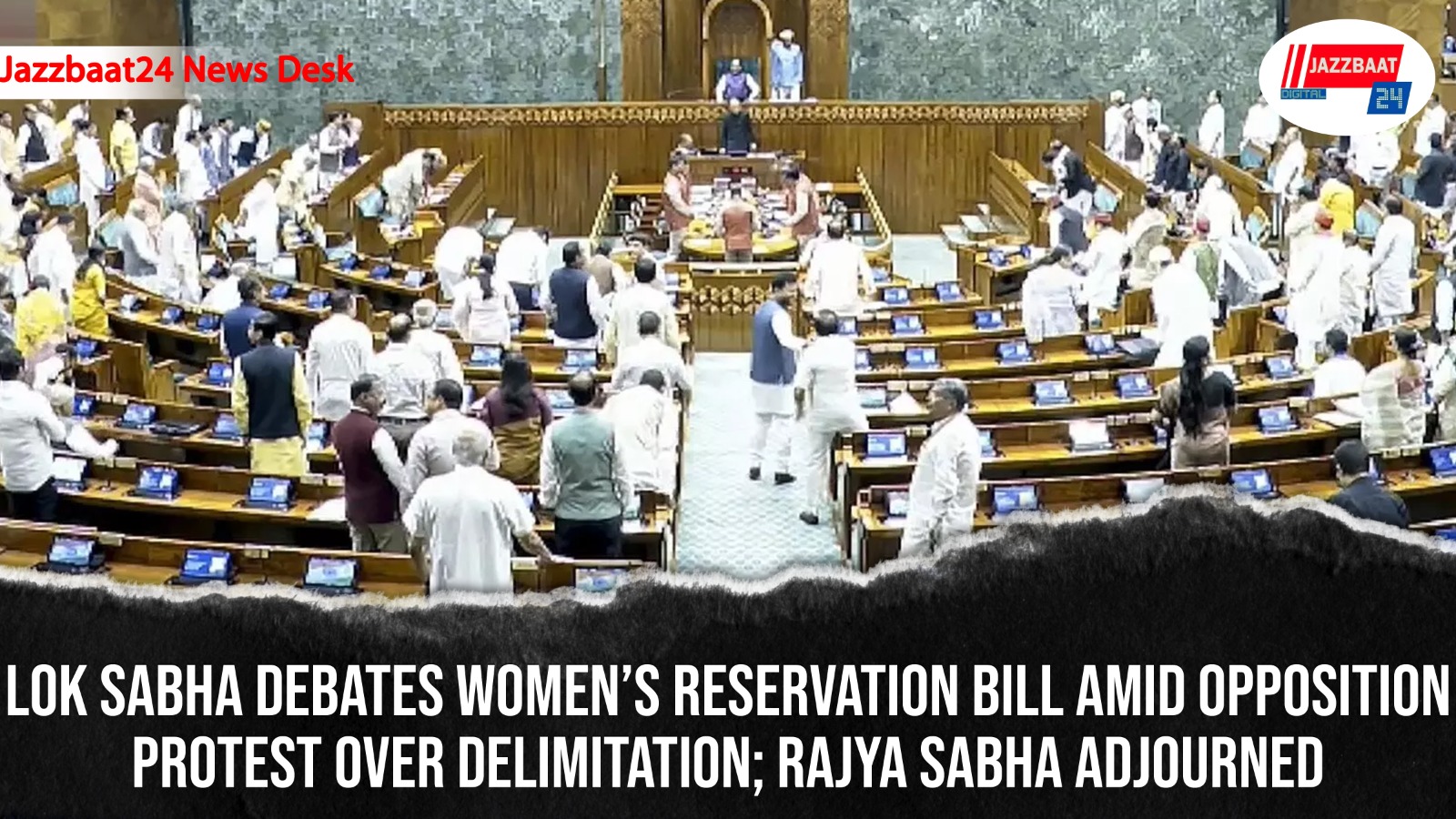
The Lok Sabha on Thursday took up a high-stakes debate on the Women’s Reservation Bill during a special Parliament session, even as Opposition parties staged strong protests over the linked delimitation exercise, while the Rajya Sabha was adjourned for the day.
The Constitution (One Hundred and Thirty-First Amendment) Bill, 2026, aimed at operationalising 33 per cent reservation for women in the Lok Sabha and State Assemblies, was formally introduced after a division of votes in the Lower House. The Bill received support from the ruling alliance, even as the Opposition voted against it and raised objections over its linkage with the proposed delimitation exercise.
The government has also introduced accompanying legislation on delimitation, which proposes a major restructuring of parliamentary constituencies based on updated population data. Under the plan, the strength of the Lok Sabha is expected to rise significantly in the coming years, with assurances from the government that no state will lose representation.
However, Opposition leaders argued that linking women’s reservation with delimitation could delay its implementation and alter the balance of political representation, particularly between northern and southern states. Several MPs accused the Centre of using the quota legislation to push through broader political and electoral changes.
Inside the House, sharp exchanges were witnessed as leaders from different parties debated the timing, intent, and impact of the bills. While the government described the move as a historic step towards gender equality and “Nari Shakti”, Opposition members demanded that women’s reservation be implemented immediately on existing seats without being tied to constituency redrawing.
Prime Minister Narendra Modi, addressing the Lok Sabha earlier, said the legislation would mark a new era in women’s political empowerment and urged all parties to treat it as a national reform beyond partisan politics.
The Lok Sabha is expected to continue detailed discussion on the three related bills, with voting scheduled after the extended debate. Meanwhile, proceedings in the Rajya Sabha were adjourned until the next day amid continuing political tensions and protests.
The special Parliament session, running from April 16 to 18, is focused on the twin issues of women’s reservation and delimitation, both of which are expected to significantly reshape India’s electoral landscape ahead of the 2029 general elections.