

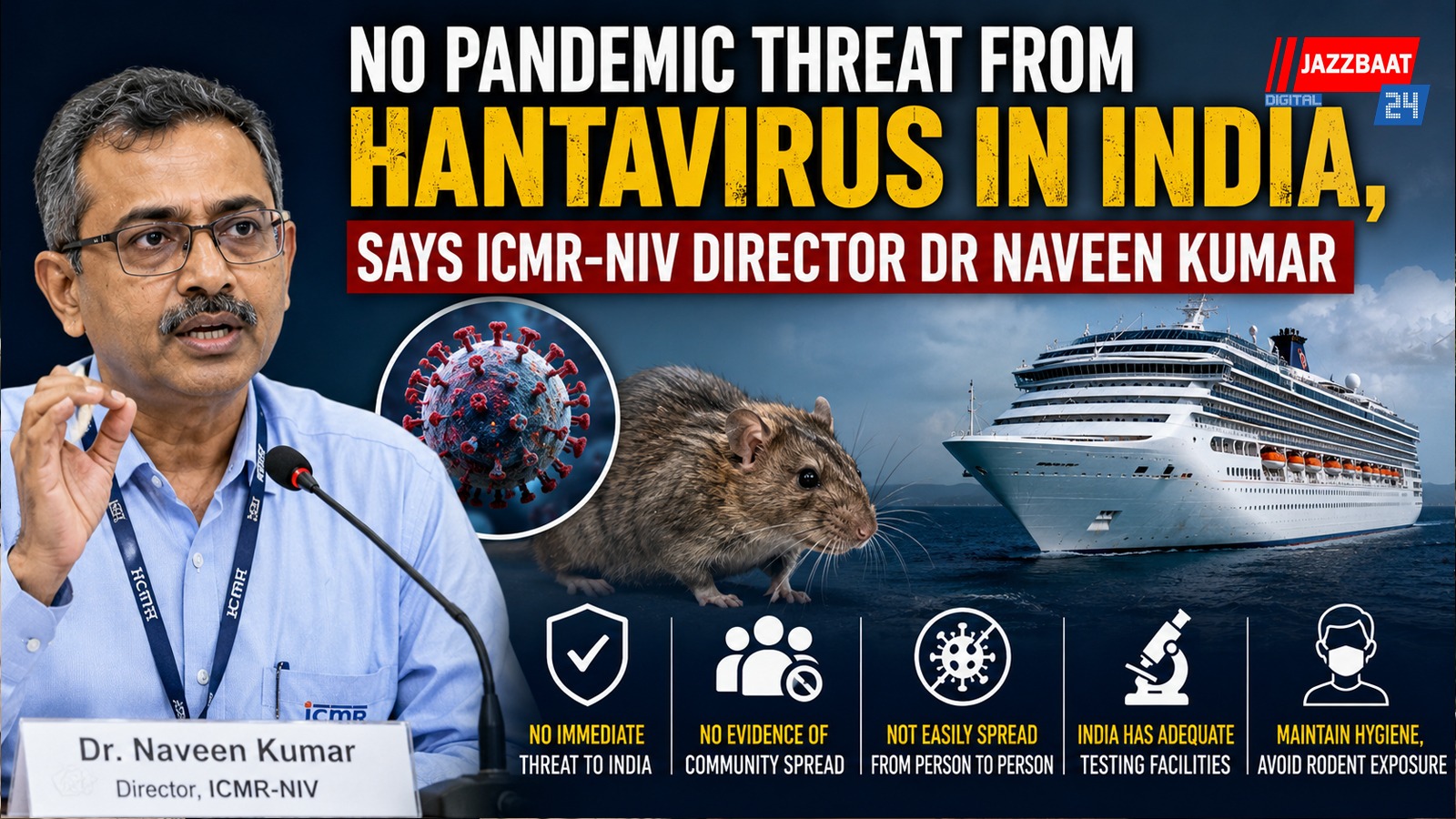
Amid rising concerns over reported hantavirus cases involving two Indian nationals aboard a cruise ship, the Indian Council of Medical Research (ICMR) has clarified that there is no immediate public health threat to India and no signs of a pandemic-like situation.
Dr Naveen Kumar, Director of the ICMR’s National Institute of Virology (NIV), said on Friday that the reported cases appear to be isolated incidents and there is currently no evidence of community spread in India.
The clarification came after international reports suggested that two Indian passengers on a cruise ship were suspected to have contracted hantavirus during an outbreak being monitored by global health authorities. According to the World Health Organization (WHO), the cases are part of a small cluster linked to the vessel, and precautionary measures are already underway.
Explaining the nature of the disease, Dr Kumar said hantavirus is mainly spread through contact with infected rodents or exposure to their saliva, urine, or droppings. People can become infected by inhaling virus particles in closed or poorly ventilated places such as ships, warehouses, barns, or storage areas.
He stressed that hantavirus is very different from COVID-19 and does not spread easily from person to person. According to him, human-to-human transmission is extremely rare and has only been documented in limited cases involving specific South American strains like the Andes virus. Most strains found in Asia and Europe are not known for sustained human transmission.
WHO Director-General Tedros Adhanom Ghebreyesus has also stated that while the incident is serious, the overall public health risk remains low. However, health authorities continue monitoring passengers and close contacts linked to the cruise ship due to the virus’s incubation period.
Dr Kumar further assured that India has adequate diagnostic infrastructure to detect and manage suspected hantavirus cases. He noted that the ICMR-NIV and a nationwide network of 165 Viral Research and Diagnostic Laboratories are equipped with RT-PCR testing facilities for confirmation of infections.
Medical experts said symptoms of hantavirus may initially resemble flu-like illness and can include fever, severe body ache, fatigue, headache, nausea, abdominal pain, and dry cough. In severe cases, patients may develop breathing difficulties or kidney complications.
Health authorities have advised people working in rodent-prone environments to maintain hygiene and avoid exposure to contaminated spaces, while emphasising that there is currently no indication of widespread transmission linked to the reported cases.