

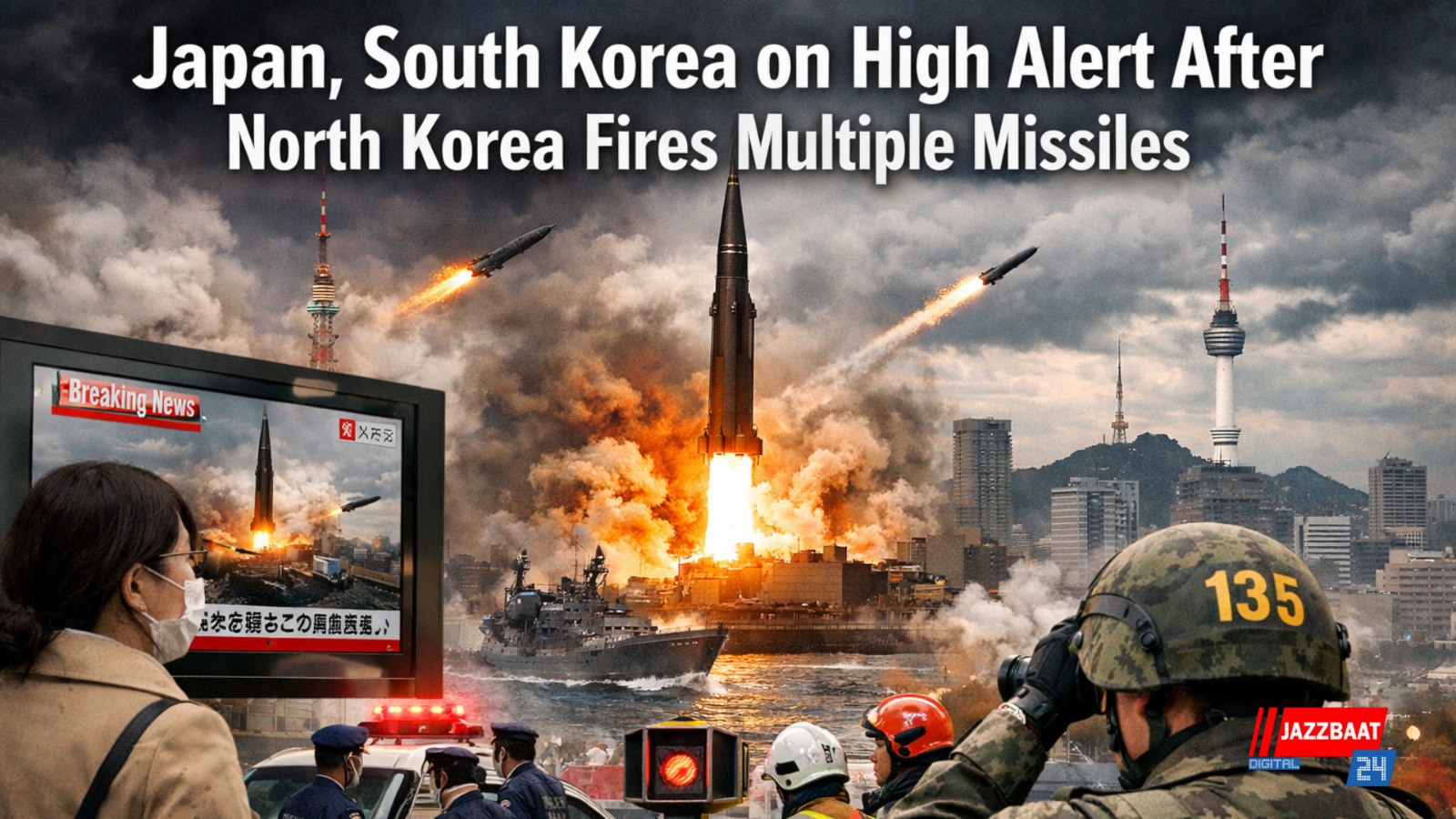
Tokyo/Seoul: Japan and South Korea were placed on high alert on Sunday after North Korea launched multiple ballistic missiles into the sea, triggering swift emergency responses and renewed regional security concerns.
According to Japanese government sources and South Korea’s military, the missiles were fired early in the morning from North Korea’s eastern coastal area, believed to be near Sinpo. The projectiles reportedly travelled a few hundred kilometres before falling into the sea, and there were no immediate reports of damage to aircraft or ships.
Japanese Prime Minister Sanae Takaichi said the government activated its top-level crisis management system immediately after detecting the launch. In a statement shared on social media, she confirmed that “what may be multiple ballistic missiles were launched from North Korea” and added that Japan, the United States, and South Korea were closely coordinating to analyse the situation.
She further stated that the missiles were believed to have already fallen outside Japan’s Exclusive Economic Zone (EEZ), but emphasised that authorities were maintaining “complete preparedness” to deal with any emergency situation. She also instructed ministries and agencies to ensure rapid information sharing and public safety measures.
South Korea’s defence authorities also convened emergency meetings and raised surveillance levels, closely monitoring further possible launches. Military officials described the action as a clear provocation and a violation of United Nations Security Council resolutions.
The latest missile activity comes amid rising tensions on the Korean Peninsula, where North Korea has conducted multiple weapons tests in recent months. Analysts say the repeated launches appear aimed at demonstrating military capability and strengthening strategic leverage in future diplomatic negotiations.
Regional security experts have warned that continued missile tests could further escalate instability in East Asia, especially as Japan, South Korea, and the United States strengthen trilateral security cooperation.
Despite the tensions, officials in Tokyo and Seoul have reassured the public that defence systems are actively monitoring the situation and that no immediate threat to domestic territory has been confirmed.
The situation remains under close observation as intelligence agencies continue to assess North Korea’s latest missile activity and its broader strategic intentions.