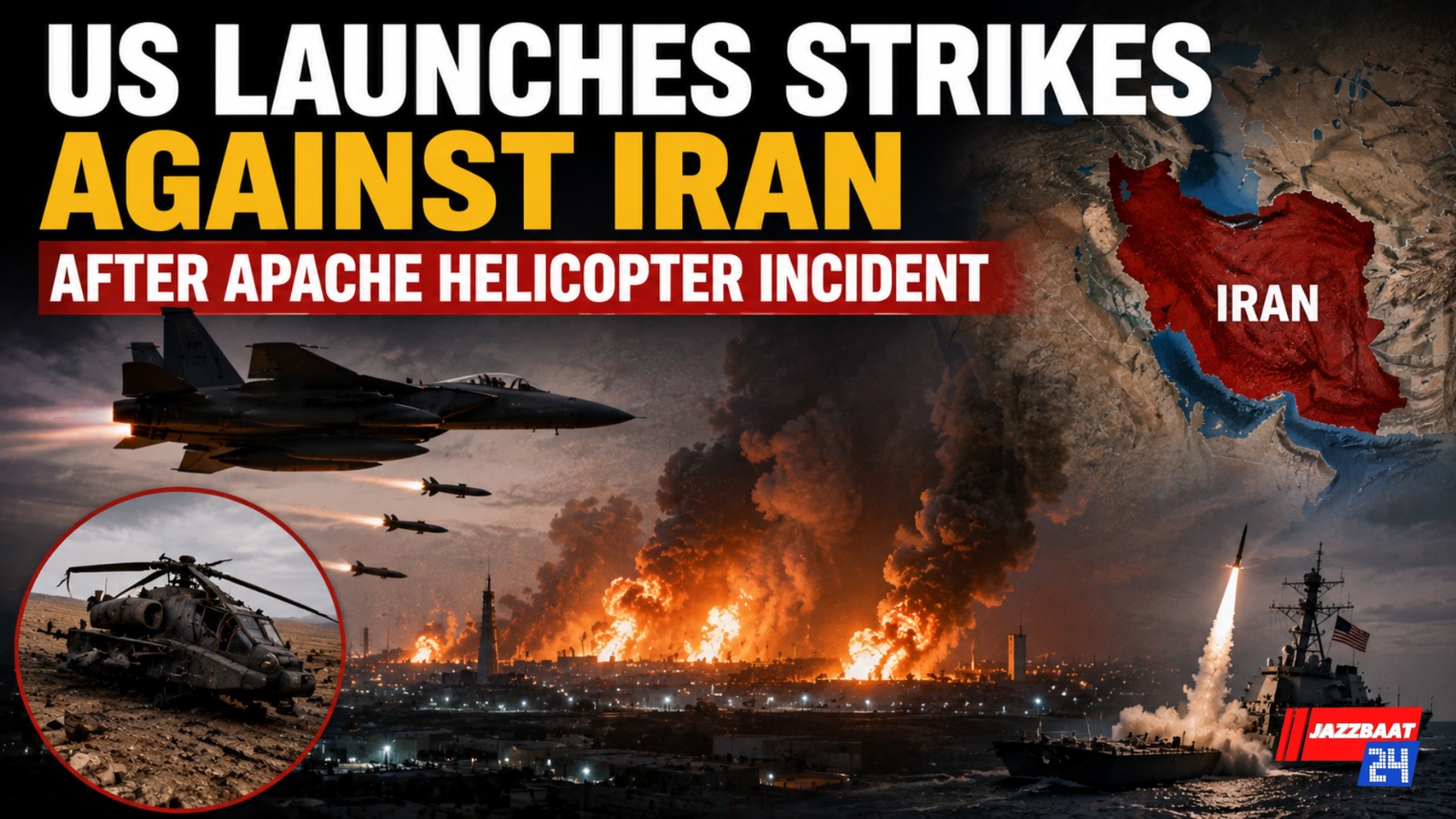
The United States has launched a new round of military strikes against Iran following the downing of a U.S. Army Apache helicopter near the strategically important Strait of Hormuz, marking a significant escalation in tensions between the two countries. Explosions were reported across several locations in southern Iran late Tuesday as American forces targeted military infrastructure linked to Iran's air-defense network.
According to U.S. Central Command (CENTCOM), the operation was carried out as a “proportional response” to what Washington described as an unjustified act of aggression. The strikes reportedly targeted Iranian radar installations, surveillance systems, ground-control stations, and air-defense sites located near the Strait of Hormuz, one of the world's most critical maritime oil routes.
The crisis began after an American AH-64 Apache attack helicopter went down near the Strait of Hormuz. U.S. officials claim the aircraft was brought down by an Iranian drone, although Iranian authorities have denied deliberately targeting the helicopter. Both American crew members were successfully rescued in a dramatic operation involving an unmanned naval vessel and are reported to be in stable condition.
President Donald Trump defended the military response, stating that while the helicopter incident itself was not a major strategic loss, the United States could not allow attacks on its forces to go unanswered. American fighter jets and naval aircraft reportedly carried out multiple waves of precision strikes over several hours before concluding the operation.
Iranian state media reported explosions in areas including Qeshm Island, Sirik, Bandar Abbas, and parts of Jask County. Tehran condemned the attacks and warned that it would not leave any aggression unanswered. Iranian officials have accused Washington of undermining ongoing diplomatic efforts and pushing the region closer to a wider conflict.
The military exchange has raised concerns about the future of fragile ceasefire and peace negotiations that have been underway in recent months. Regional governments have placed their armed forces on alert, while global energy markets are closely monitoring developments due to the Strait of Hormuz's importance for international oil shipments. Analysts warn that any prolonged disruption in the waterway could impact global energy supplies and increase oil prices worldwide.
Despite the latest escalation, both Washington and Tehran have continued to leave the door open for diplomacy. However, with military strikes, retaliatory threats, and heightened regional tensions, the prospect of a quick de-escalation remains uncertain.