
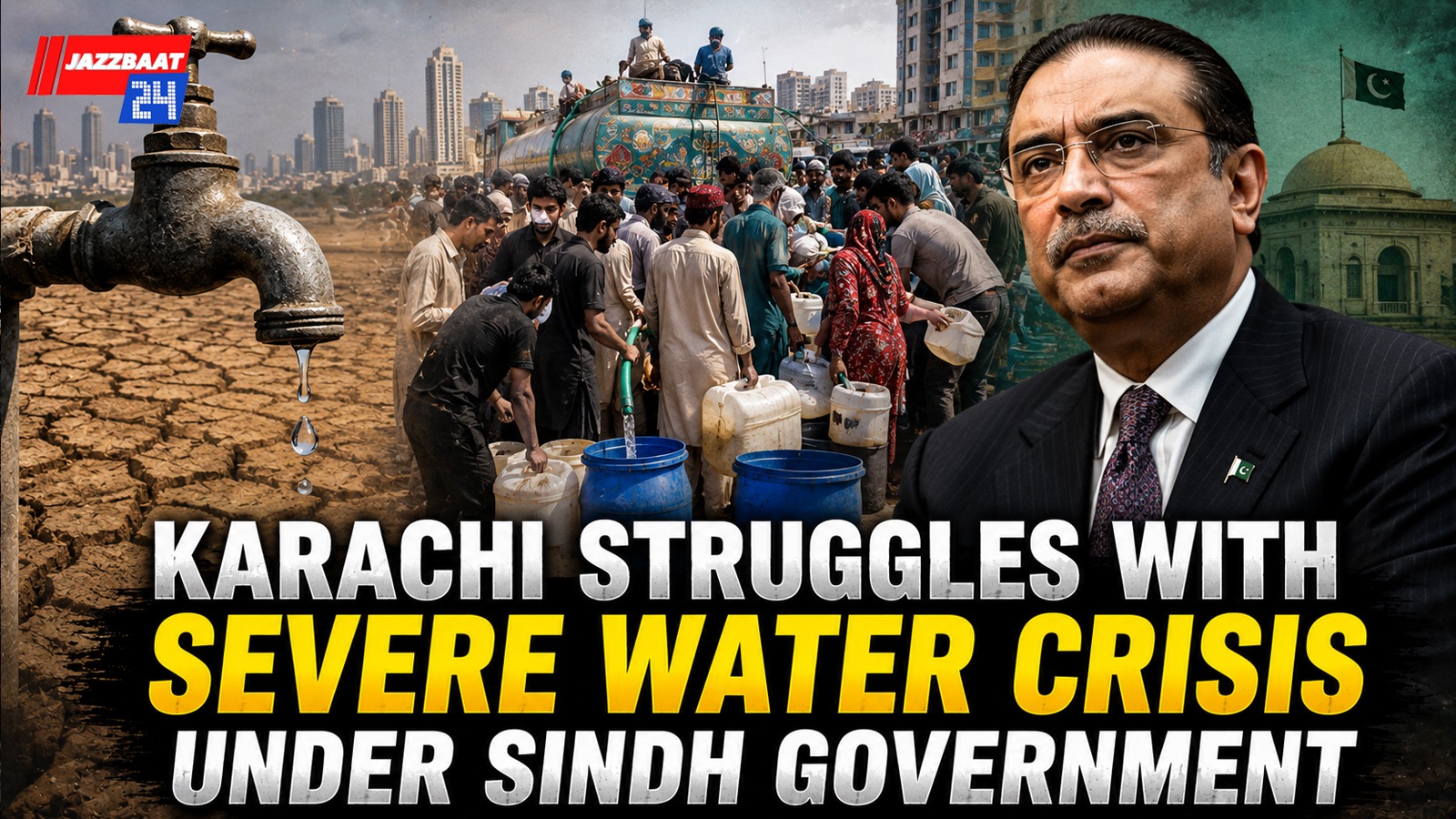
Pakistan’s financial hub Karachi is facing a worsening water crisis, with millions of residents struggling to access clean and regular water supply amid soaring summer temperatures. The crisis has triggered political protests, public anger and renewed criticism of the Sindh provincial government led by the Pakistan Peoples Party (PPP).
Several neighbourhoods across Karachi, including Gulistan-e-Jauhar, Gulshan-e-Iqbal, Liaquatabad, North Karachi and Nazimabad, have reportedly been suffering from acute water shortages for more than two weeks. Residents have been forced to rely on expensive private water tankers as taps run dry in many homes.
The issue has dominated recent sessions of the Sindh Assembly, where opposition lawmakers strongly criticised the provincial government for failing to solve Karachi’s long-standing water shortage problem. Members of the MQM-P staged protests inside the assembly demanding immediate restoration of supply, with slogans like “Give water to Karachi” echoing through the house.
Lawmakers claimed that several parts of the city receive water only once every few days, while some localities remain completely deprived of supply. Opposition leaders accused the government of poor planning, corruption and mismanagement within the water distribution system.
The Sindh government has admitted that Karachi’s water distribution network faces serious challenges. Officials informed the assembly that projects are underway to improve supply capacity, including upgrades to treatment plants and pipeline infrastructure. However, they also acknowledged that the city’s demand far exceeds current supply levels.
One of the biggest concerns remains the delayed K-IV water project, which was originally planned to provide hundreds of millions of gallons of additional water to Karachi every day. The project has faced years of delays, rising costs and technical disputes between provincial and federal authorities.
Experts and local observers have also pointed to illegal water hydrants and the so-called “water tanker mafia” as major contributors to the crisis. Reports suggest that large quantities of water are diverted illegally, forcing ordinary citizens to buy water at high prices.
The situation has become even more difficult due to extreme heat and frequent electricity outages in Karachi. With temperatures crossing 40 degrees Celsius in recent weeks, residents say daily life has become unbearable without adequate water supply.