

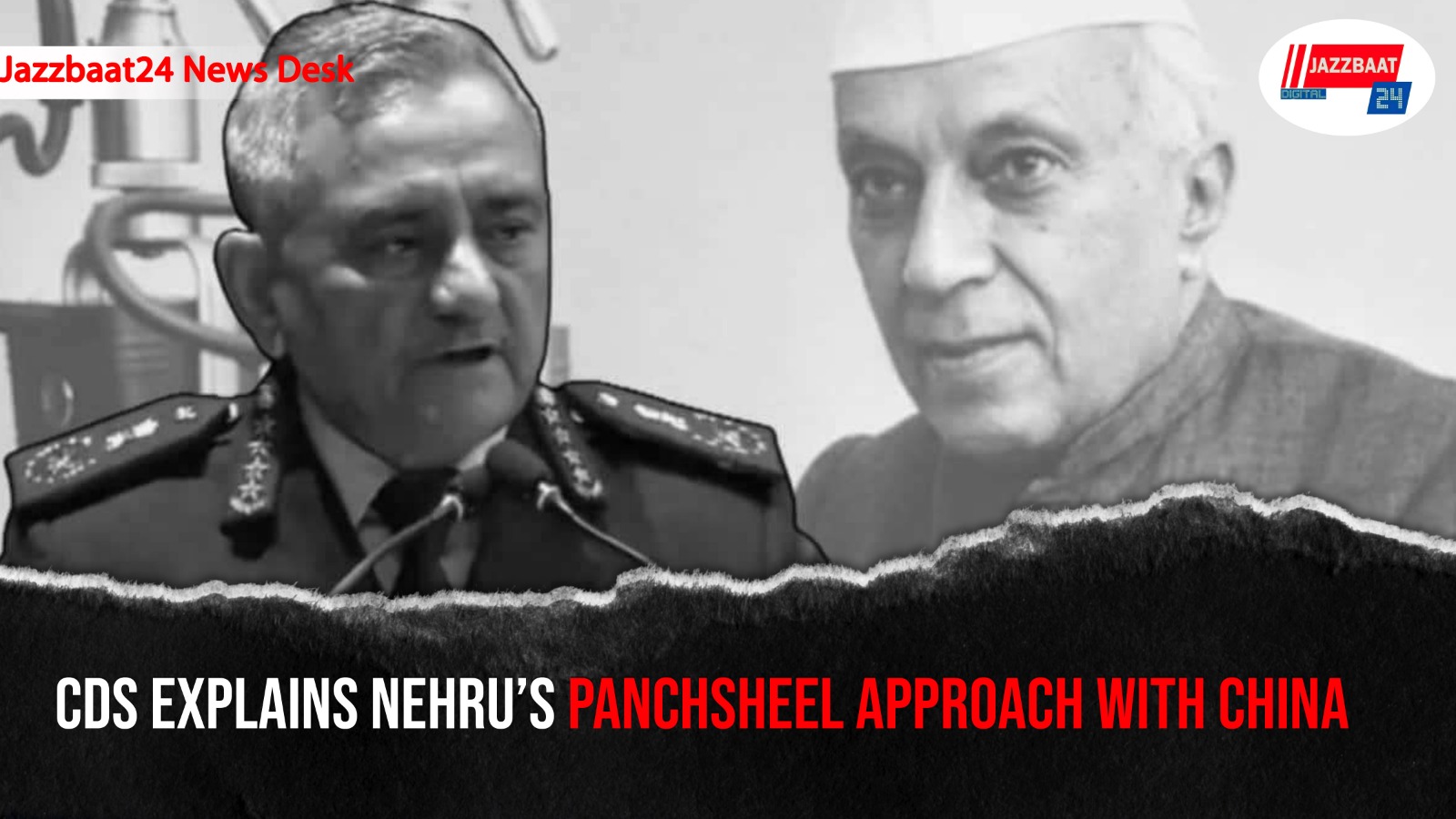
Dehradun: Chief of Defence Staff (CDS) General Anil Chauhan shed light on India’s decision to sign the Panchsheel Agreement with China in 1954, explaining the historical and strategic context behind Jawaharlal Nehru’s approach. Speaking at an event in Uttarakhand’s Dehradun, General Chauhan said that while India recognized Tibet as part of China, it assumed that the agreement would settle the northern border through identified trade passes.
“The Chinese view, however, was different. The Panchsheel Agreement was meant for trade and peaceful coexistence, not a formal boundary settlement,” Chauhan said. The agreement, signed by Nehru and Chinese Premier Zhou Enlai, included five principles emphasizing peaceful coexistence, cooperation, and non-interference. For India, the McMahon Line in the east and certain claims in Ladakh were important considerations, which likely influenced Nehru’s decision to pursue the agreement, the CDS explained.
Chauhan highlighted that post-1949, China prioritized stabilizing its border regions, including Tibet and Xinjiang, following its “so-called liberation” of Tibet. Independent India sought to build a cooperative relationship with the newly established Chinese government, even as China gave up some inherited British-era privileges. The CDS noted that India identified six key passes—Shipki La, Mana, Niti, Kingri-Bingri, Lipulekh, and Dharma—for trade and pilgrimage, assuming these demarcated the northern frontier.
Despite the agreement, tensions persisted along the Line of Actual Control (LAC), culminating in the deadly clash of June 2020, where 20 Indian soldiers were killed and over 30 Chinese troops reportedly lost their lives. General Chauhan emphasized that understanding this historical context is crucial to interpreting India-China relations and the evolution of border policy.
The discussion underscores Nehru’s attempt to balance strategic caution with diplomacy, highlighting that while Panchsheel fostered trade and cooperation, it did not resolve underlying territorial ambiguities that continue to affect bilateral relations today.