
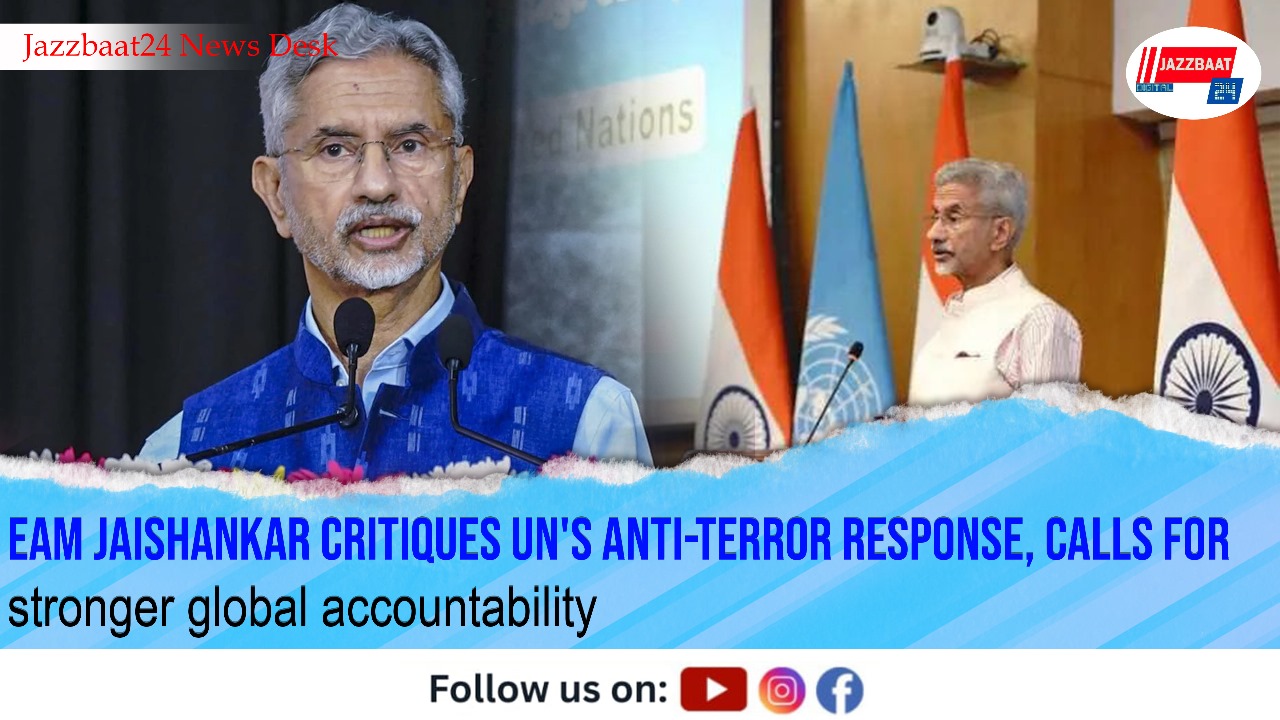
On the 80th anniversary of the United Nations, External Affairs Minister S. Jaishankar called attention to the challenges facing global institutions, questioning the UN's effectiveness in addressing terrorism and the economic distress confronting the Global South.
Few examples are more telling about the challenges facing the UN than its response to terrorism. When a sitting Security Council member openly protects the very organisation that claims responsibility for barbaric terror attacks such as at Pahalgam, what does it do to the credibility of multilateralism?" Jaishankar said, highlighting the gap between rhetoric and action in international forums, ANI reported.
Questioning world's commitment to fight terrorism
Jaishankar also probed the sincerity of the international community in combating terrorism. "If victims and perpetrators of terrorism are equated in the name of global strategy, how much more cynical can the world get? When self-proclaimed terrorists are shielded from the sanctioning process, what does it say for the sincerity of those involved?"
His remarks followed the Pahalgam terror attack on April 22, which claimed the lives of 26 tourists, including 25 Indians and one Nepali citizen. In response, the Indian Armed Forces launched Operation Sindoor on May 7, targeting terror camps run by Jaish-e-Mohammed and Lashkar-e-Taiba in Pakistan and Pakistan-Occupied Kashmir, successfully neutralising threats and repelling further escalation.
UN's credibility tested beyond security
Beyond security, Jaishankar pointed to the UN's role in development and socio-economic progress. "If the maintenance of international peace and security has become lip service, the predicament of development and socio-economic progress is even more serious," he said, stressing the importance of follow-through on global commitments.
He also highlighted the growing pressures on developing nations. "The slowing down of the SDG Agenda 2030 is a significant metric to measure the distress of the Global South. There are many more, whether it is trade measures, supply chain dependence or political domination."
Optimism and renewed faith in multilateralism
Despite the critique, Jaishankar urged countries to maintain faith in collective action and multilateralism. "Yet, on such a notable anniversary, we cannot abandon hope. However difficult, the commitment to multilateralism must remain strong. However flawed, the United Nations must be supported in this time of crisis. Our faith in international cooperation must be reiterated and indeed renewed," he said.
Closing his speech, he reflected on the significance of the gathering. "I thank you again for joining us on this important day, on this important anniversary and as my colleague said, what unites us is what is most important and the fact that we are meeting here today, I think sends a message in itself."